Shocking Slow Motion Footage Reveals Critical Flaws in Popular Pickleball Protective Eyewear
Pickleball has grown exponentially over the past few years, bringing millions of new players to courts across the country. With that growth has come an increased awareness of safety concerns, particularly when it comes to eye injuries. Many players have turned to protective eyewear as a solution, trusting that these specialized glasses will keep them safe from errant balls traveling at high speeds near the kitchen line. But recent testing reveals a disturbing truth that every pickleball player needs to understand: not all protective eyewear actually protects you, and some models might even make injuries worse.
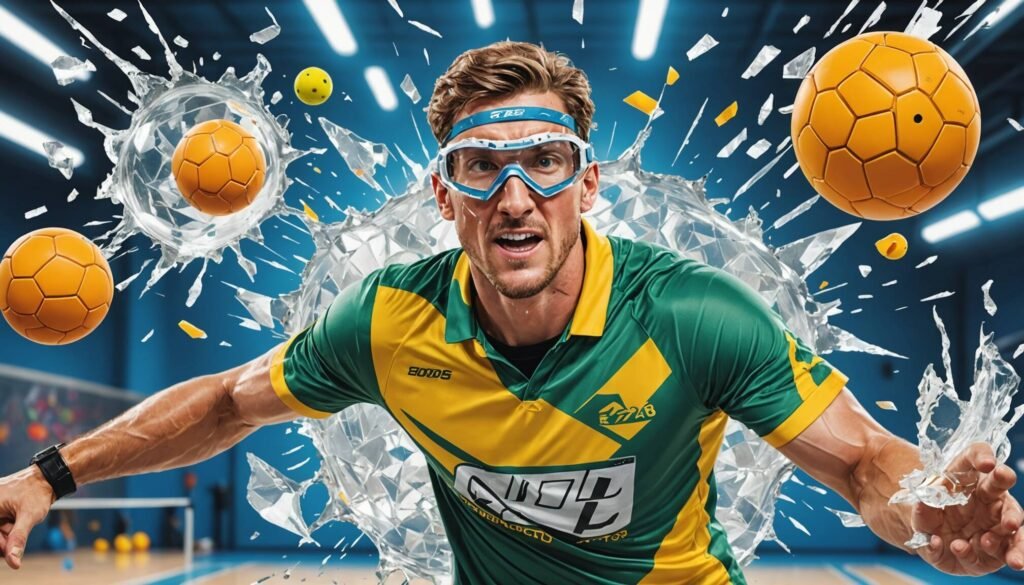
Paddle reviewer and testing specialist John Kew recently released findings from comprehensive impact testing on popular pickleball eyewear brands, and the results are nothing short of alarming. Using high-speed cameras and a ball cannon to simulate realistic game scenarios, Kew and his co-host Eddie discovered that several widely-used eyewear models fail catastrophically when struck directly by a pickleball. The frames shatter into sharp fragments, lenses pop out completely, and the impact energy transfers directly into the eye socket of the wearer. Even more concerning is that these failures occur at speeds around 40 to 46 mph, which represents realistic ball velocities that players encounter regularly during kitchen exchanges and fast-paced rallies.
Understanding the Testing Methodology and Why It Matters
The testing process Kew employed provides valuable insights into how protective eyewear performs under real-world conditions. Using a ball cannon mounted to fire directly at a ballistic gel head wearing various eyewear models, the team could control variables and capture slow-motion footage of exactly what happens during impact. They started testing at speeds around 40 mph, gradually increasing velocity to extreme levels reaching 210 mph to identify the absolute failure points of each design.
This methodology matters because it replicates the kinds of direct hits that cause serious eye injuries on pickleball courts. While many balls are returned successfully during play, the dangerous moments occur when a player gets caught off guard by a speed-up, when a ball deflects unexpectedly off the net, or during quick kitchen exchanges where reaction time is minimal. In these scenarios, players don’t have time to turn their heads or close their eyes, and the eyewear becomes the only line of defense between a hard plastic ball and vulnerable eye tissue.
The ballistic gel head used in testing approximates human tissue density and response, allowing the slow-motion cameras to capture not just frame failure but also how much force transfers through to where the eye would be located. This comprehensive approach reveals the complete picture of protection or lack thereof. What became immediately apparent through this testing is that eyewear construction quality and design philosophy vary dramatically between brands, with life-altering consequences for players who unknowingly choose inadequate protection.
The Catastrophic Failures That Should Concern Every Player
The most disturbing results from Kew’s testing involved eyewear models that shattered into sharp fragments upon impact. In slow-motion footage documented in the testing video, you can see frames exploding into needle-like shards that fly in multiple directions, including toward the face and eye area they’re supposed to protect. This failure mode transforms protective equipment into a potential weapon, where the fragments themselves could cause lacerations to the face, eyelids, and potentially the eye itself if they penetrate past the broken lens.
Equally problematic were models where lenses popped out of their frames entirely upon impact. When a lens dislodges, it provides zero protection to the eye, and the now-exposed frame edges can concentrate impact forces into smaller areas. The combination of a missing lens and compromised frame structure means the eye receives nearly the full force of the ball strike, defeating the entire purpose of wearing protective eyewear in the first place.
Prescription glasses emerged as a particularly risky category in the testing. Many players who need vision correction simply wear their everyday prescription glasses on the court, assuming they provide at least some protection. However, Kew’s testing revealed that standard prescription eyewear typically features lenses that pop out very easily under impact stress. The frames used for prescription glasses are designed for daily wear comfort and style, not for absorbing high-velocity impacts. This makes them fundamentally unsuitable for pickleball safety despite their superficial appearance of providing coverage.
What makes these failures even more concerning is that they occurred at realistic game speeds. A 46 mph ball speed is not unusual in competitive recreational play, especially during hands battles at the net or when a player executes an aggressive put-away shot. Many intermediate and advanced players regularly generate ball speeds in this range or higher. This means the catastrophic failures documented in testing represent actual risks players face during normal gameplay, not just theoretical extreme scenarios.
The Eyewear Models That Actually Provide Protection
Fortunately, Kew’s testing didn’t produce entirely negative results. Two brands demonstrated engineering approaches that actually work to protect eyes during ball impacts: Brioti and RIA. Understanding why these models succeeded while others failed provides important guidance for players shopping for protective eyewear.
The Brioti Focus model carries a Z87.1+ rating, which indicates it meets certain industrial safety standards for impact resistance. During testing, this eyewear absorbed direct hits at 57 mph with zero damage to the frame or lens structure. When testing ramped up to 123 mph, well beyond realistic pickleball speeds, the glasses finally failed, but they did so in a controlled manner. The frame separated at designed seams rather than shattering randomly. This engineering approach, called “controlled failure,” ensures that even when the eyewear reaches its limits, it doesn’t create additional hazards for the wearer.
The RIA Reflex model performed even more impressively in testing. This eyewear carries an ASTM F3164 rating, a standard specifically developed for sports eyewear. At 55 mph, the RIA Reflex showed no damage whatsoever. The testing team then pushed velocities to extreme levels, ultimately hitting the eyewear with balls traveling at 210 mph. At this ridiculous speed, far beyond anything encountered in actual play, the temples finally broke, but critically, the lenses remained intact and in place, and the frame material didn’t fragment into sharp pieces.
The key differentiator for these successful models is engineering philosophy. Rather than simply making eyewear as strong as possible with rigid materials, effective protective eyewear incorporates controlled break points, impact-absorbing materials, and secure lens retention systems. When force exceeds the design limits, the eyewear breaks apart at predetermined points in ways that direct energy away from the face and eye area rather than concentrating it or creating secondary projectiles.
What This Means For the Average Pickleball Player
If you’re new to pickleball or haven’t thought much about eye protection, this information might seem overwhelming or even alarming. The reality is that serious eye injuries in pickleball remain relatively rare compared to the total number of people playing the sport. However, when eye injuries do occur, they can be devastating and life-changing. We’re talking about detached retinas, orbital fractures, permanent vision loss, and injuries requiring multiple surgeries and months of recovery.
The question every player needs to ask is whether the relatively minor inconvenience and cost of quality protective eyewear is worth avoiding even a small risk of permanent vision damage. For most players, especially those who play frequently or at competitive levels, the answer should be obvious. But knowing that you need eye protection and knowing which eye protection actually works are two different things, and this is where Kew’s testing provides invaluable guidance.
For players who wear prescription lenses, the message is clear: your everyday glasses are not adequate protection for pickleball. You need to invest in sports-specific eyewear that either accommodates prescription inserts or works with contact lenses. Some companies manufacture prescription protective eyewear specifically rated for impact resistance, combining vision correction with genuine safety features. Yes, this represents an additional expense beyond standard glasses, but it’s an expense that could prevent a catastrophic injury.
Even for players with perfect vision, understanding eyewear ratings and construction quality is essential. Not all “sports eyewear” marketed to pickleball players actually meets rigorous safety standards. Look for specific ratings like Z87.1+ or ASTM F3164 that indicate the eyewear has undergone standardized impact testing. Be skeptical of generic sports glasses that make protective claims without citing specific safety certifications or standards.
Breaking Down Safety Ratings and What They Actually Tell You
The alphabet soup of safety ratings on protective eyewear can be confusing for consumers who just want to know if their glasses will protect them. Understanding what these ratings mean helps players make informed decisions rather than relying solely on marketing claims or brand reputation.
The Z87.1+ rating comes from ANSI, the American National Standards Institute, and specifically addresses impact resistance for occupational and educational safety glasses. The “+” designation indicates the eyewear has passed high-velocity impact testing where a quarter-inch steel ball traveling at 150 feet per second strikes the lens. While this test uses a different projectile than a pickleball, it establishes baseline impact resistance that translates reasonably well to sports applications. Eyewear with Z87.1+ ratings has been engineered to keep lenses in place and frames intact under significant impact stress.
The ASTM F3164 standard is more directly relevant to pickleball players because it was specifically developed for sports eyewear. ASTM International created this standard to address the unique impact scenarios encountered in athletic activities, including considerations for peripheral vision, frame stability during movement, and repeated lower-level impacts. Eyewear meeting ASTM F3164 has been tested with sport-specific projectiles and impact angles, making it particularly suitable for racquet sports applications.
Some eyewear may carry multiple ratings or certifications from different organizations. This generally indicates more comprehensive testing and provides additional confidence in the product’s protective capabilities. However, the presence of certification marks alone doesn’t guarantee perfect protection in every scenario, which is why independent testing like Kew’s work provides such valuable real-world validation beyond laboratory standards.
The Physics of Impact and Why Eyewear Design Matters So Much
Understanding what actually happens during a ball-to-eyewear impact helps explain why some designs succeed while others fail catastrophically. When a pickleball traveling at 40-50 mph strikes protective eyewear, enormous forces concentrate into a very small area over an extremely brief time period. The eyewear must simultaneously accomplish several challenging objectives: distribute impact force across a wider area, absorb energy to reduce the magnitude of force reaching the face, maintain lens position to preserve the protective barrier, and avoid creating secondary hazards through frame failure.
Materials science plays a crucial role in achieving these objectives. Polycarbonate lenses offer excellent impact resistance while remaining relatively lightweight, making them the material of choice for quality sports eyewear. Frame materials must balance rigidity needed to maintain structure with flexibility that allows some energy absorption. Advanced designs incorporate multiple materials in different frame sections, using rigid materials where structural integrity is critical and more flexible materials in areas where controlled deformation can absorb energy.
The lens retention system represents perhaps the most critical design element. If lenses pop out easily, the eyewear provides no protection regardless of how strong the lenses or frames might be individually. Effective retention systems use mechanical interlocking, flexible gaskets, or chemical bonding to keep lenses firmly seated even when frames flex under impact. Some designs incorporate multiple redundant retention features, ensuring that even if one system fails, others maintain lens position.
Frame geometry also affects protective performance. Wraparound designs that follow facial contours more closely provide better peripheral protection and reduce the likelihood of balls striking the eye from angles outside the lens coverage area. However, wraparound geometry creates engineering challenges for lens retention and frame strength, requiring more sophisticated design and manufacturing approaches. This is one reason why genuinely protective eyewear typically costs more than fashion-oriented sports glasses that prioritize appearance over safety engineering.
Practical Guidance for Choosing and Using Protective Eyewear
Armed with information about testing results and safety ratings, players can make better decisions about protecting their vision on the court. Start by determining your budget for protective eyewear, keeping in mind that quality options typically range from about seventy-five to two hundred dollars. While this might seem expensive, it’s considerably less than the medical costs associated with treating a serious eye injury, not to mention the potential for permanent vision impairment.
Look specifically for eyewear that carries Z87.1+ or ASTM F3164 ratings as a baseline requirement. These certifications indicate the product has undergone standardized testing rather than relying solely on manufacturer claims. Read reviews from other pickleball players, paying particular attention to comments about comfort during extended wear, stability during quick movements, and any reports of frame or lens failures.
Consider your specific needs regarding prescription correction, light conditions you typically play in, and whether you need eyewear that accommodates hearing aids or other considerations. Many quality protective eyewear manufacturers offer multiple lens tints optimized for different lighting conditions, which can enhance both safety and performance by improving ball visibility. Some players invest in multiple lens options they can swap based on whether they’re playing indoors, outdoors in bright sun, or outdoors on overcast days.
Once you’ve purchased quality protective eyewear, inspect it regularly for signs of damage or wear. Lenses that develop scratches or cracks lose impact resistance and should be replaced. Frame joints should remain tight and secure; any looseness might indicate degraded structural integrity. Most manufacturers recommend replacing protective eyewear after any significant impact even if no visible damage is apparent, as the internal structure may be compromised in ways that aren’t immediately obvious but reduce protection against subsequent impacts.
Clean your eyewear properly using appropriate cleaning solutions and microfiber cloths rather than shirt tails or paper towels that can scratch lenses. Store eyewear in a protective case when not in use to prevent accidental damage. These simple maintenance practices ensure your protective eyewear continues performing as designed throughout its usable life.
The Broader Context of Pickleball Safety
Eye protection represents just one element of comprehensive pickleball safety, but it’s an element that deserves serious attention given the potentially severe consequences of eye injuries. The testing conducted by John Kew serves as a wake-up call for the pickleball community about the importance of evidence-based safety equipment choices rather than relying on assumptions or marketing messages.
As pickleball continues growing and attracting players of all ages and skill levels, safety awareness needs to keep pace. Organizations governing the sport, facility operators, and the player community all share responsibility for promoting safety practices including appropriate protective equipment. Some tournament organizations have begun requiring protective eyewear for certain age divisions, recognizing that the competitive intensity of tournament play creates elevated injury risks.
The eyewear testing also highlights a broader need for consumer education about sports safety equipment. Many players simply don’t know what to look for when evaluating protective gear, making them vulnerable to marketing claims that sound impressive but lack substantive safety validation. Independent testing like Kew’s work provides crucial information that helps players make genuinely informed decisions about protecting themselves on the court.
Looking Forward: What Players Should Do With This Information
If you currently play pickleball without eye protection, seriously consider whether that’s a risk you want to continue taking. Watch the testing footage that John Kew published and imagine those impacts occurring to your unprotected eyes. For many players, seeing the slow-motion documentation of what happens during eyewear failures provides the motivation needed to prioritize protective equipment.
If you already use protective eyewear, verify what safety ratings your current glasses carry. If they lack Z87.1+ or ASTM F3164 certification, or if they’re standard prescription glasses, consider upgrading to eyewear specifically engineered for impact protection. The investment in quality protective eyewear is minimal compared to the value of your vision.
Share this information with other players in your community, particularly those who may be new to the sport and unaware of eye injury risks. Many pickleball players are older adults for whom vision is already a precious resource that tends to degrade with age; protecting what vision they have becomes even more critical. Younger players building pickleball skills they hope to enjoy for decades also have compelling reasons to protect their eyes from the outset rather than waiting for a close call to motivate action.
Consider supporting continued independent testing and consumer advocacy in the pickleball equipment space. Reviewers like John Kew provide valuable services by conducting rigorous evaluations that go beyond marketing claims to reveal actual product performance. The more players value and support this kind of work, the more accountability exists for manufacturers to produce equipment that genuinely protects players rather than just extracting money from growing market demand.


