The Critical Kitchen Line Skill Most Rec Pickleball Players Are Missing
If you’ve been putting in the hours on the pickleball court but feeling like your progress has plateaued, there’s probably a specific reason why. After speaking with countless recreational players and analyzing what separates the weekend warriors from those who consistently win at higher levels, one skill stands out above all others: taking balls out of the air at the kitchen line. This single capability might be the most underutilized weapon in the recreational player’s arsenal, and mastering it could transform your entire approach to the game.
The kitchen line represents the most contested real estate in pickleball. It’s where rallies are won and lost, where patience meets aggression, and where the difference between a 3.0 player and a 4.0 player becomes crystal clear. Yet most recreational players approach this critical zone with a passive mindset, content to let balls bounce and react to what their opponents give them. This defensive posture might feel safe, but it’s precisely what’s holding you back from taking your game to the next level.
Understanding the Time Game in Pickleball
Pickleball, at its core, is a game about controlling time. Every shot you make is either buying yourself more time to set up your next move or stealing time from your opponents to execute theirs. When you understand this fundamental concept, the importance of taking balls out of the air at the kitchen line becomes immediately apparent. By attacking balls before they bounce, you’re compressing the time your opponents have to react, forcing them into rushed decisions and defensive positions.
Think about what happens in a typical recreational rally. Player A hits a dink that bounces on Player B’s side of the kitchen. Player B watches it bounce, takes a comfortable stance, and returns it with plenty of time to aim and execute. Now contrast that with what happens when Player B takes that same ball out of the air before it bounces. Suddenly, Player A has less time to prepare, less time to read the ball’s trajectory, and less time to position themselves optimally. This time compression is what creates opportunities for you to take control of the point.
The concept extends beyond just one shot. When you consistently take balls out of the air, you’re sending a message to your opponents that they can’t rely on comfortable, predictable exchanges. They begin to feel rushed even when they have time because they’re anticipating your aggression. This psychological pressure compounds over the course of a game, leading to more errors from your opponents and more easy putaways for you.
Why Recreational Players Avoid This Shot
There are several reasons why most rec players don’t take balls out of the air as often as they should. The first is simply a matter of comfort and familiarity. When you’re learning pickleball, you’re taught to let the ball bounce whenever possible because it’s easier to track, easier to time, and easier to control. This becomes ingrained in your muscle memory, and breaking that habit requires conscious effort and practice.
The second reason is fear of making mistakes. Taking a ball out of the air requires quicker reflexes, more precise timing, and better hand-eye coordination than waiting for it to bounce. Many recreational players worry that they’ll miss these balls or hit them into the net, so they default to the safer option of letting everything bounce. While this caution is understandable, it’s also limiting your potential for growth and keeping you stuck in predictable patterns that better players will exploit.
The third reason is technical. Most recreational players simply don’t know the proper mechanics for taking balls out of the air at the kitchen line. They try to use the same swing mechanics they use for groundstrokes or volleys from deeper in the court, which doesn’t work well in the tight confines of kitchen line play. Without proper instruction, these attempts often result in balls sailing long or finding the net, reinforcing the belief that it’s better to just let the ball bounce.
The Fundamental Mistake That Kills Your Reach
One of the most common technical errors that recreational players make when attempting to take balls out of the air at the kitchen line is leaning their body into the kitchen without properly extending their paddle. You’ll see this all the time on recreational courts: a player leans forward at the waist, their upper body crossing into the kitchen zone, but their paddle remains relatively close to their body. This approach severely limits your effective reach and puts you at risk of a kitchen fault if you lose your balance.
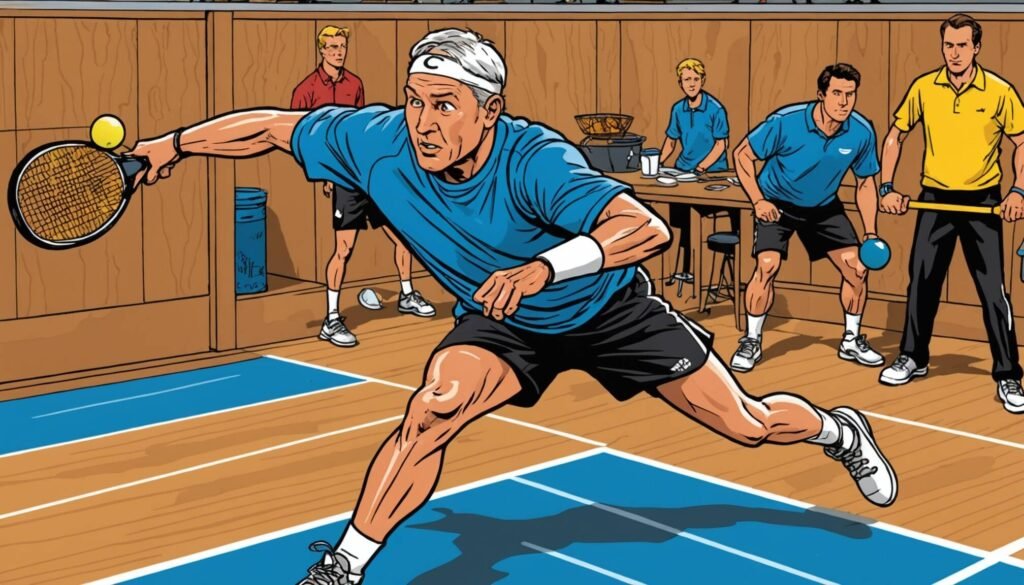
The correct approach is to think about maximizing your reach by extending your arm and paddle tip as far forward as possible while keeping your feet planted safely behind the kitchen line. Your paddle should be an extension of your arm, and your arm should be fully extended when making contact with balls near the kitchen line. This isn’t about being taller or having longer arms; it’s about using your body efficiently to cover as much space as possible.
When you extend properly, you’re able to take balls out of the air that would otherwise drop into the kitchen and bounce. This gives you offensive opportunities that simply don’t exist when you’re leaning with your body but not extending with your paddle. The difference might only be a few inches, but in the tight quarters of kitchen line play, those few inches can mean the difference between an aggressive attack and a defensive reset.
The Technical Breakdown: How to Execute This Shot Properly
Now let’s get into the specific mechanics of taking balls out of the air at the kitchen line. This isn’t a power shot, and it’s not a traditional volley. It’s a controlled, compact motion that relies on precise positioning and timing rather than strength or speed. Understanding these mechanics is crucial because they’re fundamentally different from other shots in pickleball.
The first and most important element is setting your paddle angle before the ball arrives. Many recreational players make the mistake of adjusting their paddle angle during contact or even after they’ve started their forward motion. This introduces inconsistency and makes it nearly impossible to control where the ball goes. Instead, you want to read the incoming ball’s trajectory, decide where you want to place your return, set your paddle to the appropriate angle, and then keep that angle locked in as you make contact.
Your wrist plays a crucial role in this shot, but not in the way most people think. Rather than actively moving your wrist during the shot, you want to keep it tight and stable throughout the entire motion. Think of your wrist as a locked joint that maintains the paddle angle you’ve already set. Any flicking or rotating of the wrist at contact will send the ball in unintended directions and make your shots unpredictable, even to yourself.
The power and lift for this shot come from your shoulder, not your wrist or forearm. When you need to lift a ball that’s coming in low, you’re using a gentle shoulder rotation to bump the ball up and over the net. When you need to drive a ball that’s coming in higher, you’re using that same shoulder motion to push through the ball. This shoulder-driven approach gives you consistency and control because your shoulder is a larger, more stable joint than your wrist.
The contact itself should feel like a controlled bump rather than a swing or hit. You’re not trying to impart a lot of pace on the ball; you’re redirecting its existing momentum and sending it back over the net with purpose and placement. This bump-style contact is what allows you to maintain control even when balls are coming at you quickly or from awkward angles.
Breaking Down the Kitchen Line for Beginners
If you’re relatively new to pickleball or if some of these concepts seem confusing, let’s take a step back and explain the kitchen line and why it matters so much in the first place. The kitchen, officially called the non-volley zone, is the seven-foot area on each side of the net. You cannot hit a ball out of the air while standing in this zone; you must either let the ball bounce first or step back behind the line to hit it as a volley.
The kitchen line is where most advanced pickleball is played. After the serve and return, players quickly move up to position themselves right behind this line because it offers the best combination of offensive capability and court coverage. Being at the kitchen line allows you to cut off balls early, hit down on high balls, and apply pressure to your opponents. The team that establishes themselves at the kitchen line first usually has a significant advantage in the point.
When we talk about taking balls out of the air at the kitchen line, we’re referring to volleying balls while your feet are positioned behind the kitchen line but reaching forward into the space above the kitchen to make contact with balls before they bounce. This is perfectly legal and, in fact, is one of the most important skills in competitive pickleball. The ability to intercept balls in this manner allows you to take time away from your opponents and shift from defensive to offensive positioning within a single shot.
For players who are used to letting everything bounce, this represents a significant mindset shift. You’re moving from a reactive style of play to a more proactive style. Instead of waiting to see where the ball bounces and then responding, you’re actively looking for opportunities to attack balls out of the air and seize control of the point. This shift doesn’t happen overnight, but once you start to develop this skill, you’ll find that your entire approach to the game changes.
The Wrist Stability Principle
Let’s dive deeper into why wrist stability matters so much for this particular shot. In many racquet sports, wrist action is an important source of power and spin. Tennis players snap their wrists to generate topspin on groundstrokes. Badminton players use wrist flicks to create deceptive shots. But pickleball, especially at the kitchen line, is different. The distances are too short and the margin for error too small to rely on active wrist movement.
When you flick or rotate your wrist at contact, you’re introducing an additional variable into your shot mechanics. Each time you hit the ball, your wrist might be in a slightly different position, moving at a slightly different speed, or rotating at a slightly different angle. These small variations compound to create inconsistency, meaning you can execute what feels like the same shot multiple times and get wildly different results.
By keeping your wrist locked in position, you’re essentially removing that variable from the equation. Your paddle becomes a stable platform with a fixed angle, and the only things that change from shot to shot are your shoulder rotation and your contact point. This dramatically increases your consistency because there are fewer moving parts that can go wrong. You’ll find that your placement becomes more reliable, your mishits decrease, and you develop a better feel for how the ball will come off your paddle.
The mental aspect of wrist stability is also important. When your wrist is locked in, you’re forced to prepare earlier and commit to your shot selection before contact. This might feel limiting at first, but it actually makes you a more decisive player. Instead of trying to make last-second adjustments with your wrist, you learn to read the ball earlier, position yourself better, and trust your preparation. This improved decision-making carries over into other aspects of your game as well.
Using Your Shoulder as the Engine
Once you’ve mastered keeping your wrist stable, the next piece of the puzzle is learning to generate the necessary power and lift from your shoulder. This is a subtle movement, not a big swinging motion, but it’s what allows you to control the height and depth of your shots while maintaining consistency and accuracy.
Think of your shoulder as a hinge that can rotate slightly forward and up. When a ball is coming at you at or below net height, you want to use a gentle upward rotation of your shoulder to lift the ball over the net. The amount of rotation you need depends on how low the ball is and how much arc you want on your shot. For a ball that’s well below the net, you might need a more pronounced shoulder lift. For a ball that’s right at net height, just a tiny shoulder bump might be enough.
For balls that are coming at you above net height, you’re using that same shoulder rotation but in a more forward direction rather than upward. You’re still not swinging hard; you’re just redirecting the ball’s momentum with a controlled push from your shoulder. This allows you to take high balls and angle them down into your opponent’s court, creating offensive opportunities from balls that many recreational players would just block back passively.
The beauty of using your shoulder as the primary driver of the shot is that it’s a much more repeatable motion than trying to time wrist flicks or arm swings. Your shoulder moves in a consistent arc, and once you develop the muscle memory for different shoulder rotations, you can reproduce those movements reliably under pressure. This is why players who master this technique can execute the same shot over and over again, even in tight game situations.
Practical Application on the Court
Understanding the theory behind this skill is one thing, but actually implementing it during live play is where the real challenge lies. The good news is that you don’t need to transform your entire game overnight. Start by setting small, achievable goals that gradually build your comfort and competence with taking balls out of the air at the kitchen line.
Begin by simply identifying opportunities during your recreational games where you could have taken a ball out of the air but chose to let it bounce instead. Don’t try to change your behavior yet; just build awareness of how often these opportunities present themselves. You might be surprised to discover that in a typical game, there are dozens of balls that you could intercept if you were more aggressive.
Once you’ve built that awareness, commit to attempting to take at least three or four balls out of the air during your next game. Don’t worry about making mistakes or hitting perfect shots. The goal at this stage is simply to start breaking the habit of letting everything bounce and to begin developing a feel for the timing and mechanics of the shot. Some of these attempts will work out well, and some won’t, but each repetition is teaching your body what works and what doesn’t.
Pay special attention to your wrist position during these attempts. After each shot, do a quick mental check: Did I keep my wrist stable, or did I flick it at contact? If you flicked it, what was the result? Most likely, if you flicked your wrist, the ball either sailed long or dove into the net. This immediate feedback will help reinforce the importance of wrist stability and gradually train you to keep your wrist locked in position.
Similarly, focus on feeling the shoulder lift on balls that are below net height. After you hit one of these shots, ask yourself: Did I use my shoulder to lift the ball, or did I try to scoop it up with my arm or wrist? When you use your shoulder properly, the shot should feel smooth and controlled. When you try to scoop with your arm or wrist, it usually feels rushed and uncertain.
How This Changes Rally Dynamics
As you become more comfortable taking balls out of the air at the kitchen line, you’ll start to notice some interesting changes in how rallies develop. First, you’ll find yourself winning more points outright because you’re creating angles and opportunities that didn’t exist when you were letting everything bounce. A ball that you previously would have let bounce and returned neutrally can now be attacked aggressively and put away for a winner.
Second, you’ll notice that your opponents start to play differently against you. Players who are used to having time to set up their shots will suddenly find themselves under pressure, making more errors and hitting weaker returns. They might try to hit harder or aim for sharper angles to avoid giving you attackable balls, but this often leads to more unforced errors on their part. You’re essentially forcing them out of their comfort zone just by being more aggressive at the kitchen line.
Third, you’ll find that you have more control over the pace and rhythm of rallies. When you’re taking balls out of the air, you’re the one dictating when points speed up and when they slow down. You can choose to extend a rally by taking balls out of the air and placing them carefully, or you can choose to end a rally by taking a ball out of the air and attacking it aggressively. This control is empowering and allows you to play more strategically rather than just reacting to what your opponents give you.
The psychological impact on your own confidence shouldn’t be underestimated either. When you know you have the ability to attack balls out of the air at the kitchen line, you stand at the net with more authority and presence. You’re not hoping balls will land in favorable spots; you’re actively looking for opportunities to impose your will on the point. This mental shift often translates into better overall play because you’re approaching the game from a position of strength rather than defense.
Common Questions and Concerns
Many recreational players have questions and concerns when they first start working on this skill. One common worry is about hitting the ball too hard and losing control. This is actually less of a concern than you might think because the mechanics we’ve discussed naturally limit how hard you can hit the ball. When you’re using your shoulder to bump the ball rather than swinging with your arm, you’re not generating enough force to consistently hit the ball long. The bigger risk is actually hitting the ball into the net because you didn’t lift enough with your shoulder.
Another


