
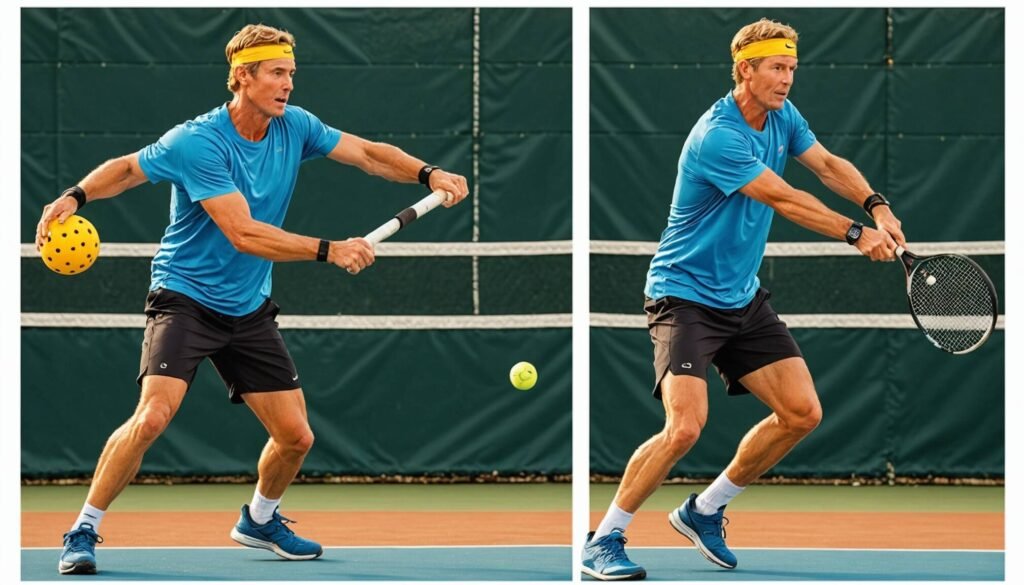
Generate Effortless Power in Pickleball Through Proper Body Rotation
If you’ve been playing pickleball for a while and feel like you’re working harder than you should to generate power, you’re not alone. Many players, regardless of their background, find themselves muscling through shots, relying heavily on arm strength to drive the ball with pace. The result is often fatigue, inconsistency, and shots that lack the punch you’re looking for. The solution, however, isn’t about swinging harder or finding a more powerful paddle. It’s about understanding how your body creates power naturally and efficiently.
The fundamental insight comes from understanding that pickleball power originates from your body’s core rotation, not from isolated arm movements. This concept, while simple on the surface, represents a transformative shift in how most recreational players approach their game. When you watch professional players, their shots seem effortless yet explosive. They’re not necessarily stronger than you, but they’ve mastered the art of channeling energy from their entire body through the paddle and into the ball.
Mari Humberg, a PPA-ranked top 20 player, recently broke down these mechanics in a detailed lesson that highlights exactly how recreational players can tap into this same power source. Her approach focuses on what she calls the “unit turn,” a technique that synchronizes your hips, shoulders, and non-dominant arm to work together as a single coordinated system. This stands in stark contrast to the arm-isolated approach that many players default to, particularly those coming from other racquet sports or those who are self-taught.
Understanding the Unit Turn Concept
The unit turn is deceptively simple in theory but requires deliberate practice to execute consistently. At its core, the unit turn means rotating your hips, shoulders, and non-dominant arm together as one cohesive unit rather than relying on your dominant arm to generate power independently. Think of your body as a coiled spring: when you wind up for a shot, everything turns together, storing energy that releases through the kinetic chain when you unwind into the ball.
Humberg demonstrates this principle brilliantly through a throwing drill that makes the concept immediately tangible. When you try to throw a ball without rotating your hips, using only your arm, the throw barely reaches the baseline. But when you engage your full body, turning your hips and shoulders into the throw, the ball sails all the way to the fence. This dramatic difference in distance and power comes not from throwing harder with your arm, but from accessing the much larger muscle groups in your core and lower body.
This same principle applies directly to your pickleball shots. Whether you’re hitting a drive from the baseline, executing a putaway at the kitchen line, or smashing an overhead, the power generation mechanism remains fundamentally the same. Your body rotates as a unit, and your arm follows this rotation rather than creating the power itself. For players who have been struggling to add pace to their shots, this realization often represents a breakthrough moment in their development.
The beauty of the unit turn is that it actually makes pickleball less physically demanding, not more. When you’re using your entire body efficiently, you’re distributing the workload across multiple large muscle groups rather than overstressing your shoulder and arm. This not only generates more power but also reduces fatigue and the risk of injury, particularly the shoulder and elbow issues that plague players who rely too heavily on arm strength.
Mastering Drives with the Closed Stance
When learning to incorporate proper body rotation into your drives, Humberg strongly recommends starting with a closed stance, especially if the unit turn is new to you. A closed stance naturally forces you to rotate your entire body because you can’t cheat by just swinging your arm. In a closed stance, your front foot is positioned slightly across your body, which means that to make contact with the ball, you must turn your hips and shoulders through the shot. There’s simply no way to reach the ball effectively without engaging your whole body.
This is particularly important for players who tend to be arm-heavy, a common characteristic among those with tennis backgrounds but also prevalent in self-taught players who have developed the habit of muscling the ball. The closed stance serves as a natural training mechanism, building the correct muscle memory before you progress to more advanced stances. Once you’ve internalized the mechanics of the unit turn and can execute it consistently, you can experiment with semi-open or open stances, but the fundamental principle remains unchanged: your power comes from turning your whole body, not from swinging your arm harder.
Here’s the counterintuitive aspect that surprises many players: putting your full body into a drive doesn’t mean you need to swing hard with your arm. In fact, the opposite is true. Humberg emphasizes the importance of keeping your arm controlled and loose while allowing your hips and shoulders to do the heavy lifting. When players learn to loosen up their rotation while maintaining a relaxed arm, their drives immediately gain topspin and dip naturally without requiring any additional arm effort. The momentum generated from proper body rotation does the work automatically.
The practical application involves a straightforward drill that you can practice with a partner or even solo if you have a ball machine. Have someone feed you balls, or set up a rally where you’re hitting ground strokes, and focus exclusively on rotating fully into each shot while consciously keeping your arm relaxed. You should feel as though your arm is almost passive, simply following the momentum created by your body’s rotation. The difference in both power and consistency becomes immediately apparent, and you’ll likely find that you’re generating more pace with less effort.
This relaxed arm approach also dramatically improves your consistency because you’re not trying to time a hard arm swing with the incoming ball. When your arm is following your body’s rotation, the timing becomes more natural and repeatable. You’ll find that your drives land deeper in the court with better trajectory, and your mishits become less frequent because you’re using a more reliable power source.
Applying Rotation to Kitchen Line Putaways
Kitchen line putaways present a particular challenge for many players because they occur in high-pressure situations where you have a clear opportunity to end the point. The temptation to use all arm and muscle the ball away is strong, but this approach often leads to errors, balls that float too high, or putaways that lack the pace needed to prevent your opponent from defending. The fix for putaways is identical to the solution for drives: proper body rotation with a relaxed arm.
The stakes feel higher at the kitchen line because you’re closer to the net and the ball is typically lower, but the rotational principle doesn’t change. Humberg uses the same throwing drill at the kitchen line to illustrate this point effectively. She asks players to attempt spiking the ball down without any rotation, using only their arm, and then to repeat the motion with full hip and shoulder turn. The difference in power and angle is staggering, yet the arm effort remains the same or even decreases in the second attempt.
One key detail for putaways involves stance selection. Unlike drives where a closed stance is often beneficial for learning, putaways typically require an open stance because you want to stay as close to the kitchen line as possible without stepping into the non-volley zone. An open stance allows you to maintain your position at the line while still being able to reach balls to either side. However, the open stance doesn’t eliminate the need for rotation; it simply means your rotation happens from a different starting position.
With an open stance at the kitchen line, your hips and shoulders still need to turn into the shot, but the rotation is more compact and quicker. Your arm should feel loose and almost passive, following the momentum of your body rather than generating power independently. Humberg demonstrates this with a flowing motion that generates serious pace without looking forced or violent. The putaway becomes a natural extension of your body’s rotation rather than an isolated arm swing.
Many players struggle with putaways because they tighten up in the moment, sensing the opportunity to win the point and inadvertently tensing their entire upper body. This tension disrupts the kinetic chain and forces them to rely on arm strength alone. By consciously focusing on body rotation and keeping your arm loose, you’ll find that your putaways become more consistent and more effective, with better angles and more pace.
Why Tight Arms Undermine Your Power
The issue of tight arms is one that many pickleball players hear about from coaches and playing partners, but understanding why tight arms develop and how to fix them requires looking at the root cause. Players don’t consciously decide to tighten their arms; rather, they tighten their arms because they’re trying to generate power from them. It’s a natural compensation mechanism when you haven’t learned to access power from your body’s rotation.
Humberg reframes this issue perfectly: once you shift the power source from your arm to your hips and shoulders, your arm naturally relaxes. It’s not about forcing yourself to keep a loose arm through sheer willpower; it’s about eliminating the need for your arm to be tight in the first place. When your body is generating the power through proper rotation, your arm simply doesn’t need to work hard. It becomes a whip at the end of the kinetic chain rather than the engine driving the movement.
This shift in understanding represents a fundamental change in how you conceptualize power generation in pickleball. Instead of thinking about swinging harder, you start thinking about rotating more fully. Instead of focusing on your arm speed, you focus on your hip and shoulder turn. The arm motion becomes almost an afterthought, something that happens naturally as a result of good body mechanics rather than something you need to consciously control and force.
The practical implication is significant for long-term player development and injury prevention. Players who rely on tight, forceful arm swings are far more likely to develop shoulder, elbow, and wrist issues over time. The repetitive stress of muscling the ball, especially during long play sessions or tournaments, takes a cumulative toll on these relatively small joints and muscles. By contrast, when you’re using proper body rotation, the stress is distributed across much larger muscle groups that are better equipped to handle the load.
Learning to relax your arm while rotating your body fully requires patience and deliberate practice. You may initially feel like you’re losing power when you first loosen your arm because you’ve been relying on that tension. However, as your body learns to rotate more efficiently and your timing improves, you’ll discover that you’re actually generating more power with the relaxed approach. The key is trusting the process and giving yourself time to develop the new motor pattern.
The Universal Application Across All Shots
One of the most valuable insights from understanding proper body rotation is recognizing that this principle applies universally across every shot in pickleball. Humberg notes that everything in the game, from drives to drops to overheads, comes from the unit turn. The overhead, for instance, follows exactly the same mechanics as your groundstrokes and putaways; the only difference is that you’re executing it in response to a lofted ball, often while moving backward or adjusting your position.
This universal application means that once you master the unit turn, your entire game improves simultaneously. You’re not learning separate techniques for different shots; you’re learning one fundamental movement pattern that adapts to different situations. This makes skill development more efficient and helps your game feel more cohesive and natural. Instead of having to think through different mechanics for different shots, you’re always returning to the same basic principle: rotate your body as a unit, keep your arm relaxed, and let the kinetic chain do its work.
For the overhead specifically, the rotation might feel slightly different because you’re opening up your stance and turning your shoulder to track the ball above you, but the power generation mechanism remains identical. Your hips and shoulders rotate together, and your arm follows this rotation. Many players struggle with overheads because they try to use all arm strength, reaching up and swinging down without proper body rotation. The result is often a weak overhead that lacks pace or an error from poor timing.
When you apply the unit turn to overheads, you’ll notice that the ball comes off your paddle with significantly more pace and better angle, yet you’re not swinging any harder with your arm. The rotation of your body, combined with the natural momentum of turning into the shot, generates the power automatically. Your arm simply needs to be in the right position and relaxed enough to transfer that energy efficiently to the ball.
Practical Drills for Developing Body Rotation
Understanding the concept of body rotation is one thing; developing the muscle memory and coordination to execute it consistently is another. The good news is that the drills for building this skill are straightforward and can be practiced at any level. The throwing drill that Humberg demonstrates serves as an excellent starting point because it removes the paddle from the equation and lets you focus purely on the body mechanics.
Start by standing on the court without a paddle and simply throw pickleball balls toward a target, first using only your arm with no hip or shoulder rotation. Notice how little distance you achieve and how much effort it requires. Then throw the same way but engage your full body, turning your hips and shoulders into the throw. The dramatic difference in distance and ease makes the principle immediately clear to your body, not just your mind. This kinesthetic learning is crucial for developing the correct movement pattern.
Once you’ve internalized the throwing motion, translate it directly to your paddle work. Start with simple ground stroke rallies where you focus exclusively on the unit turn, not on where the ball is going or whether you’re winning the point. Give yourself permission to miss shots as you’re learning because you’re building a new motor pattern. Focus on the feeling of your hips and shoulders turning together, your non-dominant arm pointing toward the ball as you prepare, and your dominant arm staying relaxed throughout the motion.
A helpful practice technique is to exaggerate the rotation at first, turning more than you think you need to. This helps override the tendency to default back to arm-heavy swings. As the motion becomes more natural, you can dial back the exaggeration, but the full rotation should remain the foundation of every shot. Film yourself if possible, or have a knowledgeable friend watch, to ensure you’re actually rotating your body and not just think you are. Many players believe they’re using their body when they’re still primarily using their arm.
Another effective drill involves hitting drives from a closed stance exclusively for an entire practice session. This forces your body to rotate because you can’t rely on an open stance to compensate with arm swing. Set up a target area in the back third of your opponent’s court and focus on consistently hitting that target with relaxed, rotation-based drives. As your consistency improves, you’ll gain confidence in the technique and can begin applying it in game situations.
For Those New to Pickleball or Body Mechanics
If you’re relatively new to pickleball or haven’t spent much time thinking about sports biomechanics, the concept of body rotation might seem abstract or complicated at first. Let’s break it down in the simplest possible terms. Imagine you’re trying to throw something heavy, like a bowling ball, as far as you can. You wouldn’t just use your arm, would you? Instinctively, you’d turn your whole body into the throw, using your legs, hips, and torso to generate force. That same instinct applies perfectly to hitting a pickleball.
The reason body rotation is so effective comes down to basic physics and anatomy. Your arm muscles are relatively small compared to your core muscles, hip muscles, and leg muscles. When you use only your arm to hit the ball, you’re tapping into a limited power source and putting significant stress on small joints. When you use your whole body, you’re accessing much larger, stronger muscle groups that can generate force more easily and sustainably. It’s the difference between trying to push a car with just your arms versus pushing it with your whole body leaning into it.
The term “unit turn” simply means that your hips, shoulders, and arms all turn together at the same time, as if they were one solid piece. Think of it like turning your entire upper body as a single block rather than twisting different parts independently. When you prepare for a shot, everything turns back together. When you hit the ball, everything turns forward together. Your arm doesn’t do something separate from your body; it’s just one part of the whole unit that’s rotating.
For beginners, the most important takeaway is that you don’t need to swing hard to hit the ball with power. This feels counterintuitive because in most aspects of life, more force equals more result. But in pickleball, like in golf or tennis, efficiency matters more than effort. A proper, full body rotation with a relaxed arm will generate more ball speed than a tense, hard arm swing with minimal body involvement. It might take some time to believe this, but once you experience it yourself, it becomes obvious.
One simple way to start feeling this in your own game is to consciously turn your belly button toward where you want the ball to go. Your hips follow your belly button, and your shoulders follow your hips, so by focusing on turning your belly button through the shot, you’re engaging your whole body naturally. This simple cue often helps beginners access body rotation without having to think through all the technical details. Try it on a few shots and notice whether the ball


