Why Pickleball Refs Struggle to Call Illegal Serves, and Often Don’t
Pickleball’s serve rules are deceptively simple on paper but brutally complex in practice. The requirement that players strike the ball below waist level during a serve sounds straightforward until you watch a professional match and realize just how difficult this rule is to enforce. It’s become one of the sport’s most persistent officiating challenges, creating an unspoken understanding between referees and players that has shaped how the game is called at the highest levels.
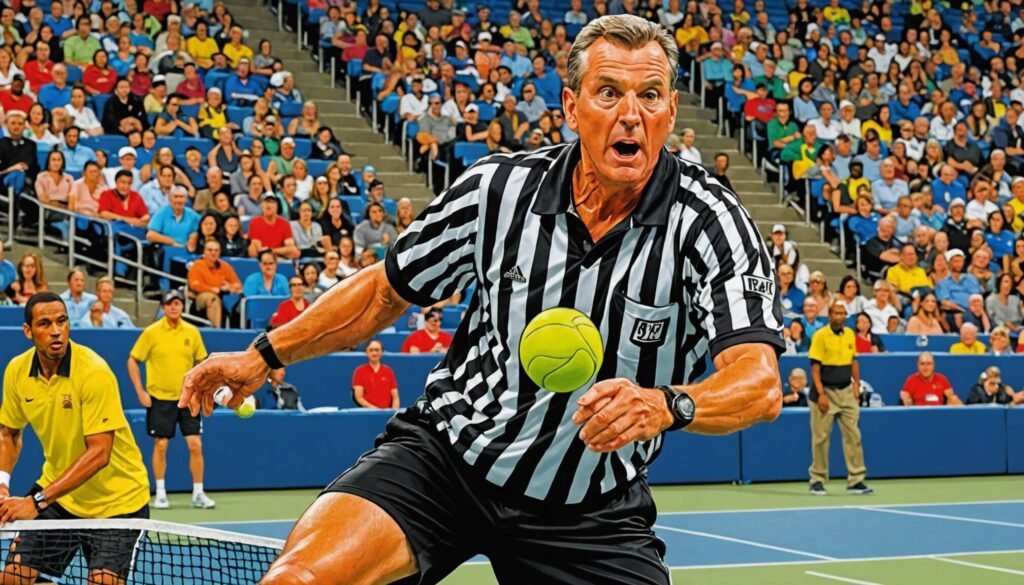
The reality is that unless a serve violation is glaringly obvious, most referees won’t make the call. This isn’t laziness or incompetence on their part. It’s a practical acknowledgment of the limitations inherent in trying to judge a split-second movement from across the court while accounting for countless variables that make each serve unique. USAP head referee Ron Ponder recently demonstrated exactly why this rule presents such a nightmare for officials, breaking down the mechanical and perceptual challenges that make illegal serve calls so problematic in competitive play.
The Anatomy of a Difficult Rule
The waist-level serve restriction exists for good reason. It prevents players from developing overhead serve advantages that would fundamentally alter pickleball’s character as a game built on finesse and strategy rather than pure power. The rule states that contact with the ball must occur below the waist, with the paddle head remaining below the wrist at the point of contact. These restrictions are designed to keep serves reasonable and returnable, maintaining the rally-focused nature that makes pickleball accessible and enjoyable for players of all skill levels.
But enforcing this rule requires referees to make instantaneous judgments about body positioning, contact points, and paddle angles while standing anywhere from twenty to forty feet away from the action. In a demonstration video, Ponder illustrated the core challenge facing officials: the human waistline is not a standardized measurement. Every player’s body is different, and those differences create massive complications for consistent rule enforcement.
Consider the variables at play during any given serve. One player might wear their shorts high on their torso, creating one visual reference point for where their waist appears to be. Another player might wear their shorts lower, changing that reference point entirely. Some players have longer torsos relative to their leg length, while others have shorter torsos. These anatomical differences mean that what looks like a waist-level serve for one player might appear completely different for another player of the same height.
The complexity multiplies when you factor in movement. Players don’t serve from a rigid, upright position. They bend, twist, rotate their hips, and shift their weight during the serve motion. All of these movements change where the waistline appears to be at any given moment. A referee watching from the side of the court sees a different angle than a referee watching from behind the baseline. The three-dimensional nature of the serve motion means that perspective dramatically affects what officials can actually observe.
Then there’s the speed factor. Professional players don’t slowly wind up and gently tap the ball over the net. Modern pickleball serves are quick, explosive movements that happen in a fraction of a second. The entire motion from the beginning of the backswing to contact with the ball might take less time than it takes to blink. Referees are expected to track the paddle position, identify the exact moment of ball contact, determine where that contact point is relative to the server’s waist, and simultaneously verify that the paddle head remains below the wrist line. All of this must happen in real time with no ability to review or slow down the footage.
Why Selective Enforcement Has Become the Norm
The practical result of these challenges is that illegal serve calls have become relatively rare in competitive pickleball unless the violation is extremely obvious. This selective enforcement isn’t officially sanctioned or acknowledged in any rulebook, but it’s become an understood reality of how the game is officiated. Referees develop an informal threshold where they’ll only make the call if they’re absolutely certain a violation occurred, and that certainty is hard to achieve given all the variables involved.
This creates an interesting dynamic in tournament play. Players who understand this reality can push the boundaries of the serve rule without much risk of being called for a violation. It’s not that they’re blatantly cheating or that referees are ignoring obvious infractions. Rather, it’s that the gray area between clearly legal and clearly illegal serves is enormous, and players have learned to operate within that gray area with relative impunity.
From a competitive standpoint, this inconsistency poses problems. Two players might execute very similar serves, but only one gets called for a violation based on slight differences in body positioning, referee angle, or simple chance. The player who gets called feels unfairly singled out, especially when they’ve seen dozens of similar serves go unchallenged. The player who doesn’t get called might not even realize they’re skirting the rule’s boundaries. This lack of consistency undermines confidence in officiating and can affect match outcomes in ways that feel arbitrary.
Yet despite these problems, the current approach might actually be the most reasonable solution available given the constraints. The alternative would be strictly enforcing every possible violation, which would require either significantly slowing down the pace of play for video review on every questionable serve, or accepting an even higher rate of incorrect calls as referees err on the side of calling violations they’re not entirely certain about. Neither option seems better than the status quo of selective enforcement based on obvious violations.
The psychological impact on players is also worth considering. When serve rules are enforced inconsistently, players become more tentative and uncertain about their serve motions. They might alter their natural mechanics to stay well below the threshold, potentially sacrificing serve effectiveness out of fear of violation calls. Or they might do the opposite, testing the boundaries more aggressively because they know calls are unlikely. Either way, the uncertainty shifts player focus away from strategy and execution toward gaming the enforcement patterns.
What This Means for the Average Player
If you’re relatively new to pickleball or play primarily at the recreational level, this entire discussion might seem overly complicated for what should be a simple rule. The good news is that for most casual play, the waist-level serve restriction isn’t something you need to obsess over. If you’re making a genuine effort to contact the ball below your waist with an underhand motion, you’re almost certainly fine. The enforcement challenges that plague professional referees don’t typically affect recreational games where players call their own lines and violations.
However, understanding why this rule is difficult to enforce can actually improve your game awareness and make you a better pickleball citizen. When you realize just how many variables affect whether a serve looks legal or illegal, you become more forgiving of both referees and opponents. That player whose serve looks questionable might not be trying to cheat. They might have a different body type that makes their legal serve appear higher than yours. The referee who doesn’t call an opponent’s borderline serve isn’t necessarily missing an obvious violation. They might simply lack the certainty needed to make that call.
For players moving into tournament play or more competitive recreational leagues, it’s worth being extra conservative with your serve motion. Since enforcement tends to focus on obvious violations, you want to ensure your serve is clearly legal rather than borderline. This means making contact noticeably below your waist, keeping your paddle head well below your wrist, and maintaining a serve motion that looks unambiguously legal from any angle. You might sacrifice a small amount of serve power or deception, but you’ll eliminate any risk of violation calls and avoid putting referees in difficult positions.
The serve rule challenge also highlights a broader truth about pickleball as it continues to grow and professionalize. Many rules that worked perfectly well for a casual backyard game become increasingly problematic as the sport develops more competitive structures, faster play, and higher stakes. The waist-level serve restriction is just one example of how pickleball’s rulebook is still evolving to match the realities of modern competitive play. Understanding these growing pains helps players at all levels appreciate the complexity involved in governing a sport that’s expanding as rapidly as pickleball.
The Future of Serve Rule Enforcement
So where does pickleball go from here? The serve rule challenge isn’t going away on its own, and as the sport continues to professionalize, the pressure for consistent enforcement will only increase. Several potential solutions have been discussed within the pickleball community, each with its own advantages and drawbacks.
One option would be implementing technology-assisted officiating for serve violations. High-speed cameras positioned at strategic angles could capture the serve motion and allow for quick review when a serve appears questionable. This approach works in other sports like tennis, where Hawk-Eye technology has revolutionized line calling. However, implementing such systems would require significant financial investment in equipment and infrastructure, potentially pricing smaller tournaments out of having quality officiating. There’s also the question of whether slowing down play for serve reviews would disrupt the flow and rhythm that makes pickleball enjoyable.
Another approach would be simplifying the rule itself to make enforcement more objective. Instead of the ambiguous waist-level requirement, the rule could specify that contact must occur below a certain height relative to the ground, or require the paddle to remain below shoulder level, or mandate that the server’s arm must be moving in an upward arc at contact. Each of these alternatives would create different enforcement challenges, but they might be easier for referees to judge consistently than the current waist-level standard.
Some have suggested eliminating the waist-level restriction entirely and allowing overhead serves, which would completely sidestep the enforcement problem. However, this would fundamentally change pickleball’s character and likely lead to serve-dominated play that reduces rallies and makes the game less accessible to players with limited mobility or power. The serve restrictions exist for good reasons beyond just tradition, and removing them might solve one problem while creating several others.
A more incremental approach would be improving referee training and positioning to maximize their ability to judge serve legality. If referees are taught to focus on specific visual cues and position themselves at optimal angles, they might be able to make more accurate calls without technological assistance. This wouldn’t eliminate the fundamental challenges of judging a fast-moving, three-dimensional motion, but it could reduce the gray area where uncertainty prevents enforcement.
The reality is that there’s no perfect solution. Every option involves tradeoffs between enforcement consistency, game flow, rule simplicity, and the financial and logistical feasibility of implementation. The current approach of selective enforcement based on obvious violations isn’t ideal, but it might be the most practical option given the constraints. As one of several rule modifications being considered for the sport’s future, the serve restriction remains a work in progress.
Living With Ambiguity
Perhaps the most important lesson from the illegal serve enforcement challenge is that sports rules exist in the real world where perfect enforcement is often impossible. We like to think of rules as black and white, clearly defining what’s allowed and what isn’t. But in practice, rules are interpreted and enforced by human beings with limited perception, working in real time under pressure to make split-second judgments about complex movements.
This doesn’t mean rules are meaningless or that enforcement doesn’t matter. Rather, it means we need realistic expectations about what officiating can achieve. The waist-level serve rule serves an important purpose in maintaining pickleball’s accessible, rally-focused character. The fact that it’s difficult to enforce consistently doesn’t negate that purpose. It just means players, referees, and tournament organizers need to work together to find practical ways to uphold the rule’s intent even when its letter is challenging to apply.
For players, this means serving in good faith and making genuine efforts to comply with the spirit of the rule rather than looking for ways to exploit enforcement difficulties. For referees, it means making calls when they have sufficient certainty while acknowledging the limitations of what they can realistically observe. For tournament organizers, it means creating officiating structures that support referees and provide them with the best possible conditions for making accurate calls.
The serve rule challenge also reminds us that pickleball is still a relatively young sport working through the growing pains of rapid expansion and professionalization. The rules and enforcement mechanisms that govern the game today will likely look different in five or ten years as the sport continues evolving. Being part of that evolution means accepting some ambiguity and imperfection along the way, while working collectively toward better solutions that serve the game’s long-term health.
Understanding why referees struggle to call illegal serves doesn’t excuse rule violations or justify sloppy officiating. But it does provide valuable context for why the game is called the way it is, and why quick fixes aren’t as simple as they might appear. The next time you see a questionable serve go uncalled in a tournament match, you’ll understand that the referee isn’t necessarily missing something obvious. They’re dealing with one of pickleball’s genuinely difficult officiating challenges, doing their best to make accurate calls within the limitations of human perception and the complexity of the rule itself.


