The Bump Shot: The Subtle Pickleball Technique Taking Over the Game
The bump shot in pickleball is having a moment. What was once a niche technique reserved for high-level competitive players is now showing up more and more across courts nationwide, and there are compelling reasons why this subtle yet effective shot deserves attention. This isn’t a flashy overhead smash or a lightning-fast drive that turns heads. Instead, the bump shot represents something more nuanced: a way to control the tempo of play, dictate positioning, and keep opponents constantly guessing about your next move. As pickleball continues to evolve and players at all levels look for ways to add sophistication to their game, the bump shot has emerged as one of those techniques that separates intermediate players from advanced competitors.
The fundamental appeal of the bump shot lies in its simplicity combined with its tactical effectiveness. Unlike power shots that require significant wind-up and risk, or delicate dinks that demand precise touch, the bump occupies a middle ground that offers consistency and control. It’s a shot that doesn’t demand exceptional athleticism or years of practice to begin implementing, yet it opens up strategic possibilities that can transform how you approach points at the kitchen line. For players looking to elevate their game beyond just hitting the ball back and forth, understanding and mastering the bump shot provides a pathway to more intelligent, controlled play.
Understanding the Bump Shot for Beginners
If you’re relatively new to pickleball or haven’t encountered the bump shot in your regular play, it’s worth taking a moment to understand exactly what this technique involves and why it matters. At its core, the bump shot is executed at the kitchen line, which is the non-volley zone that extends seven feet from the net on both sides of the court. When you’re standing at this line engaged in what’s often called the “dinking game,” you’re typically exchanging soft shots back and forth with your opponents, waiting for an opportunity to attack or for someone to make an error.
The bump shot comes into play when your opponent hits a ball with some pace, typically an aggressive dink that’s traveling through the air toward you. Rather than letting that ball bounce, which would push you back and potentially give your opponent the advantage, you lean forward and intercept the ball out of the air. The key distinction here is what you do when you make contact. You’re not swinging at the ball. You’re not trying to add speed or spin. You’re not flicking your wrist to redirect it sharply. Instead, you’re simply allowing the ball to make contact with your paddle face and guiding it smoothly back into your opponent’s kitchen.
Think of it like catching a ball with a baseball glove versus swatting at it. The bump shot absorbs the incoming energy and redirects it with control rather than fighting against it or trying to add more force. This approach gives you several advantages: you maintain your forward position at the line, you take time away from your opponent, and you keep the ball low and controlled, which makes it difficult for them to attack. For players who are used to either letting every ball bounce or aggressively attacking anything that comes at them, the bump shot offers a third option that balances offense and defense beautifully.
How to Execute the Bump Shot in Pickleball
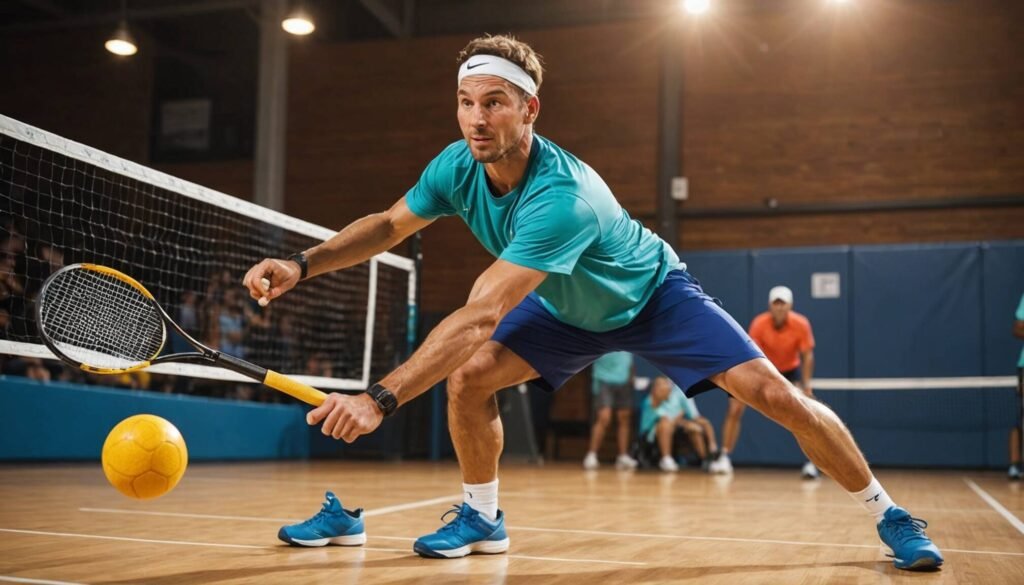
The technical execution of the bump shot requires attention to several specific elements, each of which contributes to consistency and effectiveness. The shot begins with proper positioning at the kitchen line. You want to be balanced on the balls of your feet, ready to move forward rather than back. Many players make the mistake of standing too upright or leaning back slightly, which makes it difficult to reach forward and intercept balls out of the air. Instead, maintain a slight forward lean with your knees bent, which allows you to extend your reach into the court without losing balance.
As a ball approaches with pace, the natural instinct for many players is to tense up and prepare to block or defend. The bump shot requires the opposite mindset. As the ball comes toward you, you want to reach out with your paddle while maintaining a loose grip. This loose grip is crucial because it allows the paddle to absorb the ball’s energy rather than creating a rigid surface that causes unpredictable bounces. Think of your paddle as a cushion rather than a wall. The ball should sink slightly into the paddle face before rebounding back across the net.
The motion itself comes primarily from your shoulder and arm, not from your wrist or hand. This is perhaps the most important technical detail and the one that players most frequently get wrong. Your wrist should remain locked in a neutral position throughout the entire stroke. Any wrist movement introduces variables that reduce consistency. Instead, use your shoulder to guide your entire arm forward in a pushing motion. You’re not swinging or snapping, you’re extending and pushing through the contact point. The paddle face should remain relatively stable throughout, pointing roughly where you want the ball to go.
The target for your bump shot is typically deep into your opponent’s kitchen, ideally at their feet or to a spot that forces them to move. Because you’re taking the ball out of the air and pushing it forward, you have natural depth on the shot without needing to add much force. The ball’s existing momentum combined with your forward push creates enough pace to get it deep, but the controlled nature of the stroke keeps it from flying long. This balance between depth and control is what makes the bump shot so effective in match situations.
Why the Bump Shot Is Becoming Essential in Modern Pickleball
The growing prevalence of the bump shot in competitive play reflects broader trends in how the game is evolving. As players have become more skilled, the dinking exchanges at the kitchen line have become increasingly sophisticated. Gone are the days when dinking was simply about keeping the ball low and waiting for an opponent to pop it up. Modern advanced pickleball features aggressive dinks, attacks from the kitchen line, and constant jockeying for position and advantage. In this environment, having multiple tools to handle different types of balls becomes essential.
The bump shot serves as a crucial alternative to other kitchen line techniques. When an opponent hits an aggressive dink at you, you have several options: let it bounce and hit a reset, slice it out of the air, flick it aggressively to a different target, or execute a bump shot. Each option has its place, but the bump offers unique advantages. Unlike letting the ball bounce, which can push you back and give your opponent time to prepare, the bump keeps you in an offensive position. Unlike a flick or aggressive counter, which carries risk and can lead to unforced errors, the bump provides a high-percentage option that maintains pressure without overcommitting.
One of the subtle but significant advantages of incorporating the bump shot into your arsenal is the element of disguise it provides. From your opponent’s perspective across the net, the setup for a bump shot can look very similar to the setup for a flick or aggressive volley. You’re leaning forward, reaching out with your paddle, and making contact out of the air. They can’t be sure whether you’re about to attack aggressively or execute a controlled bump until the moment after contact. This uncertainty forces them to split their attention between preparing for an attack and preparing for a controlled shot, which can create indecision and slower reaction times.
The bump shot also addresses a common problem that players face as they improve: the tendency to get pushed back from the kitchen line by aggressive opponents. When you’re consistently letting balls bounce, especially balls with pace, you naturally drift backward to give yourself more time to react. This backward movement might feel safer in the moment, but it concedes positional advantage to your opponents and makes it harder to be offensive. By taking balls out of the air with bump shots, you can hold your position at the line even against aggressive play, which maintains the psychological and tactical pressure on the other side of the net.
The Critical Importance of Wrist Control
The single most common mistake players make when learning the bump shot relates to wrist movement. It’s a natural human instinct to use your wrist when hitting objects. Whether you’re throwing a ball, swinging a racket, or using a hammer, wrist action typically plays a significant role in generating force and controlling direction. However, the bump shot in pickleball requires you to override this instinct and keep your wrist locked in a stable position throughout the stroke.
The reason wrist control is so critical comes down to consistency and repeatability. Every time your wrist moves during a stroke, you’re introducing another variable into the equation. The angle of your paddle face changes based on wrist position, which affects where the ball goes and how much spin it carries. When you’re trying to execute a subtle, controlled shot like the bump, these variables can turn a good shot into a mishit. One bump might land perfectly in your opponent’s kitchen, while the next, executed with seemingly the same motion but slightly different wrist position, sails long or catches the net.
Locking your wrist doesn’t mean tensing it up or making it rigid and uncomfortable. Instead, think of finding a neutral position where your paddle is an extension of your forearm and maintaining that relationship throughout the stroke. Your wrist exists in this scenario primarily as a stable connection between your arm and your paddle, not as an active participant in generating motion. All the movement should come from your shoulder, with your arm acting as a unit that extends forward and guides the paddle through the contact point.
This technique requires practice to feel natural because it goes against instinct. Many players report that when they first consciously try to keep their wrist locked during bump shots, the motion feels mechanical or uncomfortable. This is normal and temporary. As you practice the technique repeatedly, the locked-wrist pushing motion becomes automatic, and you can execute it naturally without thinking about the mechanics. The payoff for this practice is a shot you can trust in pressure situations, knowing that the same motion will produce the same result consistently.
Taking Control of the Kitchen Line
One of the most valuable strategic benefits of the bump shot is how it allows you to assert dominance at the kitchen line. In pickleball, controlling the area near the net is fundamental to success. Points are won and lost based on who can maintain an offensive position and who gets forced back. The bump shot is a tool specifically designed to help you hold your ground and even push forward when opponents try to move you back with pace.
When you execute a bump shot effectively, you’re doing several things simultaneously. First, you’re physically reaching forward into the court, which naturally moves your body weight and position forward rather than back. This forward movement sends a subtle but important message to your opponents that you’re comfortable in an aggressive position and willing to take balls early. Second, you’re taking time away from them by intercepting the ball before it bounces, which reduces their preparation time for the next shot and can rush their decision-making.
The bump shot also creates a specific tactical problem for opponents. When they hit an aggressive dink at you, they’re typically expecting one of two outcomes: either you’ll let it bounce and they’ll have time to prepare for your next shot, or you’ll try to counter-attack aggressively, which creates an opportunity for them if you miss or hit it high. The bump shot presents a third outcome they may not be prepared for. You’re taking the ball early like an aggressive counter, but you’re not giving them an attackable ball. Instead, you’re pushing it right back into their kitchen with good depth, forcing them to deal with a difficult ball while you maintain excellent positioning.
This dynamic is especially effective against players who like to sit back and wait for mistakes. Some opponents are content to exchange soft dinks indefinitely, knowing that eventually you’ll either get impatient and try something risky or you’ll make an error and pop the ball up. The bump shot disrupts this patient game plan by allowing you to be aggressive with your positioning and ball-taking while maintaining the consistency and control of defensive play. You’re moving forward, taking balls out of the air, and maintaining pressure without the high error rate that comes with truly aggressive shots.
Practical Drills and Practice Methods
Developing a reliable bump shot requires dedicated practice, but the good news is that the drills are straightforward and don’t require complex setups. The most basic drill involves standing at the kitchen line with a practice partner who feeds you balls with moderate pace from the opposite kitchen line. Start with relatively easy feeds that come directly at you, which allows you to focus purely on the mechanics of the stroke: loose grip, locked wrist, shoulder-driven push through the ball. As you become comfortable with the basic motion, have your partner vary the feeds to different locations, forcing you to move and adjust while maintaining proper technique.
A progression drill that builds match-specific skills involves alternating between regular dinks and bump shots. Your partner hits a soft dink, which you return with a regular dink, then they hit an aggressive dink with pace, which you bump back into their kitchen. This alternating pattern mimics the rhythm of real points and helps you develop the recognition and reaction skills needed to identify when a bump shot is appropriate versus when a regular dink or different shot is the better choice. The key is to make this pattern unpredictable as you improve, so you’re genuinely reacting rather than anticipating based on a set sequence.
Another valuable practice method focuses specifically on reach and positioning. Have a partner feed you balls that require you to extend forward to reach them. The goal here is to develop comfort with leaning into the court and taking balls at full extension while maintaining balance and control. Many players are hesitant to reach too far forward for fear of falling into the kitchen or losing balance, but the bump shot often requires maximum reach to take balls as early as possible. Practicing at full extension builds the confidence and body awareness needed to execute these shots in match situations.
Common Mistakes and How to Correct Them
Beyond the wrist movement issue already discussed, several other common mistakes can undermine the effectiveness of your bump shot. One frequent problem is gripping the paddle too tightly. Many players, when they see a ball coming at them with pace, instinctively tighten their grip in preparation for contact. This tight grip turns your paddle into a rigid surface that causes the ball to rebound too quickly and with too much pace. The result is bump shots that consistently fly long or miss the intended target. The solution is to consciously maintain a loose grip, which feels counterintuitive when a ball is coming at you quickly but produces much better results.
Another mistake involves paddle angle at contact. While the bump shot should maintain a relatively consistent paddle face throughout the stroke, some players either open the face too much, causing balls to pop up, or close it too much, causing balls to go into the net. The ideal paddle angle is slightly tilted upward from vertical, just enough to get the ball over the net with a gentle arc that brings it back down into the kitchen. Finding this angle requires experimentation and practice, but once you develop a feel for it, the shot becomes much more consistent.
Timing represents another challenge for players learning the bump shot. Because you’re taking balls out of the air, you need to judge when to extend your paddle and make contact. Reaching too early means the ball hasn’t arrived yet and you’ll be caught off balance, while reaching too late means the ball will have passed your optimal contact point and you’ll be jamming yourself or letting it bounce after all. The key to good timing is tracking the ball early and starting your forward movement before the ball arrives, so your paddle is extending forward as the ball enters your hitting zone. This creates a smooth meeting of paddle and ball rather than a rushed stab or late block.
Integrating the Bump Shot Into Your Overall Game Strategy
While the bump shot is valuable, it’s important to understand it as one tool among many rather than a technique to use in every situation. Effective pickleball requires reading the situation and selecting the appropriate shot based on ball height, pace, placement, opponent positioning, and your own position on the court. The bump shot excels in specific scenarios, particularly when dealing with aggressive dinks at the kitchen line that have pace but aren’t quite high enough to attack with a putaway volley.
A useful framework for decision-making at the kitchen line considers both ball height and your court position. When balls are below the net and you’re at the line, controlled shots like dinks and bumps are appropriate. When balls are at or above net height and you’re at the line, aggressive shots like flicks and volleys become viable. The bump shot occupies an important middle ground: it’s a controlled shot that you can use on balls with pace, allowing you to maintain offensive positioning without taking the risks associated with aggressive attacks.
The bump shot also pairs well with other kitchen line techniques in creating patterns and combinations that keep opponents off balance. For example, you might use bump shots consistently for several exchanges to establish a rhythm and position, then suddenly flick the next ball aggressively when your opponent settles into expecting another bump. Or you might alternate between bump shots down the line and


