
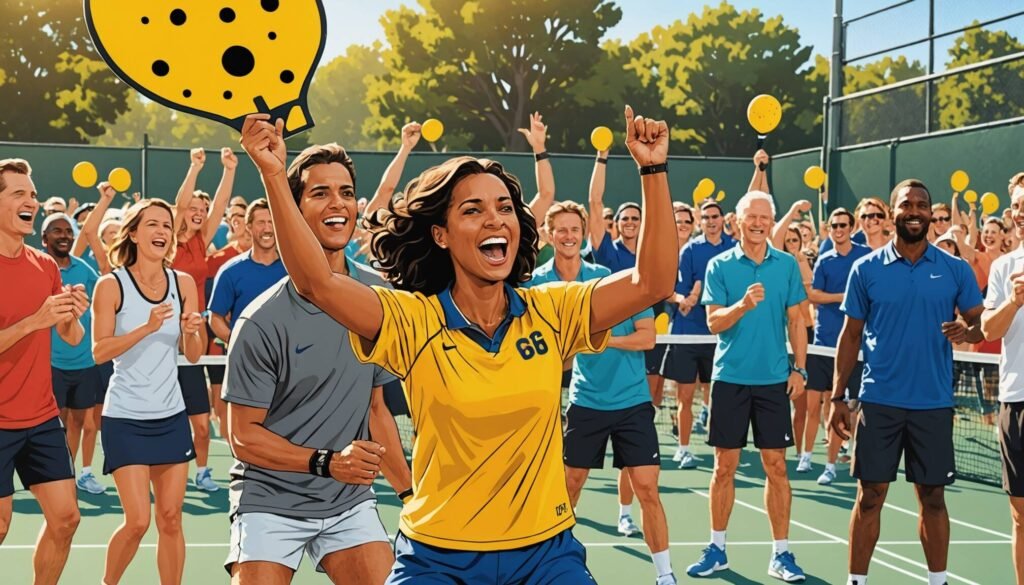
Black and Oncins Capture First Gold Together at PPA Sacramento Open
The PPA Sacramento Open delivered drama, emotion, and unforgettable moments as professional pickleball players competed in California’s capital city. With major implications for the upcoming PPA Finals in San Clemente, this tournament proved to be a critical stop on the tour, even as several top players chose to skip the event following their participation in the MB PPA Tour Asia event in Hanoi. The absence of star players like Anna Leigh Waters, Anna Bright, Christian Alshon, and Hayden Patriquin opened the door for other competitors to shine, and they certainly delivered.
Mixed Doubles: An Emotional First Gold for Black and Oncins
The mixed doubles final at the PPA Sacramento Open will be remembered as one of the most emotionally charged matches of the year. Eric Oncins and Tyra Black captured their first gold medal together, defeating Jorja and JW Johnson in a five-game thriller that had everyone on the edge of their seats. What made this victory even more remarkable was the adversity Tyra faced, competing with a heavily taped leg after injuring her hamstring earlier in the day during women’s doubles competition.
The path to gold wasn’t easy for the duo. They started by defeating the sixth-seeded Jonathan Truong and Jessie Irvine in straight games, 11-9, 11-3 in the quarterfinals. The semifinals presented a tougher challenge against second seeds Parris Todd and Andrei Daescu, but Oncins and Black prevailed 11-6, 9-11, 11-7 to earn their spot in the championship match.
In the finals against the husband-and-wife team of Jorja and JW Johnson, Tyra’s injury became a major storyline. Knowing his partner was compromised, Eric understood he needed to elevate his game and play with intensity and speed. They came out firing, taking the first game 11-7. However, the Johnsons are championship-caliber players for a reason, and they stormed back with authority, winning games two and three by scores of 11-6 and 11-3. The momentum had completely shifted, and it appeared the match might be slipping away from Oncins and Black.
But champions find a way to respond under pressure, and that’s exactly what happened in games four and five. Despite Tyra’s obvious discomfort and limited mobility, the pair dug deep and grinded out two closely contested games, winning both 11-8 to claim the gold medal. The narrow margins in those final two games reflected just how evenly matched these teams were and how much heart it took for Oncins and Black to close out the match.
This victory represented something deeply personal for both players. For Eric Oncins, this was his first-ever gold medal in mixed doubles and his first gold medal earned in the United States. He had previously won two gold medals in men’s doubles in Asia the previous year, but this achievement on American soil clearly meant something special. For Tyra Black, this marked her second mixed doubles gold, having won earlier in the year at the Indoor National Championships with Christian Alshon.
The emotions poured out during the post-match interview, with both players crying as they reflected on what they had accomplished together. In a sport where partnerships can be fluid and change frequently, finding the right chemistry with a partner is invaluable, and Oncins and Black clearly have something special. Their willingness to fight through adversity, support each other when things got tough, and ultimately triumph in the face of both physical limitations and championship-level opposition speaks volumes about their character and potential as a team moving forward.
Women’s Doubles: Todd and Rohrabacher Finally Break Through
In only their third tournament together, Rachel Rohrabacher and Parris Todd captured gold in women’s doubles, capping off a steady progression of improvement that has been impressive to watch. The duo had shown promise from the start, earning bronze at Red Rock in March 2025, then upgrading to silver in Newport Beach the previous month. Sacramento represented the culmination of their development as a team, as they finally reached the top step of the podium.
As the second-seeded team in the draw, Rohrabacher and Todd faced a challenging path that required them to defeat the sixth seed, fifth seed, and ultimately the top-seeded team in the finals. Their ability to handle the pressure and execute against increasingly difficult opponents demonstrated both their skill level and mental toughness.
The finals matchup pitted them against the top-seeded team of Tyra Black and Jorja Johnson, both elite players who had already proven themselves throughout the tournament. What made Rohrabacher and Todd’s performance so impressive was their tactical versatility. They didn’t rely on a single formation or strategy. Instead, they showed they could play straight up, stack with Parris on the left side, or stack with Rachel on the left side, constantly adjusting based on the situation and keeping their opponents off balance. This kind of strategic flexibility is becoming increasingly important in women’s doubles at the professional level, and we can expect to see more teams adopting this approach in the future.
The gameplan for Rachel and Parris was clear from the opening point: be aggressive and dictate play whenever possible. They executed this strategy to perfection in game one, coming out with aggressive returns and attacks to take the game 11-5. However, the match was significantly affected by Tyra’s injury. Late in the first game, Tyra hurt her leg while trying to reach a ball and came up noticeably limping. She requested a medical timeout, and there was a delay while waiting for medical personnel to arrive. The trainer wrapped her right leg, but within five minutes of resuming play, Tyra removed the tape, clearly uncomfortable but trying to push through the pain.
Despite the injury, Black and Johnson showed their competitive fire by winning game two 11-6, reminding everyone why they were the top seed. But the injury clearly had an impact, and Rohrabacher and Todd seized control of the match in games three and four. They dominated those final two games, winning 11-4 and 11-6 to claim the championship.
This victory raises interesting questions about the future of partnerships in women’s doubles. The musical chairs effect that occurred when Anna Bright and Anna Leigh Waters decided to partner together caused a cascade of partnership changes throughout the women’s game. Based on their chemistry, consistent improvement, and now a gold medal together, the Rohrabacher-Todd partnership appears to have serious staying power and could become a more permanent fixture on tour.
Men’s Singles: Staksrud’s Dominant Run Continues
Federico Staksrud added another gold medal to his 2026 collection, capturing his third singles title of the year with an absolutely dominant performance in Sacramento. What makes Fed’s success in singles particularly remarkable is the consistency he’s shown in one of the most volatile and unpredictable events in professional pickleball. While doubles play often sees the same teams consistently reaching the podium, singles tournaments frequently produce surprising results with different winners. Staksrud’s ability to consistently finish in the top four demonstrates his exceptional skill level and mental fortitude.
The statistics from Sacramento tell the story of Fed’s dominance: he didn’t lose a single game all week long. His march to gold included victories over Pesa Teoni, Tama Shimabukuro, Noe Khlif, Roscoe Bellamy, and Zane Ford in the final. Perhaps most impressively, he pickled Khlif in game two of their quarterfinal match, winning 11-0, which is a rare occurrence at the professional level and speaks to the gap in performance that day.
The broader storyline in men’s singles continues to be the battle between three elite players: Federico Staksrud, Chris Haworth, and Hunter Johnson. These three have been trading the number one ranking back and forth, and all have legitimate claims to being the best men’s singles player in the world at any given moment. Their competition is pushing the level of men’s singles to new heights, and fans can expect this rivalry to continue defining the discipline over the next six months to a year. The question isn’t whether one of these three will win the next tournament, but rather which one will emerge victorious.
Controversial Referee Decisions Create Headlines
While the on-court action delivered plenty of drama, some of the biggest talking points from Sacramento involved officiating decisions that left players, fans, and commentators debating the rules and their application. Two incidents in particular stood out, both involving head referee Don Stanley, and both raising questions about how certain rules should be interpreted and enforced.
The first incident involved Hunter Johnson in his quarterfinal match against Zane Ford. Johnson, who had just finished game two and was down in the match, called a timeout and walked toward his bench. In what appeared to be a gesture of frustration, he threw his paddle with his left hand toward his bag. The paddle handle hit the ground and took an unexpected bounce, striking a spectator in the stands in the leg. Don Stanley was called to the court to assess the situation, and after reviewing what had occurred, made the decision to disqualify Johnson from the match.
This ruling sparked immediate debate. While everyone agreed that the paddle should never have ended up hitting a spectator, the question was whether Johnson’s action constituted the kind of intentional or reckless behavior that warranted a disqualification versus a penalty point or warning. The fact that the paddle took a weird bounce and the contact appeared to be unintentional complicated the situation. Some argued that player safety and spectator safety must be the paramount concern and that any action that results in contact with a patron should carry severe consequences. Others felt that the punishment didn’t fit the crime, especially considering the contact was clearly accidental and not the result of Johnson throwing the paddle toward the stands.
The second controversial call also involved Stanley and occurred during a men’s doubles quarterfinal match between Eric Oncins and Dylan Frazier versus Pablo Tellez and Jack Sock. Oncins received a technical warning for blowing on a ball. This is an extremely rare call that most recreational players and even many competitive players might not be aware exists in the rulebook. The rule is designed to prevent players from using air to alter the trajectory or movement of the ball, which could be considered an unfair advantage. However, the application of this rule in a professional match raised eyebrows and led to significant discussion on social media about whether the referee was being overly technical or properly enforcing a legitimate rule.
These incidents highlight an ongoing tension in professional pickleball: as the sport grows and the stakes increase, how should referees balance strict rule enforcement with common sense and the spirit of competition? Should officials take a more permissive approach and only intervene in cases of clear and significant violations, or should they maintain strict adherence to every rule regardless of how minor the infraction might seem? These questions don’t have easy answers, but they’re becoming increasingly important as professional pickleball continues to mature as a sport.
Fahey Ends Medal Drought with Singles Gold
Kate Fahey’s path back to the top of the podium in women’s singles had been long and frustrating, making her gold medal in Sacramento all the more satisfying. Since her last singles victory at this same tournament back in September, Fahey had collected one bronze and five silver medals. She had been right there, consistently reaching the finals and semifinals, but couldn’t quite break through to capture gold. That pattern firmly establishes her as the clear number two player in women’s singles right now, always in contention but often finishing just behind the champion.
Fahey’s tournament got off to a rocky start in the Round of 32, where she dropped the only game she would lose all week to Kwon Mihae, falling 9-11 in the first game. Mihae, a product of the UPA Asia Trailblazer program, showed she belonged on the court with one of the world’s best players. However, Fahey’s experience and class showed through as she completely dominated the next two games, winning 11-1 and 11-3 to advance.
After that early scare, Fahey was absolutely unstoppable. She went on to pickle her opponents three times throughout the week, including in the finals, demonstrating a level of dominance that even surprised longtime followers of her game. The championship match against Kaitlyn Christian was particularly impressive, with Fahey winning 11-3, 11-0. A shutout game in a professional final is rare and indicates that Fahey was operating at an elite level while her opponent struggled to find any rhythm or effective counter-strategies.
What makes Fahey such a consistently successful singles player is her well-rounded game. She possesses the athleticism to chase down balls and extend rallies, which is crucial in singles where court coverage is paramount. Her groundstrokes are remarkably consistent, allowing her to engage in long exchanges without making unforced errors. And when she gets opportunities at the net, she has the touch and reflexes to put balls away. This combination of attributes ensures that she’ll continue to be a fixture on the medal stand for the foreseeable future, and it’s only a matter of time before she breaks through to become the undisputed number one in women’s singles.
Johns and Tardio Maintain Perfect Record in Men’s Doubles
The dominance of Ben Johns and Gabe Tardio in men’s doubles continues to border on absurd. After their performance in Sacramento, the duo improved to a perfect 7-0 record in the United States for 2026. While other teams occasionally take a game or even two games off them, no one has been able to solve the puzzle and defeat them in a match.
The statistics paint a picture of absolute dominance that we rarely see in professional sports. In 35 matches played in 2026, Johns and Tardio have lost only nine games total. That’s a 77-9 record at the game level, translating to a 90% game win percentage. To put that in perspective, they’re winning nine out of every ten games they play against the best men’s doubles teams in the world. Four of those nine losses came against Hayden Patriquin and Christian Alshon, who weren’t even present in Sacramento, making Johns and Tardio’s path to gold even smoother than usual.
Despite their overwhelming superiority, Sacramento did provide a few moments of drama for the top-seeded team. They dropped a game in the quarterfinals against Blaine Hovenier and Jaume Martinez Vich, showing they’re not completely invincible. They lost another game to Federico Staksrud and Andrei Daescu, both elite players in their own right, proving that on any given game, a hot team can challenge them. The finals against JW Johnson and CJ Klinger also included a game loss in the second game, making the match closer than many expected. However, Johns and Tardio ultimately prevailed 11-8, 7-11, 11-6, 11-2, with that final game showing their ability to raise their level when necessary and close out matches decisively.
Even though they lost three games in Sacramento, more than they’ve lost in some entire tournaments, Johns and Tardio look to be firing on all cylinders heading into the Atlanta Pickleball Championships. The question isn’t whether they’ll win, but whether any team can even push them to five games. Until someone figures out how to consistently apply pressure and exploit whatever small weaknesses might exist in their game, we can expect this dominance to continue for the foreseeable future. They’ve established themselves as one of the most dominant partnerships in pickleball history, and they’re adding to that legacy with every tournament they play.
Understanding the Significance: A Guide for Casual Fans
If you’re relatively new to following professional pickleball or just tuning in to see what all the excitement is about, the PPA Sacramento Open provides an excellent case study in what makes this sport so compelling to watch. Let’s break down some of the key elements that made this tournament special and what they mean for someone who might not follow the sport religiously.
First, it’s important to understand the tournament structure. Professional pickleball events typically feature four main draws: men’s singles, women’s singles, men’s doubles, women’s doubles, and mixed doubles. Singles is exactly what it sounds like: one player per side, covering the entire court alone. Doubles features two players per side who must work together to cover the court and execute strategy. Mixed doubles pairs one man and one woman on each side, creating unique strategic dynamics since players often target the woman as the theoretically weaker player, though many female pros have proven this assumption wrong.
The scoring system in pickleball uses


