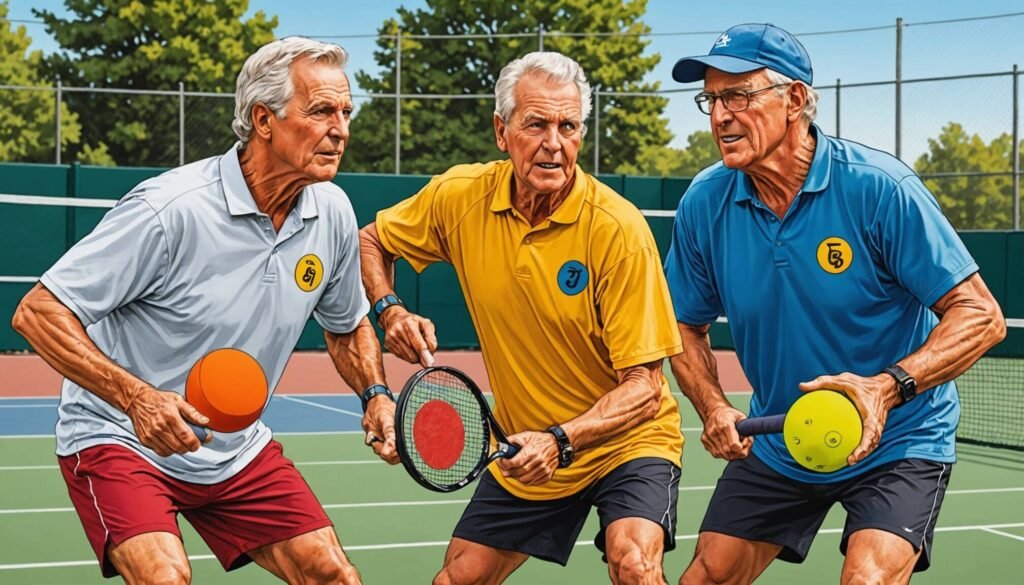
Senior Pickleball Doubles Strategy: Play Smarter Not Harder After 60
Senior pickleball doubles strategy is where experience beats athleticism every single time. You’ve been around long enough to know that grinding harder doesn’t always mean winning smarter. And in doubles pickleball after 60, that insight is your biggest competitive edge.
The game is different at this stage. Recovery time is real. Reaction speed changes. But the court doesn’t get any bigger, the kitchen line doesn’t move, and a well-placed dink is still worth exactly the same as a blast from a 25-year-old who doesn’t know when to reset. The players who understand this, and build their doubles game around it, win more matches than they lose.
This isn’t about accepting limitations or playing safe. It’s about leveraging what you’ve learned over decades and applying it to a sport that rewards patience, positioning, and tactical precision more than raw speed. For players over 60, doubles pickleball offers a level playing field where court awareness can neutralize a younger opponent’s physical advantages, and where strategic shot selection consistently outperforms mindless aggression.
Why Senior Pickleball Doubles Strategy Starts at the Kitchen Line
The most important principle in any senior pickleball strategy is this: get to the non-volley zone line, the kitchen line, and stay there. Full stop.
Research published in the Journal of Aging and Physical Activity in 2025 found that older athletes compensate for reduced sprint speed by excelling in spatial positioning and anticipatory decision-making. That’s textbook doubles pickleball. The player who gets to the kitchen first, and stays composed there, controls the point.
For players over 60, this matters even more. You don’t need to cover the whole court. You need to position yourself correctly at the kitchen, eliminate unnecessary movement, and force your opponents into unforced errors. That’s the entire game plan. Every other tactic feeds into this one.
Getting there isn’t always clean, though. The transition zone, the no-man’s land between the baseline and the kitchen, is where points get lost. Understanding your movement through that zone is critical. When serving, you and your partner are stuck at the baseline while your opponents already have someone at the kitchen. Your job is to neutralize that disadvantage as quickly as possible with a quality third shot, then advance together.
When receiving serve, one partner should already be at the kitchen while the other returns. After the return, the returning player hustles forward to join their partner. Two players at the kitchen line is the power position. One player back is a vulnerability. Zero players at the kitchen means you’re essentially giving your opponents the point.
The transition doesn’t happen by accident. It requires intention, footwork, and most importantly, the right shot selection to create the space and time you need to move forward safely. That’s where the soft game becomes essential.
The Soft Game Is Your Secret Weapon
Here’s the thing about power: it punishes you when your timing is off. And as recovery time extends with age, mistimed power shots cost more than they used to. The soft game, dinking, resetting, drop shots, is where senior doubles players have an enormous advantage over younger, less patient opponents.
Dinking is the art of exchanging low, unattackable shots into the kitchen from the kitchen line. Done well, it’s not passive. It’s pressure. You’re waiting for your opponent to lift the ball, and the moment they do, you or your partner attacks. That patience is something players develop over years, not months.
When you’re in a hard exchange and the pace gets too hot, the reset is your best friend. A soft block that lands in the kitchen buys time, neutralizes pace, and frustrates aggressive opponents who are looking to end the point with power. Learning to reset better is one of the most underrated skills in the game, and it’s especially valuable in senior doubles because it lets you de-escalate a point without surrendering the kitchen line.
If you’re still working on your third shot drop, the shot off the serve return that lets the serving team advance to the kitchen, prioritize it. It’s the single most important shot in doubles pickleball, and it doesn’t require physical strength. It requires touch. Which is exactly what experienced players tend to have more of.
The drop shot is your gateway to kitchen line dominance when you’re the serving team. A well-executed drop lands softly in your opponent’s kitchen, forcing them to hit up on the ball rather than attacking down. That gives you and your partner the split second you need to move from the baseline to the kitchen line together. A poor drop, one that sits up or lands short in the transition zone, invites an aggressive attack that keeps you pinned back.
Practice your drops with purpose. Aim for depth, not just height. A drop that lands near the kitchen line is harder to attack than one that bounces mid-court. And don’t get discouraged if it takes time to develop consistency. This is a finesse shot, and finesse improves with repetition and focused attention, not brute force.
What Does Good Communication Actually Look Like in Doubles?
The most overlooked senior pickleball doubles strategy isn’t a shot, it’s communication. Knowing who takes the middle ball, who calls the poach, and who covers the lob separates coordinated teams from ones that just happen to be wearing matching shirts.
Before a match, agree on these things. First, establish a middle ball rule. Typically the forehand player takes it, but decide before the first rally, not during it. Second, assign lob responsibility. Who retreats when a lob sails overhead? Both of you can’t chase it. Third, agree on switch signals. A simple word like “switch” or “yours” avoids mid-rally collisions.
Understanding pickleball doubles communication in doubles apply at every age, but they’re non-negotiable for senior players. With slower lateral recovery, wasted steps are extremely costly. Knowing exactly where your partner will be, before the ball comes, is the difference between a clean put-away and a missed opportunity.
The best senior doubles teams function like one unit with two brains. They know each other’s patterns, cover each other’s weaknesses, and make opponents feel like every gap is already covered. That coordination doesn’t happen naturally. It’s built deliberately, over time and through communication.
Call the ball early. If you’re taking it, say “mine” or “got it” loud enough that your partner hears it before they commit to moving. If there’s any doubt, the player with the forehand should take it, but only if that’s been agreed upon beforehand. Silence during a rally creates hesitation, and hesitation creates errors.
After each point, talk briefly. Not to criticize, but to confirm. “I’ll take the next lob.” “You poach if they go cross-court.” Small clarifications prevent big mistakes. The teams that talk between points are almost always the teams that execute better during them.
How to Use Court Positioning to Minimize Movement
Senior pickleball doubles strategy isn’t just about what shots to hit, it’s about where you stand so you don’t have to run. Smart positioning means you’re always angled to cover your most likely ball. The classic formation keeps both players near the centerline with slightly staggered positioning, which eliminates the wide gap that opponents exploit down the middle.
A few principles that pay off in senior doubles make a measurable difference in both efficiency and outcomes. First, stagger rather than square up. One player slightly ahead of the other creates better coverage without doubling up on the same zone. Understanding stagger in pickleball is a tactical edge most recreational players skip.
Second, after the return of serve, move forward. Don’t hang back. Your return of serve should be deep enough to give you time to advance. Third, cut angles, not distance. Step into the ball when possible rather than chasing it laterally. A small step toward the ball at the right moment replaces a full lunge that you’ll feel the next day.
Also worth understanding: your opponents will target the weakest player’s backhand and the middle of the court. When you know that, you can pre-position to take that option away before they even try it. If your backhand is your weaker side, shade slightly toward the middle to protect it. If your partner has a stronger forehand, let them take more of the centerline balls.
When both players are at the kitchen line, avoid standing too close to the sideline. The angles of the court mean that a ball hit down the line is actually easier to defend than one hit behind you or through the middle. Stay within a step or two of the centerline, stagger your depth slightly, and keep your weight on the balls of your feet so you can react in any direction.
Positioning is about prediction and preparation. The more you can eliminate reactive scrambling and replace it with proactive setup, the less energy you waste and the more control you maintain throughout the match.
Senior Pickleball Doubles Strategy for the Return Game
The return of serve is one of the highest-leverage moments in doubles pickleball, and it’s largely underrated. A deep, well-placed return gives the returning team an instant advantage. A short return hands the serving team an easy put-away and keeps them at the baseline with time to reset.
For senior players, the goal on the return is simple: deep and cross-court. Don’t try to win the point on the return. Win the positioning battle instead. A return that lands near the baseline gives you and your partner time to advance to the kitchen together while the serving team scrambles to execute a third shot drop or drive.
The returner’s partner should already be at the kitchen line as the serve is hit, not hovering in no-man’s land. Two players at the kitchen is a power position. One is a liability. After the return, the player who hit it should immediately move forward to join their partner at the line. This creates the two-up formation that puts maximum pressure on the serving team.
Also consider varying your return placement occasionally. A return aimed at the server’s feet as they advance can produce a weak third shot that you and your partner can attack immediately. Don’t always go cross-court. Mix in an occasional return down the line or up the middle to keep your opponents guessing and prevent them from cheating toward one side.
The return doesn’t need to be fancy. It needs to be consistent, deep, and placed with intention. That’s what gives you and your partner the time and space to establish your position at the kitchen and take control of the point from there.
Shot Selection: What to Hit, When to Hit It
Here’s where senior doubles players sometimes leave points on the table. They either go for too much when they should be patient, or they dink endlessly when a good attack opportunity is sitting right there.
The rule of thumb: attack the ball above the net, reset the ball below it. A ball that rises above net height is attackable, put it away with a firm volley aimed at the feet. A ball that’s low or headed into the kitchen is not the time for power. Soft, patient, and precise wins that exchange.
Power shots have a place in doubles, but they’re situational tools, not a default mode. For players over 60, the margin for error on a power shot is smaller, and the recovery time if you miss it and end up in an awkward position is longer. Use them when the setup is clean and the opportunity is clear.
And don’t sleep on the lob. A well-timed lob over an opponent who’s crowding the kitchen is one of pickleball’s most effective weapons. The lob requires placement and timing more than pace. Senior players who master it create an entirely different dynamic, now your opponents can’t crowd the line without worrying about what’s coming over their heads.
Shot selection comes down to reading the situation in real time. Is the ball high or low? Are your opponents leaning forward or back? Is there a gap you can exploit, or is patience the better play? The more you train yourself to assess these variables before you swing, the fewer unforced errors you’ll make and the more often you’ll capitalize on the opportunities your opponents give you.
One of the most effective tactics for senior players is learning how to make opponents hit the more difficult shots. Don’t give them easy balls to attack. Keep them off balance. Make them hit up, hit soft, or hit from an awkward position. The team that forces their opponents into harder shots almost always wins the consistency battle.
Understanding the Game for Beginners and Casual Fans
If you’re new to pickleball or just trying to understand what makes senior doubles different from other formats, here’s the simplest way to think about it. Pickleball is played on a court about one-third the size of a tennis court. It uses a paddle and a plastic ball with holes, similar to a wiffle ball. Points are scored only by the serving team, and games are typically played to 11 points, win by two.
In doubles, two players are on each side of the net. The key strategic area is the kitchen, a seven-foot zone on each side of the net where you cannot volley the ball. You can step into the kitchen, but only after the ball has bounced. This rule creates the foundational dynamic of the game: players try to hit soft shots that land in the opponent’s kitchen, forcing them to hit up, which creates attackable balls.
For senior players, the physical demands are manageable because the court is small and rallies often emphasize control and placement over speed and power. The strategy becomes less about chasing down every ball and more about being in the right position before the ball even arrives. That’s why experienced players can compete effectively against younger, faster opponents, they’re reading the game two or three shots ahead and positioning themselves accordingly.
Doubles also rewards teamwork in ways that singles does not. You and your partner need to move in sync, communicate constantly, and cover for each other’s weaknesses. The best teams aren’t necessarily the ones with the hardest hitters. They’re the ones who make the fewest mistakes, position themselves intelligently, and create opportunities through patience and placement.
For anyone watching a senior doubles match, you’ll notice less sprinting and more calculated movement. You’ll see longer rallies where both teams are exchanging soft shots at the kitchen line, waiting for someone to make an error or create an opening. And you’ll see moments where a perfectly placed shot ends the point instantly, not because it was hit hard, but because it was hit to the exact right spot at the exact right time. That’s the essence of senior pickleball doubles strategy.
Key Takeaways
Get to the kitchen line and stay there. It’s the foundation of every effective senior pickleball doubles strategy. Prioritize the soft game: dinking, resetting, and third shot drops require touch, not power. Communicate before the match, not during it. Assign responsibilities for middle balls, lobs, and switches.
Use court positioning to minimize unnecessary movement. Stagger, cut angles, and anticipate rather than react. Attack the ball above the net. Reset the ball below it. Know the difference before the ball arrives. The return of serve is a weapon. Go deep and cross-court to seize the positioning advantage.
Senior pickleball doubles isn’t about doing more. It’s about doing less, but doing it with precision, intention, and intelligence. The players who embrace that philosophy don’t just compete, they win.
Frequently Asked Questions
What is the best senior pickleball doubles strategy for players over 60?
The best senior pickleball doubles strategy for


