12 Pickleball Tips That Will Transform Your Game
The best advice you’ll ever receive in pickleball might come from players who’ve already made every mistake you’re about to make. That’s the foundation of wisdom shared by Chris and Aizec Olson, co-hosts of Pickleball Studio, who recently broke down 12 essential lessons from their competitive journey. These aren’t superficial quick fixes or trendy hacks. They’re battle-tested insights that address everything from injury prevention to advanced footwork mechanics, the kind of knowledge that separates players who plateau from those who break through to higher levels of play.
What makes these tips valuable isn’t their complexity but their practicality. Every single recommendation addresses a real problem that shows up in match play, whether you’re grinding through recreational tournaments or trying to crack into competitive brackets. The brothers distilled years of experience, countless injuries, and thousands of hours on court into actionable guidance that works across skill levels. If you’re serious about improvement, these lessons offer a roadmap that bypasses the trial-and-error process most players endure.
Understanding These Tips: What Makes Them Different
Before diving into the specific recommendations, it’s worth understanding what sets these pickleball tips apart from generic advice. Most instruction focuses on technique in isolation, teaching you how to hit a forehand or execute a third shot drop without connecting those mechanics to the broader context of injury prevention, court positioning, or psychological preparation. These 12 tips take a different approach. They recognize that sustainable improvement requires addressing the whole system: your body’s conditioning, your mental approach to shot selection, your positioning before and after contact, and your ability to read opponents in real time.
For players new to competitive pickleball or those transitioning from recreational play, this holistic perspective might feel overwhelming at first. You’re not just working on one thing; you’re rebuilding multiple aspects of your game simultaneously. But that’s exactly why these tips are transformative. They compound. Better conditioning means you can train footwork longer. Better footwork means you can execute technique more consistently. Better technique means you can focus more energy on reading your opponents. Each piece reinforces the others, creating a flywheel effect that accelerates improvement beyond what isolated skill work can achieve.
Why Injury Prevention Is Your First Priority
The most critical lesson from Pickleball Studio isn’t about technique at all. It’s about sustainability. You cannot play pickleball at any serious level without a deliberate commitment to injury prevention. This reality catches many newer players off guard because pickleball feels accessible and low-impact compared to sports like tennis or basketball. The truth is far less forgiving. Playing without proper conditioning is unsustainable unless you already maintain an extremely active, healthy lifestyle with built-in strength training and mobility work.
The Olson brothers don’t sugarcoat this reality. One of them shared that he’s watched countless friends, including himself, get sidelined by injuries that could have been prevented with basic gym work. A torn ACL doesn’t care how clean your cross-court dink is or how well you’ve mastered the third shot drop. Once you’re injured, you’re done playing for months, and rehabilitation is a grueling process that makes prevention look easy by comparison.
The solution isn’t complicated, but it does require consistency. Find pickleball-specific workouts that emphasize core stability and single-leg exercises. Trainers like Connor Derekson, who works directly with professional pickleball players, have created routines specifically designed for the demands of the sport. The key difference between pickleball conditioning and general gym work lies in the emphasis on unilateral leg strength and core stability rather than heavy compound lifts or bodybuilding-style isolation work. Pickleball demands explosive lateral movement, rapid deceleration, and the ability to maintain balance while rotating through shots. Your training should reflect those demands.
Equally important is warming up properly before you play. Don’t just show up at the court and immediately start ripping drives or diving for dinks. Use resistance bands to activate your shoulders and hips. Start with light hitting to raise your heart rate gradually. Ease into intensity over the first 10 to 15 minutes rather than going full speed from the first point. Your future self, six months from now when you’re still playing pain-free, will thank you for building these habits early.
Getting Low and Wide: The Foundation of Movement
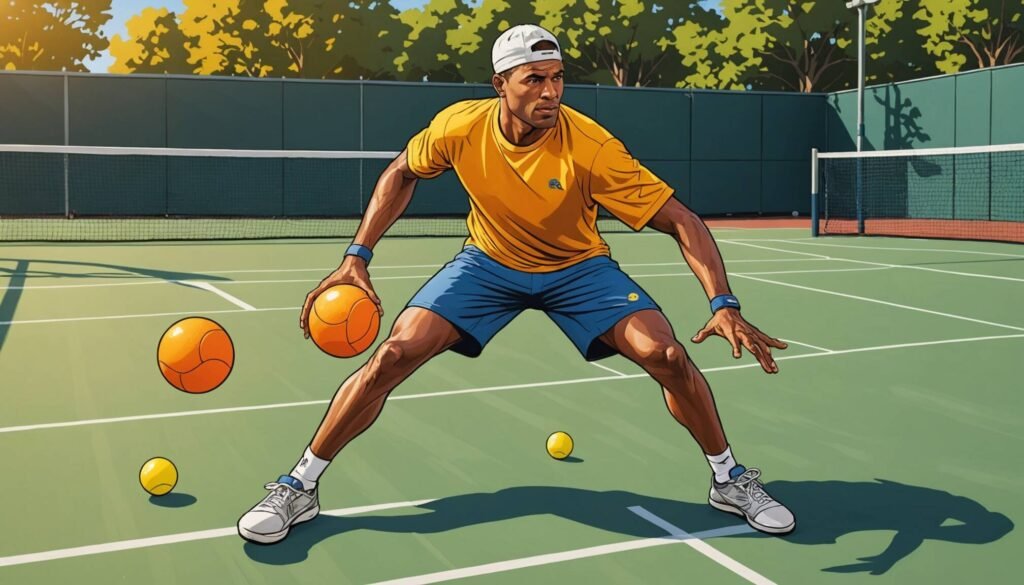
If there’s one physical adjustment that separates good players from great ones, it’s this: you can basically never be too low. Seriously. No one has ever watched a pickleball player and thought they were getting too low. It’s always the opposite. Players stand too upright, their base is too narrow, and they’re constantly caught flat-footed when the ball changes direction.
Watch professional players like Vivian David reset at the kitchen line. She’s practically on the floor, her legs bent at extreme angles, her center of gravity so low that she looks like she’s ready to sit down. On the men’s side, Christian Alshon lives in a permanent squat. His legs are constantly activated, and that’s a major reason why he can handle speed-ups out of the air and hit rolls with such consistency. He’s already in position to react because his base is set.
Why does this matter? When your legs are bent and your base is wide, you can move quicker, dodge balls more easily, and reach dinks without having to reset your feet. You’re already positioned to react. Compare that to standing upright: now you have to move, get low, and then hit the ball. That’s two extra steps you don’t have time for when the pace accelerates.
Here’s the most practical tip within this category: film yourself playing. You think you’re getting low. You’re not. One of the Pickleball Studio hosts mentioned filming himself hitting 15,000 backhands over two weeks as part of a focused training block. On day one, he watched the footage and thought he was standing way too straight. The next day, he consciously tried to get lower, really bending his knees and widening his stance. When he reviewed that second day’s footage, he was shocked to see he was standing almost exactly the same way as the first day. Your body’s perception of its own position is wildly inaccurate. Without video feedback, you’ll continue making the same postural mistakes while thinking you’ve already fixed them.
The solution is simple but physically demanding: widen your stance and bend your knees. Both adjustments work together to create stability, keep you lower to the ground, and position you to move forward into the kitchen instead of backward away from it. This forward momentum is critical because it keeps pressure on your opponents and allows you to take balls earlier in their trajectory. For more on how proper positioning integrates with shot selection, check out the essential shots that complement this athletic stance.
Never Miss in the Net: The Rule That Changes Everything
This tip sounds obvious once you hear it, but it’s genuinely transformative: never miss in the net. When the ball hits the net, the point is guaranteed to be over. There’s zero opportunity for recovery, zero chance your opponent makes an error, zero possibility of extending the rally. If you miss high and give your opponent an overhead, you still have a chance. They might shank it. They might hit it long. They might miss the angle. But a net error is a dead point every single time.
The difference is both psychological and strategic. At higher levels of play, missing in the net is the worst possible outcome because there’s no path back into the point. Missing long or high at least gives your opponent a decision to make and an execution challenge to face. A net error removes all variables in their favor. You’ve done their work for them.
This principle extends directly to shot selection. If you’re in a bad position, out of balance, or caught off guard, don’t try to rip a winning drive. Hit a high, safe shot instead. Yes, it feels less satisfying. Yes, you won’t get the dopamine hit of a clean winner. But you’ll stay in the point, and staying in the point is how you win matches at every level. The players who consistently choose the high-percentage option over the flashy one are the players who win close games and tournaments.
For practical reinforcement of this concept, consider how professional players approach shot selection under pressure. They almost never take unnecessary risks from bad positions. They’re willing to hit defensive lobs, high resets, and neutral balls that keep them alive in the rally until they can regain offensive positioning. Recreational players, by contrast, try to force winners from disadvantaged positions and end up making unforced errors that hand away points.
Keep Your Weight Forward for Better Resets
One of the most underrated adjustments involves something deceptively simple: keeping your weight on your toes and leaning forward. This is especially critical during midcourt resets when you’re moving through the transition zone and dealing with fast balls coming at your body. Your instinct in these moments might be to fall backward as you make contact, using your momentum to absorb the pace of the incoming shot. That’s a sign your base isn’t wide enough and your weight isn’t properly distributed.
Instead, stay on the balls of your feet, widen your stance, and lean into the shot as you make contact. This keeps your resets lower and more consistent while simultaneously positioning you to move forward into the kitchen instead of backward toward the baseline. The difference might seem minor in the moment, but over the course of a match, this habit transforms your transition game. You’re not just hitting better resets; you’re also gaining better court position with every exchange, which compounds your advantage point after point.
It sounds like a small thing. It’s not. This single adjustment can transform your transition game because it changes your momentum and your court positioning in one fluid motion. The best players are always moving forward, always taking space, always pressuring their opponents by closing distance to the net. Keeping your weight forward during resets is how you maintain that aggressive positioning even when you’re dealing with difficult balls. Pair this concept with the tactical systems that structure your overall approach to winning rallies.
Spin Over Power: Why Control Beats Speed
Here’s a tip that separates recreational players from competitive ones: you don’t need to hit every ball as hard as you can. Especially on drives. The instinct is understandable. You see your opponent unwinding for a ball, and you think you can pass them while they’re vulnerable. So you swing hard, loading up with maximum effort, trying to hit a clean winner. But the vast majority of the time, a 70 percent hybrid drive with shape and spin is way more effective than a full-power blast.
Why? Because spin creates problems. A drive with heavy topspin dips below the net cord, forces your opponent to make a split-second decision, and gives you multiple options on the next ball. A drive hit at full power just gives your opponent more pace to counter back at you, and they might even catch you off guard with a counter-drive that you’re not ready for because you were expecting the point to be over. Players who study spin mechanics and understand why professional players have evolved away from certain techniques recognize exactly how much spin dictates modern pickleball strategy.
This principle is especially important in tournament play, where the dopamine hit of a clean winner can cloud your judgment. You’ll see players at high levels hit the back wall or dump balls into the net on drives because they’re swinging too hard, trying to end points prematurely. If they’d just dialed it back to 80 percent effort and focused on placement and spin instead of raw power, they’d be in far better positions to win those rallies. The nice thing about this adjustment is that you don’t have to change your technique dramatically. Just swing easier and focus on where the ball is going and how much spin you’re imparting rather than how hard you’re hitting it.
Treat Speed-Ups as a Setup, Not a Finish
Early in your pickleball journey, speed-ups feel like winners. You hit one, and the point’s over. That works at lower levels because your opponents aren’t expecting the sudden change of pace. But as you climb the skill ladder, this mindset becomes a liability. At higher levels, people are always expecting speed-ups. They’ll get a paddle on it 90 percent of the time. So if you hit a speed-up expecting the point to be over, you won’t be ready for the counter, and you’ll get caught flat-footed when the ball comes screaming back at you.
The better approach is to treat speed-ups as a setup for the next shot, not the finish. When you’re actively ready for the return, suddenly your hands feel faster and your reactions sharper. You’re not actually faster in any objective sense; you’re just prepared, which eliminates the surprise factor that slows down your response time. This shift in mindset is the difference between being reactive and being proactive. Reactive players hit speed-ups and hope they work. Proactive players hit speed-ups and expect to have to hit another shot, which keeps them engaged and ready.
This principle extends directly to drilling. Practice speed-up patterns with a partner where you hit a speed-up cross-court to their forehand, then prepare for a backhand counter coming back at you. Drill 50 of these in a row so the pattern becomes automatic. This habit will serve you at every level. The structured approach found in pickleball drills that focus on hands battles and speed-up exchanges will reinforce this mindset until it becomes second nature.
Rolls Aren’t About Your Wrist: Use Your Shoulder
A lot of players try to hit rolls by snapping their wrist through contact. That’s wrong, and it’s why your rolls are inconsistent. The correct technique is counterintuitive: use your shoulder, not your wrist. Keep your wrist locked in a neutral position and use your shoulder to lift the ball while rotating your forearm through the shot. It’s a smooth, controlled motion, not a snap. And here’s the weird part: it feels slower and less aggressive, but the ball comes out better. You get more spin, better placement, and far more consistency across different ball heights and speeds.
Why does this work? Because your shoulder is a larger, more stable joint than your wrist. When you lock your wrist and use your shoulder, you have more control over the ball’s trajectory and spin axis. When you snap your wrist, you’re relying on a smaller, less stable joint to generate both power and control simultaneously, which is why rolls become inconsistent. Small variations in wrist angle or timing create huge differences in outcome. Using your shoulder removes that variability.
This tip is one of those things that feels backward until you try it with intentional focus. Then it clicks, and you wonder why you ever tried to roll the ball any other way. The same principle applies to other mechanics throughout pickleball: the larger, more stable joints provide consistency, while smaller joints add touch and finesse only after you’ve established a solid foundation.
Footwork and Court Positioning: The Boring Foundation
Here’s a truth that separates players who look good from players who are actually good: footwork and court positioning are everything. And here’s the problem: nobody wants to train footwork because it’s boring. There’s no immediate gratification. You don’t hit winners. You don’t make highlight-reel plays. You just move your feet in repetitive patterns, over and over, until your body internalizes the movements.
But footwork is the foundation of everything else. Good footwork makes you look mechanically sound even when your technique has flaws. It keeps you on balance, on time, and in the right spot to execute whatever shot the situation demands. Players with great footwork look like they’re playing at a higher level than they actually are because they’re smooth, efficient, and never caught off balance. They arrive at the ball with time to set up, which makes their shot execution look effortless.
One specific element within this category is the


