
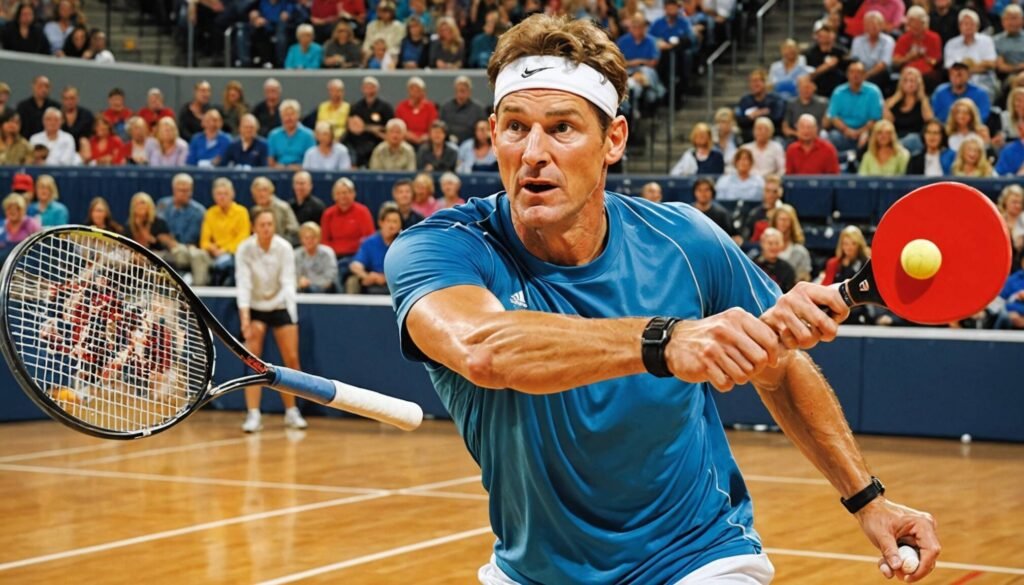
The Punch, Flick & Roll: A Complete Guide to the Backhand Volley in Pickleball
The backhand volley remains one of the most misunderstood and poorly executed shots in pickleball. Walk onto any recreational court and you’ll see players using the same generic swing for every situation, wondering why their results feel so unpredictable. The truth is simpler than most realize: what we call the backhand volley is actually three entirely separate shots, each requiring its own setup, mechanics, and strategic application.
According to Dr. Michael Oakson, widely recognized as The Pickleball Chiropractor, the persistent inconsistency most players experience with their backhand volley stems from treating these three variations as interchangeable. In reality, the punch, roll, and flick each serve distinct purposes in match play, and confusing them creates a technical mess that shows up exactly when you need reliability most. This comprehensive breakdown explores the precise mechanics that separate a dependable backhand volley from one that consistently pops up or lacks the power to finish points.
Understanding Why Your Backhand Volley Feels So Inconsistent
Most recreational players approach all three backhand volley variations with fundamentally the same motion. They drop the paddle head, swing upward, and hope the ball goes where they intend. This approach might work occasionally, but it fails under pressure because it ignores the distinct requirements of each shot type.
The backhand volley isn’t one shot wearing three different names. It’s three completely different shots that demand distinct setups, contact points, and swing paths. When you treat them as one generic motion, you sacrifice your ability to control the ball’s trajectory, generate appropriate power levels, or disguise your intentions from your opponent. This represents one of the critical pickleball techniques that creates a visible gap between intermediate players and those competing at higher levels.
Oakson emphasizes that understanding the setup and technique for each variation separates consistent players from those who struggle through matches. The setup determines your positioning relative to the ball, your footwork pattern, and your paddle angle before contact. The technique determines how your entire body moves through the shot, from your legs through your core to your shoulder, elbow, and wrist. Getting these elements right for each specific situation transforms the backhand volley from a liability into a weapon.
For players serious about comprehensive skill development beyond just volley work, exploring the essential shots provides valuable context for how the backhand volley fits into your overall game strategy. Developing all your fundamental shots together creates compounding improvements that show up faster than isolated practice.
The Backhand Punch: Your Safest Attack Option
The backhand punch represents the slowest and most controlled of the three backhand volley variations. It’s specifically designed to attack balls that sit below net height while keeping your shot low and forcing your opponent into defensive positions. Think of the punch as your high-percentage play when you need reliability over raw power.
The setup for a backhand punch begins with deliberate footwork. You want to position yourself as close to the kitchen line as possible without committing a foot fault. This forward positioning maximizes your reach into the kitchen zone, allowing you to attack volleys from deeper in the court while maintaining the control necessary to keep the ball low and away from your opponent’s strike zone.
Setting Up the Punch Backhand Volley Correctly
The most critical element of the punch setup involves dropping your paddle tip down toward the floor. Since you’re attacking from below net height, you need to position your paddle beneath the ball to create the proper contact angle. Your wrist and shoulder do the majority of work here, while your elbow remains locked throughout the entire motion. This locked elbow position is what distinguishes the punch from the other two variations and creates its characteristic consistency.
On contact, you’re looking for a snap of the wrist, but here’s where most players go wrong: you’re flicking through the ball, not up the ball. Many players instinctively open their paddle face toward the sky, which sends the ball high and gives your opponent an easy overhead opportunity to put the ball away. Instead, think about pushing the ball forward with a slight wrist snap that maintains a closed or neutral paddle face through contact.
Your shoulder also contributes significantly to the punch. You’re essentially shoving your shoulder through the ball at the same moment as your wrist snap occurs. This coordination between shoulder and wrist creates a consistent, low-to-net attack that’s difficult for opponents to counterattack effectively. The ball won’t travel with blazing speed, but that’s not the point of this shot.
The result is a relatively slow ball that stays low relative to the net tape. It won’t win the point outright in most situations, but it catches your opponent off balance and sets you up for the next shot in the rally. Because the technique is so mechanically consistent and simple, you can attack from well below the net in a stable athletic position without worrying about popping the ball up into your opponent’s strike zone. Understanding how to attack drives builds the same low-risk, high-reward tactical mindset that makes the punch such a valuable weapon.
The Backhand Roll: Maximum Topspin and Control
The backhand roll is Oakson’s personal favorite shot, and for good reason. It generates more topspin than the punch and more control than the flick, positioning it as the middle ground that works effectively in most game situations. The roll gives you the ability to be aggressive while still maintaining a safety margin that prevents unforced errors.
The setup for a backhand roll differs from the punch in one critical way that changes everything: you drop the paddle corner below the ball, not the entire paddle tip. This distinction matters tremendously because dropping the entire tip encourages excessive wrist action, which transforms the roll into a wrist-dominant shot. But the backhand roll is fundamentally a shoulder-dominant shot, and maintaining that characteristic is what makes it so reliable.
By dropping only the corner of your paddle, you naturally limit the amount of wrist movement available to you during the swing. You also want to drop your entire hand below the ball’s contact point. Since you’re still attacking from below net height in most situations, you need to sink into your legs and get that paddle corner down low enough to create the proper swing path. This approach mirrors exactly what professional players use to master topspin at the kitchen line in competitive play.
Finding the Right Contact Point on the Backhand Roll
The contact point is where the backhand roll gets genuinely interesting from a technical perspective. You want to feel a slight amount of elbow extension as you make contact with the ball. If you contact the ball with a significantly bent elbow, you’ll get jammed and pop the ball up without generating much forward power or topspin.
But overreaching creates equally problematic results. If you’re breaking your body position or compromising your arm position to reach a ball, you’re setting yourself up for failure. The key is finding that athletic position where your arm reaches out naturally without jolting forward or pulling you off balance. Your body should feel coordinated and connected throughout the entire motion.
Your hips should stay relatively quiet and stable, and your weight should remain centered on your midfoot. If you feel your weight shift dramatically forward onto your toes during the swing, you’re probably overreaching for the ball. This weight shift forward typically indicates you’re too far from the kitchen line or you’re trying to attack a ball that requires better positioning.
Your shoulder’s primary job is to lift your paddle from your knee up toward your shoulder height. Your wrist’s job is simply to open the paddle face slightly through the contact zone. Here’s the critical ratio that separates good backhand rolls from inconsistent ones: your shoulder motion should be approximately double that of your wrist motion. If you’re getting excessively wristy on backhand rolls, you’re fundamentally executing the technique incorrectly.
A highly effective practice drill involves applying light pressure to your wrist, almost like wearing a cast, so you can’t move it much during the swing. This constraint forces you to work your shoulder to get under and up the ball. Once you’ve practiced this way for several sessions, you can gradually add back some wrist motion, but you’ll have trained the proper ratio between shoulder and wrist contribution. The practice drills include targeted repetition work that trains exactly this kind of shoulder-dominant muscle memory.
The swing path also demands attention. Many players fall into what Oakson calls the “elevator swing,” where they set too close to the ball and swing almost vertically upward. This generates minimal topspin on the ball and results in numerous net errors because the ball lacks forward momentum. You need to strike a balance between extension and lift. Think about extending through the ball slightly on a forward vector, then lifting up with your shoulder to create the topspin rotation.
The Backhand Flick: Maximum Power and Aggression
The backhand flick represents the most powerful of the three backhand volley variations. It generates significantly more pace than both the punch and the roll, which is precisely what sets it apart and makes it the finishing shot in your backhand volley arsenal.
The flick requires a ball that arrives above net height. If the ball sits below net height, you simply don’t have enough room to generate the power that makes this shot effective and distinguishes it from the other two options. The nature of the flick is inherently aggressive, and there are more moving pieces involved in its execution, which means it takes more dedicated training to master compared to the punch or roll.
Your footwork should position you as close to the kitchen line as possible without committing a foot fault. You want your chest engaged over that kitchen line because you’re about to generate serious power through a coordinated kinetic chain. Understanding how to develop the flick shows exactly how professional players transformed this shot from a rare weapon into a standard part of modern pickleball.
Generating Power with the Backhand Volley Flick
The flick is the only backhand volley variation where your elbow comes into active play as a power generator. To generate maximum power, you need more joints working in your favor throughout the swing. You’re actively using your wrist, elbow, shoulder, and midback to create a coordinated explosion through the ball that generates pace your opponents can’t handle.
Start with your wrist position. From your traditional handshake grip, point your paddle tip off to the side. This is called hinging your wrist, and you’re storing up potential energy in this cocked position. When you go to hit the ball, you’ll snap that wrist through aggressively to generate immediate power at contact.
Your elbow is next in the kinetic chain. Instead of keeping it extended and locked like in the roll, you’re pointing your elbow toward your target while keeping it bent. This bent elbow position stores energy that you’ll release explosively when you snap your wrist and extend your elbow together in a coordinated motion.
Finally, your shoulder and midback contribute rotation that multiplies the power generated by your arm. As much as you want to bring your elbow toward your opponent, you also want to bring your shoulder forward if you have sufficient time to rotate. This rotation helps you unload and snap through the ball with maximum power generation. Professional players who dominate with speed-up attacks rely on this same rotational chain, as explored in detailed breakdowns of pro strategy at the kitchen line.
The result is a shot that generates significant topspin and power simultaneously. You’re focusing on extension through the ball because it’s arriving above net height. You want to punch through aggressively and get real pace on the ball that puts your opponent in a defensive position.
Here’s the power difference in practical terms: if you use only your wrist and elbow, you’ll generate a certain baseline amount of power. But the moment you add your shoulder and midback rotation to the equation, you’ll approximately double your power on the shot. The amount of rotation available depends entirely on the ball you’re receiving. If it’s really high and slow, you have more time to load and rotate fully. If it’s a decent ball at medium height, you might have to rely more heavily on your wrist and elbow with minimal shoulder rotation.
Speed Differences Matter More Than You Think
One of the most overlooked aspects of the backhand volley system is the speed difference between the three variations. Each shot should have a distinctly different pace, and understanding these differences is crucial for both execution and strategy.
The punch has the least amount of motion happening at contact, so it should consistently be your slowest backhand volley. You’re simply trying to keep it extremely low relative to the net and catch your opponent off balance with placement rather than pace. Think of the punch as generating speeds around 30-40 mph in most situations.
The roll might be slightly faster, perhaps in the 40-50 mph range, and it definitely has the most topspin out of all three shots. You can pick it up more aggressively and trust that the topspin rotation will bring it back down into the court even when you swing harder. This makes the roll your most versatile option across different game situations.
The flick is your fastest option by a significant margin. If the ball comes up above net height, you want to hinge everything and rotate to really unlock maximum power through that ball. You’re looking at 50-60+ mph depending on how much rotation you can generate and how well you coordinate the kinetic chain. Professional players have increasingly weaponized this speed gap, and understanding why pros abandoned certain shots explains exactly how shot selection at the professional level has evolved around pace variation.
Understanding these speed differences helps you disguise your intentions from your opponent. If you’re hitting all three shots at roughly the same pace, your opponent can read your setup and prepare for the same response every single time. But if you’re varying the speed based on the shot selection and situation, you keep them guessing and force them to react rather than anticipate.
Game Strategy: Where to Attack with Your Backhand Volley
Knowing how to execute the three backhand volley variations is one thing. Knowing where to hit them in actual match play is another skill entirely, and it’s where most players leave significant opportunity on the table.
Oakson runs clinics across the country, and he consistently asks players the same strategic question: if a ball is passively hit to your forehand and you’re about to rocket it at your opponent’s body, where would they set their paddle? Almost 99% of players correctly identify that opponents set backhand when protecting their bodies from a body shot.
This insight reveals a critical strategic principle. Most players instinctively set backhand when they’re protecting their bodies from aggressive attacks. So the most logical place to attack early in a rally off a backhand roll is down the line toward your opponent’s backhand


