5 Tall Person Pickleball Mistakes That Are Costing You Points
If you’re over 6 feet tall and playing pickleball, you’ve probably felt it — the frustration of lunging for balls that shorter players seem to reach effortlessly, botching overheads that look automatic, and still getting picked apart at the body like your height means nothing. The honest truth is that your height is not the problem. The problem is the habits you’ve built around it.
Most tall players unknowingly turn their size into a liability. The fixes in this article come directly from a Jilly B Pickleball YouTube session where coach Jill worked through these exact patterns with 6’6″ player Michael on a live court. What came out of it is a clear, practical picture of why tall players plateau and what to actually do about it.
What Is Tall Person Syndrome in Pickleball?
Tall person syndrome is the name for a cluster of bad habits that players over 6’0″ develop because their natural reach lets them get away with poor positioning and lazy footwork. When you’re tall, you can lunge for a ball that a shorter player would have to sprint to, and you’ll still make contact. You can skip the overhead shuffle and still get your paddle on the lob. You can stand straight up during a dinking rally and still pop the ball back.
The issue is that getting away with something is not the same as doing it well. These compensations compound over time. The lunge becomes a default movement pattern. The upright stance becomes your resting position during rallies. The jumped overhead becomes your only overhead. Before long, you’re playing reactive pickleball constantly, because your body never gets into position before the ball arrives. That is exactly what tall person syndrome looks like at the kitchen line, and it is fixable.
Breaking It Down for Newer Players
If you’re newer to pickleball or just getting serious about improving, here’s what you need to understand before diving into the mistakes: pickleball is a game that rewards control, positioning, and patience far more than raw athleticism. The kitchen line — the non-volley zone at the front of the court — is where most points are decided. Dinking is the slow, controlled back-and-forth that happens there. Whoever manages their body position, reads the ball better, and stays balanced longer usually wins those exchanges.
For tall players, the temptation is to use their reach to bail themselves out of bad positioning. That works at lower levels, but as competition improves, opponents will find every weakness that reach is covering up. These five mistakes are the most common ones, and fixing them will genuinely change how you play.
Mistake 1: Taking One Big Lunge Instead of Two Small Steps
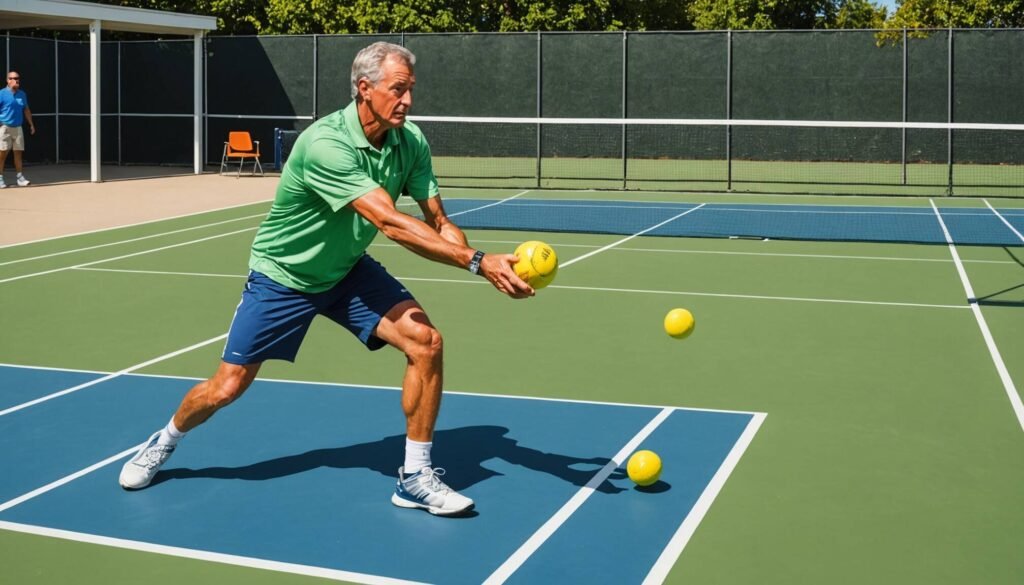
This is the most widespread error among tall players, and it shows up constantly during dinking exchanges at the kitchen. Because your arms are long, a single giant step gets you to most balls in your vicinity. That one step feels efficient because it works. But it is slow to initiate, it completely destroys your balance on contact, and it leaves you flat-footed when the next ball comes. You arrive at the ball and you have nowhere to go.
The mechanical fix is simple to understand and genuinely hard to make automatic: every time your instinct says to take one big step, force yourself to take two smaller ones instead. Two quick steps instead of one lunge. This feels counterintuitive, especially for players with a tennis background, where covering court with big strides was trained into them. But those two smaller steps get your feet under you before you hit the ball, which means you’re balanced at contact and ready to reset or attack the moment you finish the shot.
During his session with coach Jill, Michael described something that surprised him. The two-step approach felt faster, not slower, even though he was taking more steps. The reason is simple: he was already in position when he arrived. There was no extra recovery needed because he was never out of balance in the first place. This is one of those common mistakes that feels wrong to fix until the results prove otherwise.
Drill this deliberately. In your next dinking practice, put a rule on yourself: no single-step reaches. Every ball requires at least two steps to get there, even if the first step covers almost no distance. That deliberate constraint will start retraining your default footwork patterns in a way that passive play never will.
Mistake 2: Standing Too Tall During Dinking Exchanges
Between shots, standing upright to recover is completely fine. You do not need to hold a squat through an entire dinking rally. But the moment it is your turn to make contact, you need to drop. Most tall players never make that transition. They stand straight through their own shot and wonder why they keep popping dinks up or why every ball feels like a scramble.
Coach Jill’s cue for this is to get your head below the level of the ball at contact. That single adjustment changes everything. When your head is under the ball, you stop lifting through it. You start seeing the court from a perspective that actually reveals the angles available to you. Every ball at net level suddenly becomes something you can assess for a speed-up opportunity rather than something you’re just trying to survive.
The position Jill teaches for this is called ATG — “ass to the grass.” Your hips go back, your knees bend deep, and your head follows the ball down to its level. It looks extreme when you first try it, especially if you’re 6’4″ and not used to moving that way on a court. But watch Andre Daescu, who stands at 6’6″ and plays at the top level. During dink exchanges, he comes up slightly when his partner is hitting, then drops back into that low position the moment before he makes contact. That rhythm — rise, sink, contact, rise, sink, contact — is what every tall player needs to build into their game.
Standing upright also shifts your weight backward into your heels. That is a primary reason tall players struggle to counter attacks. When your weight is on your heels, you cannot push forward through the ball. You are stuck reacting instead of responding. For more on why this happens and how to stop it, the breakdown on popping up dinks covers the mechanical reasons in detail.
Mistake 3: Skipping the Overhead Shuffle
Most tall players skip the shuffle step on overheads entirely. They see the lob, recognize it late, square up to the ball, jump straight up, and try to smash it from wherever they happen to be standing. Sometimes it goes in. Often it goes straight into the net or floats for an easy put-away. This is the “jump and pray” overhead, and it is the default for tall players everywhere.
The reason it happens is that the first move is wrong. When most tall players read a lob, their first instinct is to watch the ball and then jump toward it. The correct first move is a turn and a shuffle, not a jump. Coach Jill is emphatic about this, and it goes directly against what many tennis players were taught about overhead mechanics. Here is the correct sequence for tall players specifically:
First, turn your body the moment you read the lob. Do not stand open and track it with your eyes while staying square. Turn your shoulders and your hips immediately. Second, point your non-paddle arm up to track the ball and set your shoulder position. This keeps your eyes on the ball and your body aligned for the swing. Third, shuffle your feet back into position while the ball is still ascending, and let it come down to you rather than chasing it at its peak. The ball will come to you if your footwork fires fast enough. Your job is to be in the right spot before it descends.
When Michael was coached to make his first shuffle step twice as fast as his natural instinct, his overhead improved immediately and dramatically. He described the feeling as waiting on the ball rather than reaching for it. That distinction is the whole game for overhead shots at a high level. A useful drill to accelerate the first-step habit: have a practice partner race you to a spot behind you. The competitive pressure forces your instincts to fire faster than they would in a relaxed drill setting.
Why Out Balls Are Specifically a Tall Person Problem
This one catches people off guard, but it makes complete sense once you understand the geometry. When you’re standing upright at 6’3″ and a ball is heading toward your chest, it might actually be sailing out by five or six inches. But because you’re looking down at it from that height, your perspective makes it appear to be in. So you swing. And you gift your opponents a point that was already yours if you’d just let it go.
The fix is to sink to net level before your opponent makes contact. When your eyes are lower, your perspective shifts. Balls that would clip your shoulder suddenly look clearly out. Balls that looked borderline from standing height become obviously in. The practical cue Jill gives is this: right before your opponent contacts the ball, come down. If you are still upright at the moment they hit it, you have already made the mistake. Your window to read the trajectory accurately has passed before the ball even leaves their paddle.
This adjustment alone, just learning to drop before opponent contact instead of after, can eliminate a surprisingly large number of unforced errors from a tall player’s game. It is not a complicated skill. It is a timing habit that needs deliberate practice before it becomes automatic in a real match.
Mistake 4: Committing to a Forehand or Backhand Counter Too Early
This is a pattern that shows up specifically during fast hands exchanges at the kitchen. Tall players tend to read an incoming attack and decide which side they’re countering from before the ball has even crossed the net. That early commitment leaves them completely wrong-footed when the ball goes the other direction, and because their reach encourages them to stay planted rather than move, they often can’t recover in time.
Michael was consistently loading his forehand early during his session with Jill because his opponent kept attacking his body. The moment she changed the angle, he was already committed and couldn’t adjust. The fix is staying neutral longer. Keep your paddle central, your weight balanced forward, and read where the ball is actually going before you begin your rotation. This is harder than it sounds because the instinct to pre-load is very strong, especially when you’re being attacked repeatedly from the same side.
Building a strong neutral ready position is the foundation here. Your ready position determines how quickly you can react to either side, and for tall players who are already predisposed to staying planted, a weak ready position compounds the problem. Staying central longer gave Michael time to react to both sides, and the same principle will apply to any tall player dealing with this pattern in their own game.
Mistake 5: Tracking the Ball With Your Paddle Instead of Your Feet
You’ve probably heard “track the ball with your paddle” at some point during your pickleball journey. Jill calls it the worst advice in pickleball, and it’s hard to argue with her reasoning. When your paddle leads your tracking, your feet stay planted. Your body contorts around the paddle to make contact. The shot you produce is weak, off-balance, and predictable.
The correct approach is to let your feet and your head track the ball first, with your paddle following naturally as your body arrives in position. When your feet move first, you get to the ball in a balanced stance and the paddle arrives at contact with something behind it — weight transfer, rotation, actual leverage. That is the difference between a shot that pressures your opponent and a shot that just keeps the ball in play.
This mistake hits tall players the hardest during dinking rallies, for the exact same reason as the lunge problem. Long reach means you can still make contact even when your feet haven’t moved. So the habit of letting the paddle lead never gets punished at lower levels. But as you move up in competition, opponents will read that static positioning and start targeting it specifically. They will find the one spot your reach cannot cover and camp there.
Building the foot-first habit requires intentional effort during drilling. ATG position is the anchor for it — when your hips are back and your knees are bent, your weight is already loaded for movement. From that position, moving your feet first becomes more natural. For more on the mechanics of staying ahead of the ball, the breakdown on stopping popups gives useful cues that complement this habit directly.
The Tall Player Checklist: What to Run Through Before Every Rally
These five mistakes all connect back to the same underlying issue: tall players compensate with reach instead of building position. The checklist below is not a complicated system. It is a set of habit replacements that need deliberate repetition before they feel natural in match play.
At the kitchen during dinking: two small steps instead of one lunge, and get your head below the ball at contact. On overheads: turn your body first, point your non-paddle arm, shuffle back, and let the ball come to you. When countering at the kitchen: keep the ball in front of you by extending your paddle out to meet it early, and leave it there between shots rather than pulling back. On out ball reads: drop to net level before your opponent contacts the ball so you can actually see the trajectory accurately. On your ready position: stay neutral and central longer, and do not commit to a forehand or backhand until the ball tells you where it’s going.
Players who put in the work on these specific patterns see results across every part of their game. Counters become more stable. Overheads stop misfiring on automatic balls. Dinking rallies become a genuine weapon rather than a survival exercise. If you want to build on these fixes with a broader roadmap, the guide on breaking 5.0 pairs well with the technique work covered here, and the advanced dinking breakdown is worth reading alongside it for players working on kitchen consistency specifically.
Height is a real advantage in pickleball when it’s used correctly. The reach, the overhead angle, the ability to cover court — all of it works in your favor the moment you stop letting it cover for poor positioning. Fix the five mistakes above, and your height starts working for you instead of against you.
Frequently Asked Questions
What is tall person syndrome in pickleball?
Tall person syndrome refers to the cluster of bad habits that taller players develop because their reach lets them compensate for poor footwork and positioning. Common signs include lunging for balls instead of stepping, standing upright during dinking exchanges, jumping on overheads instead of shuffling back, and tracking the ball with the paddle rather than moving the feet first.
Why do tall pickleball players struggle with overheads?
Most tall players skip the shuffle step and jump at the ball instead, which leaves them airborne and off-balance at the moment of contact. The fix starts with body rotation and a fast first shuffle step the moment you read the lob. Let the ball descend to you rather than chasing it, and you will find your overhead becomes far more controlled and consistent.


