
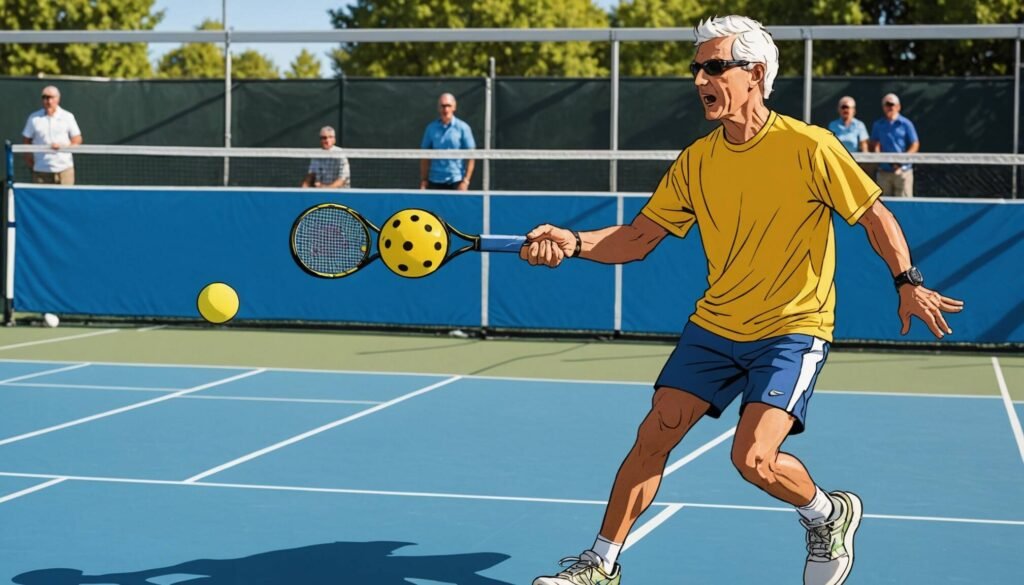
Stop Apologizing for Good Shots in Pickleball
There’s a quiet epidemic happening on pickleball courts across America, and it’s not bad footwork or poor dinking technique. It’s something far more subtle — and honestly, far more frustrating. It’s the reflex apology after a well-earned point. The hand wave. The sheepish grin. The drawn-out “sorrrrry” that follows a shot that was, by every possible measure, excellent.
This piece is a direct response to that habit, and a genuine plea to recreational pickleball players everywhere: stop apologizing for being good at this sport.
The Culture of Apology in Rec Pickleball
If you’ve spent any time on a rec court, you know exactly what this looks like. Someone rips a perfectly placed cross-court dink that clips the line. Someone else floats a lob that lands millimeters inside the baseline. A player with genuinely elite hands drops a third-shot drop so clean it might as well have been placed there by hand — and then immediately turns to their opponent and says “sorry” like they’ve committed some kind of offense.
This happens constantly. And while it comes from a good place — nobody wants to be that overbearing, trash-talking player who makes rec play miserable — the apology habit has quietly started to undermine something important about how we play and compete.
There’s a difference between being humble and being dismissive of your own skill. When you apologize for a point you genuinely earned, you’re not being modest. You’re actually doing something a little strange: you’re implying that the point was somehow undeserved. That luck, not effort, was responsible for the outcome. That your hours of practice and refinement of a specific shot didn’t really count for much.
And for your opponent? Whether they consciously register it or not, the apology can carry an unintended edge. It can feel condescending — like you’re sorry they couldn’t handle what you brought to the court. That’s obviously not the intent, but intent and perception are two different things, and on a pickleball court, perception shapes the energy of the entire session.
What’s Actually Happening at the Pro Level — And Why It Matters
To understand why this conversation is worth having, it helps to look at what’s being debated at the top levels of the sport. Right now, one of the hot-button issues in professional pickleball is whether taunting and on-court screaming should be a penalized offense. The conversation around emotional expression on the court has gotten louder as the sport’s competitive level has intensified dramatically.
Pro commentator and pickleball analyst Jim Kloss has been at the center of this discussion, raising questions about where the line is between competitive fire and unsportsmanlike behavior. It’s a genuinely polarizing topic. Some players and fans love the raw emotion. Others feel it crosses into disrespect.
But here’s the thing: for most of us who play recreational pickleball, the problem isn’t too much celebration. It’s the complete opposite. While pro players are debating whether pumping a fist or screaming after a winner is too much, rec players are so worried about coming across as arrogant that they actively downplay their own best shots.
The pro game is raging too hot. The rec game has overcorrected too far in the other direction. Somewhere in the middle is where healthy competition actually lives.
A Real-World Example That Perfectly Captures the Problem
Picture a reserved court session — four players, all hovering around the 4.5 DUPR level, playing best-of-three series and rotating partners throughout a two-hour block. Real competitive rec play. The kind of session where everyone’s pushing each other and the quality of play is genuinely high.
One of the players has an exceptional drop shot. Not just decent — legitimately elite for the rec level. The kind of drop that dies just over the net with perfect touch and leaves the opponent frozen because there’s simply nothing to be done with it. Over the course of the session, he hits this shot five or more times. Each one is executed beautifully. Each one wins the point cleanly.
And after every single one, he apologizes.
Not sarcastically. Not performatively. Genuinely. Because he’s a good guy trying to be a good sport. He doesn’t want to make anyone feel bad. That’s admirable on the surface. But follow that logic just one more step and something uncomfortable appears.
What does the apology actually communicate? It says: “I know I did something you couldn’t handle, and I feel bad about that.” Which, when you really sit with it, is kind of a strange thing to say in a competitive sport. You practiced that shot. You developed the feel for it. You read the situation correctly and executed under pressure. Why on earth should you apologize for that?
The answer, if we’re being honest, is social anxiety. A fear of being perceived as a show-off. A worry that winning points too cleanly might damage the vibe. And in pickleball specifically — a sport that has built much of its identity around being welcoming, friendly, and community-oriented — that anxiety runs especially deep.
Why Pickleball’s “Nice Guy” Culture Can Actually Hurt the Sport
Pickleball is one of the fastest-growing sports in the United States, and a huge part of its appeal is the culture. Courts are generally welcoming. Players are often friendly. People help beginners. There’s a social element that other sports just don’t have in the same way. All of that is genuinely wonderful and worth protecting.
But there’s a version of “nice” that shades into something less healthy — a version where nobody is allowed to be visibly better than anyone else, where excellence needs to be constantly apologized for, where competition is treated as something vaguely impolite. That version of niceness actually stunts the sport’s growth at the individual and collective level.
Think about it from a pure improvement standpoint. If you’re apologizing every time you execute a great shot, you’re subtly training yourself to be uncomfortable with your own skill. You’re creating a mental association between success and guilt. Over time, that association can actually interfere with your willingness to go for your best shots in critical moments — not because you can’t execute them, but because somewhere in the back of your mind, you’ve been practicing the reflex of treating those shots as something to be ashamed of.
Good competition sharpens everyone. When you bring your best to the court without apology, you force your opponents to level up. You give them a real problem to solve. You respect them enough to not sand down your edges so they feel more comfortable. That’s actually the higher form of sportsmanship — taking your opponents seriously enough to genuinely compete against them.
The Net Cord Exception — And Why It’s Different
To be fair, not all in-game apologies are created equal. There’s one scenario where an acknowledgment is completely reasonable: the net cord. The lucky clip. The ball that trickles over because it deflected off the tape in a way that had nothing to do with skill or intention.
Net cords are genuinely random. Nobody can consistently clip the top of the net to gain a repeatable advantage. When it happens and it results in a point, a quick acknowledgment — a nod, a raised paddle, a “sorry about that” — is perfectly appropriate because it’s honest. You got lucky. Saying so is just accurate.
But a perfectly executed drop shot? A lob that you placed exactly where you intended? A dink that catches the corner because you’ve drilled that angle a thousand times? Those are yours. You don’t get to apologize for those without subtly disrespecting both your own effort and your opponent’s ability to handle honest competition.
What to Do Instead
So what does the alternative actually look like? If you’ve spent years reflexively apologizing after good shots, reprogramming that habit takes some intentional effort. Here are a few things that actually work.
First, let yourself feel good about great shots — privately, if not publicly. You don’t need to pump your fist or yell. But you also don’t need to immediately neutralize the moment with an apology. Take a breath. Reset. Get ready for the next point. That’s enough.
Second, reframe what sportsmanship actually means. Sportsmanship isn’t making sure your opponent always feels comfortable. It’s playing hard, playing fair, respecting the game and the people you’re playing with, and accepting both wins and losses with grace. None of those things require you to diminish your best moments.
Third, consider what the apology does to the overall energy of the match. When you apologize after a great shot, you interrupt the rhythm of competition. You create an awkward social moment where your opponent now has to reassure you that it’s fine. That’s more disruptive to the flow than just moving on cleanly.
And finally — own your dominance when you’ve earned it. Not loudly. Not obnoxiously. But internally, with confidence. You worked for your skills. You showed up, put in the reps, developed your feel for the game. When that work pays off in a match, that’s not something that needs an apology attached to it.
For the New Players: Here’s Why This Matters to You Too
If you’re newer to pickleball and not entirely sure what all the fuss is about, here’s the plain-language version. Pickleball is a paddle sport played on a court about a quarter the size of a tennis court. It’s enormously popular right now — one of the fastest-growing sports in the country — and it attracts players of all ages and skill levels.
Because the culture of the sport has always emphasized friendliness and community, a lot of players — especially at the recreational level — have developed a habit of apologizing after winning points, particularly when those points came from a shot that was really well done. The thinking is basically: “I don’t want to seem like I’m rubbing it in, so I’ll say sorry.”
But here’s why that’s actually a problem. When you apologize for a skill-based point, you’re sending a message — even if unintentionally — that the point wasn’t fair. That you feel guilty for being better in that moment. And in a sport that’s supposed to be competitive, even at the casual level, that’s a little backwards. Imagine if a basketball player apologized every time they made a particularly clean layup. It would be weird, right? The same logic applies here.
The better approach is simple: play hard, play fair, be respectful, and let the game be a game. That means letting yourself win points without feeling bad about it — and letting your opponents do the same. That mutual respect for each other’s skill is what makes a rec game actually fun and competitive for everyone involved.
The Bottom Line
Pickleball is a sport. It has winners and losers. It has levels of skill that separate players, and those differences should be celebrated, not constantly apologized for. The culture of friendliness that makes pickleball so appealing doesn’t have to mean a culture where excellence is treated as something embarrassing.
You can be a great person and a fierce competitor at the same time. You can respect your opponents and still refuse to sand down your best shots to make them feel more comfortable. In fact, that combination — genuine warmth off the court, genuine competitive intensity on it — is probably the ideal that every serious rec player should be aiming for.
So next time you hit a drop shot that dies perfectly, or place a lob exactly where you meant to, or rip a speed-up that nobody on the other side of the net had a chance of handling — resist the urge to apologize. Nod. Reset. Get ready for the next point. That’s enough. That’s actually more than enough.
Save the “sorry” for the net cords. Everything else you earned.


