How Early Preparation Buys Time and Slows Down Pace of Play in Pickleball
The hardest part about improving at pickleball isn’t necessarily developing more power or adding spin to your shots. For many players, especially those who have been playing the game for years, the real challenge is dealing with the speed at which the game unfolds. Balls seem to come at you faster than you can react, your opponents always seem to be one step ahead, and before you know it, you’re out of position and scrambling to recover. The constant feeling of being rushed can turn what should be an enjoyable game into a frustrating experience where you’re always playing catch-up.
Here’s the reality that changes everything: the solution to feeling rushed has nothing to do with getting faster. It’s about getting smarter with your preparation and positioning. When you understand how to prepare early for each shot, you fundamentally change the speed at which the game feels like it’s moving. Instead of reacting to what’s already happened, you’re anticipating what’s about to happen. That shift in timing creates space, gives you options, and allows you to make better decisions under pressure.
Understanding the Concept of Buying Time
Before diving into the specific techniques, it’s worth taking a moment to understand what we mean by “buying time” in pickleball. This concept might sound abstract at first, but it’s actually quite straightforward once you see it in action. Buying time doesn’t mean slowing down the actual pace of the ball or asking your opponents to hit softer shots. Instead, it refers to creating more time for yourself to react and respond effectively to whatever comes your way.
Think about it this way: if you wait until a ball is almost at your paddle to start preparing your swing, you have maybe a fraction of a second to execute the shot. Your brain has to process where the ball is going, signal your body to move, adjust your paddle position, and make contact—all in that tiny window. It’s no wonder people feel rushed. But if you start preparing the moment your opponent makes contact with the ball, suddenly you have significantly more time to complete all those same tasks. The ball is traveling at the same speed in both scenarios, but in the second one, you’ve bought yourself precious extra moments by starting your preparation earlier.
This principle applies to every aspect of pickleball, from returning serves to dinking at the kitchen line to transitioning from the baseline to the net. The players who look calm and composed on the court aren’t necessarily more athletic or talented—they’re just better at buying themselves time through early preparation. They’ve trained themselves to read the game a split second faster, position their bodies more efficiently, and eliminate wasted movements that eat up valuable milliseconds.
The Ready Position at the Baseline
Let’s start with one of the most fundamental situations in pickleball: returning serve from the baseline. This is where many players unknowingly sabotage themselves before the point even gets going. The typical recreational player stands fairly upright, paddle hanging down somewhere around waist level or lower, watching the server prepare to hit. This might feel comfortable and relaxed, but it’s actually costing you significant time when the ball comes your way.
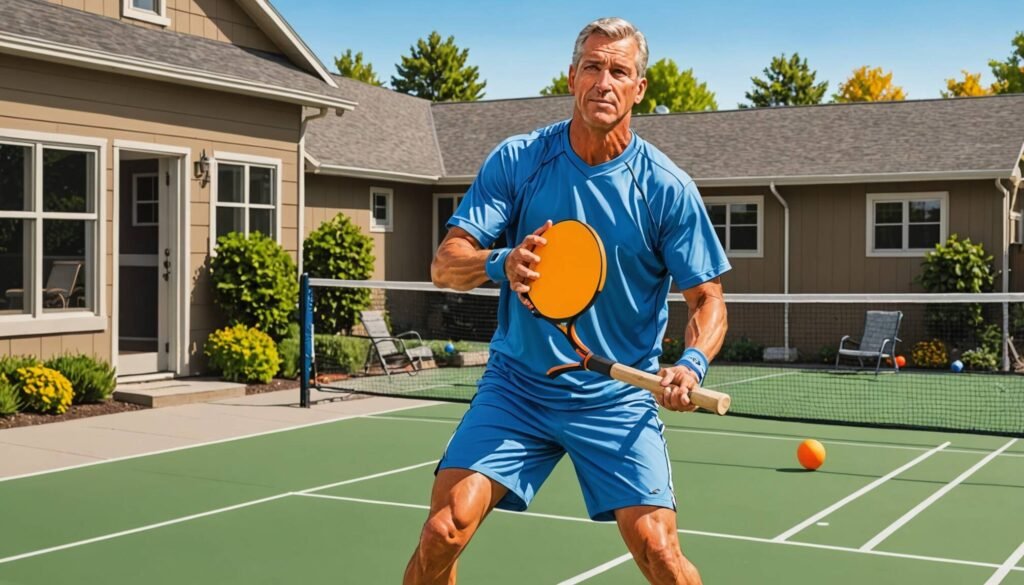
An effective ready position at the baseline looks quite different. Your knees should be bent in an athletic stance, similar to how a tennis player or volleyball player would position themselves when preparing to receive. Your weight should be on the balls of your feet, allowing you to move quickly in any direction. Most importantly, your paddle needs to be held out in front of your body, not dangling down by your side or resting against your leg.
The reason this paddle position matters so much comes down to biomechanics and efficiency of movement. When your paddle is already positioned out in front and you need to hit a forehand return, turning your shoulders naturally brings the paddle back as a single, unified motion. Your upper body rotates, and because the paddle is connected to that rotation, it moves back automatically without requiring a separate arm movement. This integration of movements is what creates speed and efficiency.
Compare that to the alternative: if your paddle starts down low, you first have to lift your arm to bring the paddle up, then turn your shoulders, then move your arm back to prepare for the shot. That’s three distinct movements instead of one integrated motion. Each of those movements takes time—not much time individually, but in a game where milliseconds matter, those small delays add up quickly. By the time you’ve completed all three movements, a fast serve might already be past you, or you’re forced to take a rushed, defensive swing that lacks control.
The same principle applies to backhand returns. With your paddle already out in front and your body in an athletic stance, you can turn your shoulders the opposite direction and the paddle comes across your body efficiently. There’s no scrambling, no last-second adjustments, just a smooth, prepared response to the incoming ball. This is what buying time looks like in practice—you’re doing less work in more time rather than more work in less time.
Preparation at the Kitchen Line
Once you’ve successfully returned serve and made your way up to the non-volley zone, commonly called the kitchen line, the game changes completely. The distances are shorter, the reaction times are faster, and the margin for error becomes razor-thin. This is where early preparation becomes even more critical, and where many players struggle most with feeling rushed and overwhelmed.
At the kitchen line, your ready position needs to adapt to the different challenges you’ll face. Your feet should be positioned wider than they were at the baseline, giving you a stable base that allows you to move laterally without losing balance. Think of a basketball player in defensive stance—that’s the kind of stable, ready-to-move-anywhere positioning you want. Your knees remain bent, keeping your center of gravity low and making it easier to react to balls at different heights.
The paddle position at the kitchen line is crucial and often misunderstood. Many players keep their paddles low, somewhere around knee or waist height, figuring they’ll lift it up if they need to. This is a significant mistake that costs points. When an opponent hits a speed-up shot—a hard, fast ball aimed at your body or shoulder—you need to get your paddle up quickly to block or counter it. If your paddle starts from a low position, you’re already behind the play. You have to recognize the speed-up is coming, process that information, then move your paddle upward rapidly. Often this results in the paddle face being too open, sending the ball flying up and giving your opponents an easy put-away.
Instead, your paddle should be held up and out in front of your body at the kitchen line, roughly at chest height or slightly higher. This might feel awkward at first if you’re used to keeping it low, but it provides enormous advantages. When a speed-up comes at you, your paddle is already in position to block it. You’re not lifting from below; you’re simply presenting the paddle face to the ball. This saves time and, just as importantly, helps you maintain better control over the paddle angle, which is critical for keeping your blocks low and controlled rather than popping them up.
For dinking exchanges, this high paddle position continues to pay dividends. Your paddle face can be preset toward your intended target before you even make contact with the ball. If you know you’re hitting a cross-court forehand dink, your paddle face should already be angled in that direction as you prepare to hit. This eliminates the need for last-second wrist adjustments or paddle manipulations that can throw off your accuracy and control.
Presetting Your Paddle Face
The concept of presetting your paddle face deserves its own discussion because it’s one of those subtle techniques that separates intermediate players from advanced ones. When you watch high-level pickleball, you’ll notice that the best players seem to have incredible touch and control. They place their dinks exactly where they want them, their volleys are crisp and accurate, and they rarely mishit balls. A big part of this consistency comes from presetting the paddle face early rather than adjusting it at the last moment.
Here’s how it works in practice: as soon as you recognize whether you’re hitting a forehand or backhand, and once you’ve decided where you want the ball to go, your paddle face should immediately orient toward that target. If you’re hitting a forehand volley down the line, the paddle face points down the line from the moment you start your swing. If you’re hitting a backhand dink cross-court, the paddle face angles cross-court right away. This early commitment to your target allows your body to support the shot properly and eliminates the need for corrective adjustments during the swing.
The most common error players make with paddle face positioning is presetting it too open, meaning the face angles upward toward the sky rather than toward the target. This typically happens because players are trying to get under the ball to generate lift, but they overdo it. An overly open paddle face sends balls sailing long or floating up high where opponents can attack them. What usually happens next is the player recognizes mid-swing that the paddle is too open and tries to close it at the last second by breaking their wrist or adjusting their arm angle. This correction rarely works well—it either results in a ball that hits the net or one that still goes too high but now with added inconsistency.
The solution is to commit to your paddle face angle early and trust it. If you’re volleying, your paddle face should be slightly closed or perpendicular to the ground, not open. If you’re dinking, the face should point toward your target zone with just enough angle to clear the net. Once you’ve set that paddle face, maintain it throughout your swing. Let the position you’ve chosen do the work rather than trying to manipulate the paddle at the last moment. This commitment is what creates consistency and, importantly, it’s what continues to buy you time—because when you’re not making last-second adjustments, you’re operating on a predetermined plan that your body can execute smoothly.
Movement and Court Positioning
Preparation isn’t just about how you hold your paddle; it’s equally about where you position your body on the court and when you start moving. One of the biggest time-buying opportunities in pickleball comes during the transition from baseline to net after the serve return. This is a moment where many players leave time on the table by waiting too long to start their movement forward.
The standard pattern in doubles pickleball is that the serving team starts with one player at the net and one at the baseline. After the return of serve, the baseline player needs to move forward to join their partner at the kitchen line. Here’s where the timing matters: you shouldn’t wait until the ball has bounced on your side and you’ve hit the third shot to start moving forward. Instead, you should begin your forward movement as soon as you can read where the return is going based on how it comes off your opponent’s paddle.
This early reading of the ball’s direction gives you a head start that pure speed can never match. Even if you’re not the fastest mover on the court, if you start moving a full second before someone who’s faster but waits longer, you’ll likely reach the net at the same time or even sooner. This is the essence of playing smart rather than relying solely on athleticism. You’re using information and anticipation to buy yourself time and position.
The same principle applies to lateral movement at the kitchen line. When you see a ball coming to the middle of the court between you and your partner, don’t wait until it’s halfway there to decide who’s taking it. The moment you can tell it’s heading to that middle zone, you or your partner should be calling for it and moving into position. Clear communication—”mine” or “yours”—prevents the hesitation that leads to mishits, collisions, or balls landing between both players while you stare at each other.
This proactive movement philosophy extends to every aspect of court positioning. If you see your opponent setting up for a hard shot to your forehand side, don’t wait until they’ve made contact to start shading that direction. If you notice they consistently hit behind you when you’re moving forward, adjust your positioning slightly deeper before they hit rather than after. Each of these small anticipatory adjustments buys you time by reducing the distance you need to cover and improving your positioning before the ball is even struck.
How This Slows Down the Game
When all these elements come together—the proper ready positions, early paddle preparation, preset paddle faces, and anticipatory movement—something remarkable happens: the game starts to feel slower. The court seems bigger, you have more time to make decisions, and shots that used to feel impossible to reach suddenly become manageable. This isn’t because your opponents are hitting slower or the ball is moving differently. It’s because you’ve fundamentally changed your relationship with time on the court.
Think about the chain reaction that occurs when you prepare early. You’re in a good ready position, so when the ball comes to you, you don’t waste time getting set. Your paddle is already in front of you, so you don’t waste time moving it into position. Your paddle face is preset toward your target, so you don’t waste time adjusting it mid-swing. You started moving toward the ball early based on reading your opponent’s paddle, so you don’t waste time covering ground. Each of these saved moments compounds with the others, and suddenly you have what feels like an abundance of time to execute your shot with control and precision.
This abundance of time leads to better decision-making, which is perhaps the most important benefit of all. When you’re rushed, you’re in survival mode—you’re just trying to get your paddle on the ball and hoping for the best. When you have time, you can actually think about shot selection. Should you dink cross-court or down the line? Is this a good opportunity to speed up, or should you be patient? Is your opponent leaning one direction, creating an opening the other way? These strategic questions can only be asked and answered when you’ve bought yourself enough time to think clearly rather than reacting desperately.
The mental aspect of feeling less rushed can’t be overstated. Pickleball is as much a mental game as it is physical, and confidence plays a huge role in performance. When you feel like you’re constantly scrambling and behind the play, doubt creeps in. You start anticipating mistakes, which often becomes a self-fulfilling prophecy. But when you feel prepared and in control, your confidence grows. You trust your technique, you believe you can handle whatever comes your way, and that belief translates into better execution and more points won.
Why This Matters for Every Player
While the original insights about early preparation came from advice aimed at senior pickleball players, the principles apply universally to anyone who plays the game. Younger players might be able to compensate for poor preparation with superior speed and reflexes, but why rely on raw athleticism when you could combine those physical gifts with smart preparation and positioning? The players who dominate at the highest levels aren’t just the most athletic—they’re the ones who have mastered these efficiency principles and eliminated wasted movement from their games.
For players who might not have the speed or reflexes they once did, these concepts are genuinely game-changing. You don’t need to outrun your opponents or have lightning-quick reactions if you’re consistently prepared before they are. You can beat faster, more athletic players by being smarter about how you use your time and energy on the court. This levels the playing field in a way that makes pickleball accessible and competitive for people of all ages and athletic abilities.
The beauty of these techniques is that they’re not dependent on natural talent or years of athletic training. Anyone can improve their ready position. Anyone can work on holding their paddle out in front rather than down low. Anyone can practice presetting their paddle face toward their target. Anyone can work on reading the ball earlier and starting their movement sooner. These are learned skills that come from awareness, practice, and repetition. They’re not gifts you’re born with—they’re habits you develop through intentional effort.
As you work on incorporating these principles into your game, be patient with yourself. Changing ingrained habits takes time, and you might feel awkward at first holding your paddle higher or committing to your paddle face earlier than you’re used to. That discomfort is temporary. With practice, these new patterns will become automatic, and when they do, you’ll notice the game genuinely feels different. Points that used to leave you feeling frantic and overwhelmed will start to feel manageable. You’ll find yourself making shots you used to miss, not because you’ve developed better technique, but because you’ve given yourself more time to execute the technique you already have.
Practical Steps to Implementation
Understanding these concepts intellectually is one thing; putting them into practice is another. The best approach is to focus on one element at a time rather than trying to change everything at once. Start with your ready position, since that’s the foundation everything else builds on. Spend several practice sessions or recreational games consciously checking your stance before every point. Are your knees bent? Is your weight forward on the balls of your feet? Is your paddle out in front of your body? Make these checks automatic through repetition.
Once your ready position feels natural, move on to paddle preparation. Focus specifically on starting your preparation earlier—as soon as you can tell where the ball is going rather than waiting until it’s close to you


