Is This the Craziest USAP-Approved Pickleball Paddle Yet?
The pickleball paddle market has never been short on innovation, but every once in a while, a design comes along that makes you stop scrolling and wonder if someone’s playing a practical joke. The latest entrant in the “what were they thinking” category is the Kobo Thunder Infinity, and it’s either the future of pickleball equipment or evidence that paddle designers have finally lost their minds. Either way, it’s officially USAP-approved, which means you could theoretically show up to a sanctioned tournament with this thing strapped to your hand.
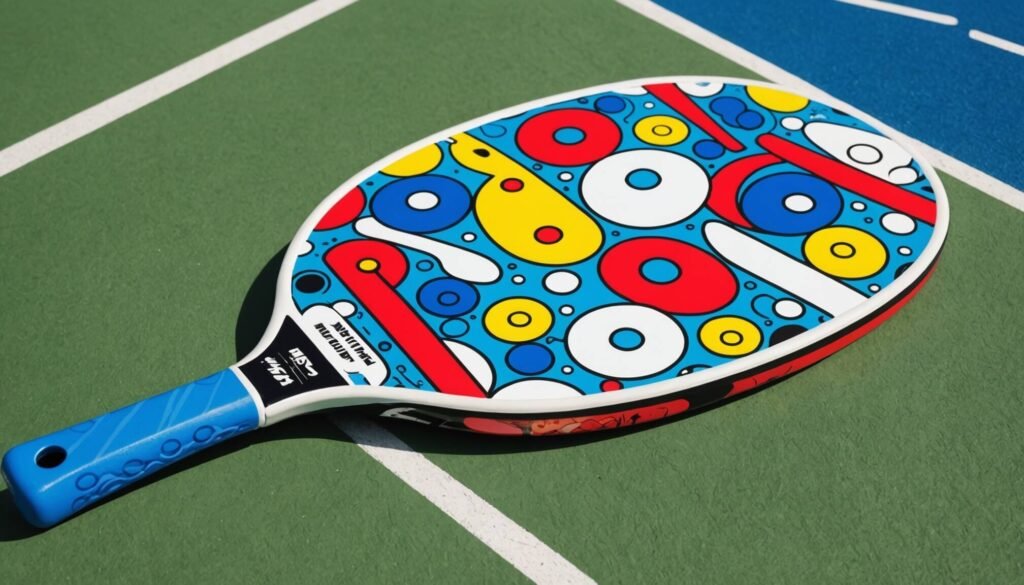
What makes this paddle so remarkable isn’t just one feature—it’s the accumulation of bold design choices that seem calculated to push every boundary simultaneously. We’re talking about a handle so elongated it looks like it belongs on a medieval weapon, an edgeless construction that defies traditional paddle geometry, throat holes massive enough to affect aerodynamics in ways we’re still trying to understand, and a head shape that honestly looks like something from a science fiction film. And if that wasn’t enough to make you pause, the color scheme hits you with an intensity that ensures this paddle will never be mistaken for anyone else’s in a crowded paddle rack.
Breaking Down the Kobo Thunder Infinity Design
Let’s start with what immediately catches your eye: that handle. Traditional pickleball paddles have evolved toward longer handles over the years as players discovered the advantages of two-handed backhands and extended reach, but the Kobo Thunder Infinity takes this trend to an extreme that feels almost confrontational. The extended handle shifts the balance point significantly and fundamentally changes how you’d need to approach paddle control and maneuverability. For players accustomed to standard handle lengths, this would require a complete recalibration of muscle memory and swing mechanics.
The edgeless design represents another departure from convention. Most modern paddles feature edge guards or foam edges that protect the paddle face and provide a defined perimeter. By eliminating this traditional boundary, Kobo has created a paddle that theoretically offers a larger sweet spot extending all the way to what would normally be the edge. Whether this translates to actual performance advantages or creates durability concerns remains to be seen, but it’s certainly a conversation starter.
Those throat holes deserve special attention because they’re not just decorative—they’re clearly engineered to serve a purpose. Large openings in the throat area can reduce air resistance during swings, potentially increasing swing speed without requiring additional effort from the player. They also reduce overall paddle weight while maintaining structural integrity in the hitting surface. The triple air-channel system mentioned in the product description suggests these aren’t random holes but carefully calculated aerodynamic features designed to optimize airflow around the paddle during play.
The head construction, described as having an “alien-like” appearance, incorporates what the manufacturer calls a unibody thermoformed structure with raw 3K carbon fiber. Thermoforming has become increasingly popular in high-end paddle construction because it allows manufacturers to create seamless structures without the weak points that can develop where different materials are joined. The 3K carbon designation refers to the weave pattern of the carbon fiber—3,000 filaments bundled together—which affects both the paddle’s stiffness and its ability to generate spin on the ball.
The Price Tag Reality Check
Now let’s address the elephant in the room: this paddle retails for four hundred dollars. Not $40, not even $140—we’re talking about $400 for a single pickleball paddle. To put that in perspective, that’s more than many players spend on their entire pickleball setup including shoes, bags, balls, and multiple paddles. It’s approaching the cost of a decent used bicycle or a monthly car payment.
This pricing positions the Kobo Thunder Infinity in rarefied air, competing not just on performance but on exclusivity and brand prestige. At this price point, you’re not just buying a tool for playing pickleball—you’re making a statement about your commitment to the sport and your willingness to invest in cutting-edge technology, whether or not that technology has been proven to deliver measurable advantages over paddles costing a quarter of the price.
The question every potential buyer needs to ask is whether the engineering innovations justify the premium. According to Kobo, the paddle represents “a new engineering direction for pickleball” developed through collaboration between an aerospace engineer, a race-team graphic designer, and a padel paddle designer. That’s an interesting pedigree, bringing together expertise from fields where aerodynamics, visual design, and racquet sports intersect. Aerospace engineering principles could certainly inform paddle design when it comes to weight distribution, material strength-to-weight ratios, and aerodynamic efficiency. A race-team graphic designer would understand how aesthetics can be integrated with functional design rather than just applied as an afterthought. And padel paddle design shares enough similarities with pickleball—both involve smaller courts, similar ball dynamics, and emphasis on control—that cross-pollination of ideas makes sense.
But does all that interdisciplinary collaboration translate to winning more points on the court? That’s the million-dollar question, or in this case, the four-hundred-dollar question. Performance claims about “explosive power,” “effortless swing speed,” and “refined control” are standard marketing language in the paddle industry. What matters is whether players can feel a tangible difference and whether that difference actually improves their game in measurable ways.
Understanding Paddle Innovation for the Casual Player
If you’re relatively new to pickleball or haven’t spent much time thinking about paddle technology, this whole discussion might seem a bit absurd. After all, isn’t a paddle just a flat surface you use to hit a ball? Why would anyone need something that looks this unusual or costs this much?
The truth is that pickleball paddle design has become surprisingly sophisticated as the sport has grown and competitive play has intensified. In the early days of pickleball, paddles were simple wooden rectangles—basically cutting boards with handles. As the sport evolved, manufacturers began experimenting with different materials, shapes, and construction techniques to optimize various aspects of performance.
Modern paddles are engineered to balance several competing priorities. Power comes from how efficiently the paddle transfers energy to the ball, which depends on core material, surface stiffness, and weight distribution. Control involves how predictably the paddle responds to different swing speeds and contact points, plus how well it allows players to place shots precisely. Spin generation has become increasingly important in competitive play, determined largely by surface texture and how the paddle face interacts with the ball. Maneuverability affects how quickly players can move the paddle into position for rapid exchanges at the net. And comfort matters too—a paddle that causes arm fatigue or vibration stress can lead to injury over time.
Every design choice represents a tradeoff between these priorities. A heavier paddle might generate more power but sacrifice maneuverability. A paddle with extreme surface texture might create more spin but offer less predictable control for finesse shots. An elongated handle provides more reach and leverage for two-handed shots but changes the balance point and might make quick reaction volleys more difficult.
What makes paddles like the Kobo Thunder Infinity interesting—or controversial, depending on your perspective—is that they reject incremental improvement in favor of radical reimagining. Rather than making a slightly longer handle or marginally larger sweet spot, they’re asking whether the fundamental assumptions about paddle design still make sense. Do we really need edge guards? Must paddles have solid throats? Should handles be a certain length just because that’s what we’re used to?
For casual recreational players who play once or twice a week for fun and exercise, these questions probably don’t matter much. A mid-range paddle from any reputable manufacturer will serve perfectly well for learning the game and enjoying social play. But for competitive players, teaching professionals, and serious enthusiasts, equipment optimization can make a real difference in performance. When you’re playing at a level where matches are decided by a few points and every advantage matters, even small improvements in paddle performance become significant.
The Wild Paddle Arms Race
The Kobo Thunder Infinity doesn’t exist in isolation—it’s part of a broader trend toward increasingly unconventional paddle designs. As USA Pickleball approval standards have become more defined and manufacturers have learned to navigate those regulations, we’ve seen an explosion of creative designs that push boundaries in various directions.
Some paddles experiment with extreme elongation, creating shapes that barely resemble traditional paddles at all. Others incorporate cutouts, channels, and perforations in locations and configurations that would have seemed bizarre just a few years ago. Materials science has advanced to the point where manufacturers can work with carbon fiber weaves, polymer cores, and surface treatments that offer performance characteristics impossible with earlier generation materials.
This design diversity reflects the sport’s rapid growth and the increasing sophistication of the player base. As more people take up pickleball and more money flows into the industry, manufacturers have greater incentive and resources to invest in research and development. The result is a virtuous cycle where innovation drives consumer interest, which generates revenue that funds further innovation.
There’s also an element of marketing spectacle involved. In a crowded marketplace with dozens of brands competing for attention, a paddle that looks unlike anything else automatically generates curiosity and conversation. Whether or not the Kobo Thunder Infinity becomes a favorite among top players, it’s already succeeded in making people talk about the brand and consider what’s possible in paddle design. In an industry where product differentiation can be challenging—after all, there are only so many ways to make a flat surface with a handle—visual distinctiveness has real value.
The Performance Claims Under Scrutiny
Kobo describes the Thunder Infinity as delivering “explosive performance with effortless swing speed and refined control.” These are bold claims that deserve examination. Explosive performance typically refers to the ability to generate power on aggressive shots—drives, smashes, and attacking volleys. This comes from paddle weight, core responsiveness, and how much energy is retained versus absorbed when the ball strikes the surface.
The unibody thermoformed construction with raw carbon fiber should theoretically provide excellent energy transfer. Carbon fiber is prized in high-performance applications precisely because it offers tremendous stiffness and strength relative to its weight. The raw designation suggests the carbon isn’t heavily coated or dampened, which should maximize responsiveness. However, this can also mean less vibration dampening, potentially creating a harsher feel on off-center hits.
Effortless swing speed claims relate to the paddle’s weight distribution and aerodynamics. The elongated handle shifts weight away from the head, reducing swing weight even if total paddle weight remains substantial. The throat holes and air-channel system should reduce air resistance, allowing faster acceleration through the swing path. For players with good technique, this could translate to generating more pace with the same effort or maintaining swing speed through longer play sessions without fatigue.
Refined control is perhaps the trickiest claim to evaluate because control is partly subjective and highly dependent on individual playing style. Some players feel more control with heavier paddles that provide stability through contact, while others prefer lighter paddles that allow precise manipulation. The carbon fiber surface should offer good spin potential, which enhances control by allowing players to shape shots with topspin, backspin, or sidespin as needed. The edgeless design expanding the effective hitting area could improve control by reducing mishits that occur when the ball catches the edge of conventional paddles.
Is This Actually Crazier Than Other Wild Designs?
The article poses an interesting challenge: is the Kobo Thunder Infinity wilder than other unconventional paddles that have gained approval? This is partly subjective—what seems crazy to one person might seem ingeniously innovative to another—but we can try to establish some criteria for evaluation.
Visual impact is one dimension. Does the paddle make people do a double-take? The Thunder Infinity certainly qualifies, with its extreme proportions and distinctive color scheme. But other designs have pushed visual boundaries in different directions, with unusual cutout patterns, asymmetric shapes, or surface treatments that challenge conventional aesthetics.
Departure from traditional design norms is another factor. The elongated handle and edgeless construction represent significant breaks from established paddle conventions. The throat holes, while unusual in pickleball, draw inspiration from other racquet sports where similar features have been used for decades. So this is evolutionary rather than entirely revolutionary.
Functional innovation matters too. Does the paddle incorporate genuinely new approaches to solving performance challenges, or is it mostly aesthetic differentiation? The engineering collaboration and attention to aerodynamics suggest real thought went into functional design, not just creating something that looks different for its own sake.
The price point adds another layer to the craziness evaluation. At $400, this paddle costs roughly four times what a solid mid-range paddle costs and double what most premium paddles command. That pricing strategy is audacious in its own right, regardless of the physical design features.
Ultimately, whether the Kobo Thunder Infinity claims the title of craziest approved paddle depends on what aspects of craziness you weight most heavily. It’s certainly a contender, joining a growing roster of paddles that challenge our assumptions about what pickleball equipment should look like and how it should function.
The Broader Implications for Paddle Development
The emergence of paddles like the Kobo Thunder Infinity raises interesting questions about where paddle design is headed and whether there should be additional regulations governing equipment in organized play. USA Pickleball has established standards for paddle dimensions, surface texture, and performance characteristics, but those standards still allow considerable room for innovation and experimentation.
Some players and observers worry that the sport is entering an equipment arms race where success becomes too dependent on having the latest, most expensive gear rather than skill development and strategic play. They point to other sports where equipment innovation has sometimes overshadowed athletic performance, creating barriers to entry for players who can’t afford cutting-edge gear.
Others argue that innovation should be encouraged because it drives the sport forward, creates excitement, and gives players options to find equipment that matches their individual preferences and playing styles. From this perspective, a diverse ecosystem of paddle designs is healthy for the sport, allowing for personal expression and continued technical evolution.
There’s also the question of whether radical designs actually deliver performance advantages or whether they’re primarily marketing exercises. This can only be answered through careful testing and real-world play by a range of players at different skill levels. Paddles that seem promising in concept sometimes disappoint in practice, while others exceed expectations.
Who Should Consider This Paddle?
Given the unconventional design and premium price, the Kobo Thunder Infinity clearly isn’t for everyone. So who might actually benefit from considering this paddle?
Advanced competitive players who have refined their technique to the point where equipment optimization makes a measurable difference are the obvious target market. These players have the skill to actually utilize whatever advantages the paddle offers and the experience to evaluate whether those advantages justify the investment.
Players specifically looking for an elongated handle with extended reach might find the extreme dimensions appealing, especially if they’ve already experimented with longer-handled paddles and want to push that characteristic further. The same applies to players prioritizing swing speed and maneuverability over raw power and stability.
Equipment enthusiasts who enjoy trying the latest innovations regardless of whether they provide competitive advantages represent another potential market. These players find inherent value in experiencing new technologies and being early adopters of emerging trends. For them, the paddle’s distinctiveness and engineering pedigree hold appeal beyond purely performance considerations.
Players with specific physical considerations might also benefit. Someone with longer arms might find the extended handle more comfortable and natural than standard proportions. Players managing arm or shoulder issues might appreciate the aerodynamic efficiency if it genuinely reduces effort required for given swing speeds.
Who should probably look elsewhere? Beginners and recreational players who haven’t yet developed consistent mechanics and don’t play frequently enough to appreciate subtle equipment differences. Players on tight budgets who need to prioritize value and proven performance over experimental designs. Anyone looking for a traditional feel and appearance who would find the unconventional characteristics distracting rather than advantageous.
The Final Verdict
Is the Kobo Thunder Infinity the craziest USAP-approved paddle yet? It’s certainly in the running. The combination of extreme design choices, audacious pricing, and unconventional engineering approach makes it stand out even in an increasingly crowded field of unusual paddles. Whether “crazy” means brilliant innovation or misguided excess depends largely on your perspective and priorities.
What’s undeniable is that paddles like this push the conversation forward about what


