New York City Launches First-Ever MLP-Backed Youth Pickleball Program
New York City is making history in the pickleball world with a groundbreaking initiative that could reshape how young people across America’s largest city engage with the fastest-growing sport in the nation. In a partnership that brings together professional pickleball, corporate backing, and public education, Conquer Kids has been designated as the Official Youth Pickleball Program of the Brooklyn Pickleball Team, marking the first time a Major League Pickleball franchise has formally supported a youth development program in New York City.
This ambitious initiative, powered by equipment manufacturer JOOLA, carries a bold mission statement: to place a paddle in the hands of every single student enrolled in the New York City public school system. With more than one million students spread across all five boroughs, this represents not just a local program but potentially the largest youth pickleball initiative ever undertaken in an American city. The program’s success could serve as a blueprint for similar efforts in cities across the United States, fundamentally changing how the next generation discovers and learns pickleball.
Understanding the Partnership and Its Significance
For those unfamiliar with the organizational structure behind this announcement, it helps to understand the key players involved and why their collaboration matters. Major League Pickleball represents the premier professional team competition in the sport, featuring top-ranked players competing for franchises backed by celebrity investors and serious capital. The Brooklyn Pickleball Team is one of these franchises, owned by a star-studded group that includes actress Eva Longoria, baseball pitcher Justin Verlander, model Kate Upton, and NFL player Odell Beckham Jr. The team has already proven its competitive credentials by winning an MLP championship in 2023.
Conquer operates as a New York City-based pickleball community and events platform, with Conquer Kids serving as its youth-focused arm. The organization has been building grassroots pickleball programs across Manhattan, Brooklyn, Queens, and the Bronx, working directly with schools and community centers to introduce young people to the sport. Now, with formal backing from a professional team and equipment support from JOOLA, the program gains institutional legitimacy and resources that could accelerate its growth exponentially.
What makes this partnership particularly noteworthy is that it represents a formalization of the relationship between professional pickleball and youth development. While many sports have long-established pathways from youth leagues to professional play, pickleball’s explosive recent growth has largely occurred among adult recreational players. This initiative signals a strategic shift toward building the sport from the ground up, creating a generation of players who grow up with pickleball as a foundational athletic experience rather than discovering it later in life.
The Initial Rollout and School Partnerships
The program is launching with an initial cohort of schools strategically distributed across multiple New York City boroughs. This geographic diversity ensures that the initiative reaches students from varied socioeconomic backgrounds and neighborhood contexts, reflecting the city’s remarkable demographic diversity. The initial partner schools include PS 307 in DUMBO, a Brooklyn neighborhood known for its waterfront location and creative community; East Side Community School in the East Village, serving Manhattan’s Lower East Side; PS 239 in Ridgewood, Queens, a working-class neighborhood with strong community ties; Allen-Stevenson School on the Upper East Side, representing one of Manhattan’s more affluent areas; and PS 9, PS 28X, and PS 12X in the Bronx, extending the program’s reach into the northernmost borough.
This selection of schools demonstrates a commitment to equity and accessibility rather than simply targeting areas with existing pickleball infrastructure or affluent communities most likely to already have exposure to the sport. By including schools across different neighborhoods and socioeconomic strata, the program embodies the stated principle that “growth only matters if it’s accessible,” as articulated by Louis Long, Co-Founder of Conquer Kids.
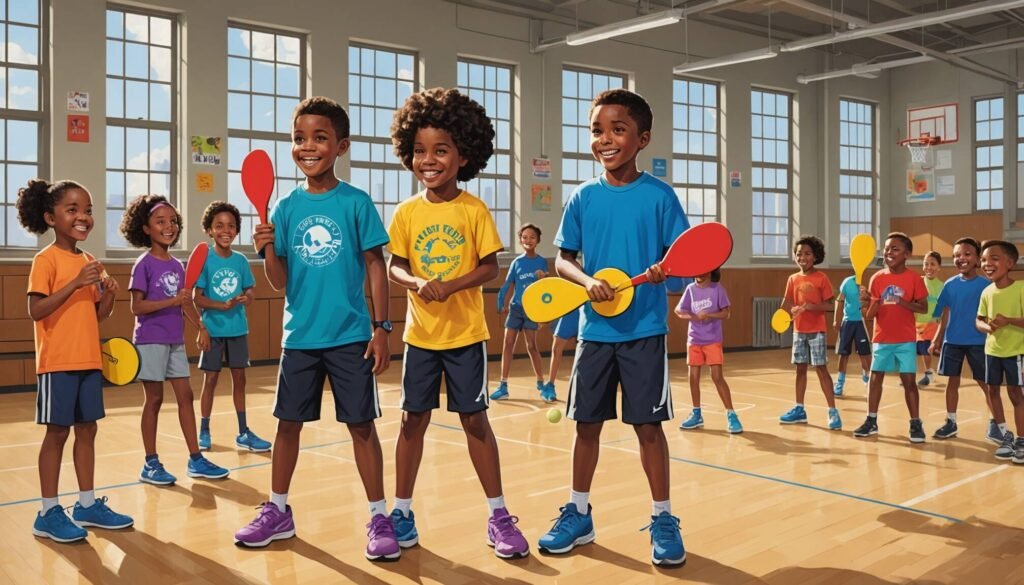
The programming itself takes multiple forms to meet students where they are and integrate pickleball into various aspects of school life. In-school instruction brings pickleball directly into physical education curricula during regular school hours, ensuring that every student at participating schools has exposure to the sport regardless of their ability to participate in after-school activities. After-school enrichment programs provide opportunities for students who develop particular interest or aptitude to deepen their engagement with pickleball in a more focused setting. Community-based programming extends beyond school walls to create opportunities for families and neighborhoods to engage with pickleball together, building social connections around the sport.
The program currently serves students from second grade through high school, an age range that allows for introducing fundamental skills to younger children while providing competitive opportunities for older students who may wish to pursue pickleball more seriously. Plans to expand into Staten Island later this year would complete the program’s presence across all five boroughs, achieving true citywide reach.
The Vision Behind the Initiative
Louis Long’s description of this as “a first-of-its-kind partnership” reflects the novel structure of the collaboration. While corporate sponsorships of youth sports programs are common, and professional athletes frequently engage in community outreach, the formal designation of a youth development organization as the official program of a professional team creates institutional accountability and ongoing commitment that transcends one-off clinics or seasonal initiatives.
The partnership structure means that Conquer Kids and the Brooklyn Pickleball Team will collaborate on multiple fronts: youth clinics led by professional players or coaches, school activations that bring the excitement of professional pickleball directly to students, community events that create opportunities for families to engage with the sport together, and player engagement initiatives that connect young players with professional athletes who can serve as role models and mentors.
Adam Behnke of the Brooklyn Pickleball Team articulated the strategic importance of youth development: “Youth development is the foundation of any sport that wants to grow the right way. By investing in kids early — especially in a city as diverse and dynamic as New York — we’re not only growing pickleball, we’re building community, opportunity, and a future generation of players who see themselves in the game.”
This final phrase—”who see themselves in the game”—speaks to the representation challenge that many sports face. By introducing pickleball to New York City public school students, the program ensures that children from immigrant families, students of color, kids from working-class backgrounds, and youth from every neighborhood see pickleball as their sport, not just an activity for a particular demographic group. This inclusive foundation could fundamentally shape the sport’s culture and participant demographics for decades to come.
The Role of JOOLA and Equipment Access
Equipment access represents one of the most significant barriers to youth sports participation, particularly in urban settings where storage space is limited and families may face financial constraints. JOOLA’s role as the powering force behind this initiative suggests that the company is providing paddles, balls, and potentially nets and other equipment necessary to launch and sustain programming across multiple schools simultaneously.
For a program aiming to put a paddle in the hands of every NYC public school student—a population exceeding one million—the equipment requirements are staggering. Even assuming shared equipment and rolling implementation, the initiative would require thousands of paddles in circulation at any given time, along with sufficient balls and portable nets to accommodate physical education classes, after-school programs, and community events.
JOOLA’s investment in this program represents a strategic bet on brand loyalty and market development. Students who learn pickleball on JOOLA equipment may develop preferences for that brand as they continue playing into adulthood. More broadly, the company’s association with youth development and accessibility could enhance its brand reputation in a market where numerous paddle manufacturers compete for consumer attention.
Implications for Pickleball’s Future
The article notes that if the pilot program proves successful, the model could expand to other U.S. cities. This possibility carries significant implications for how pickleball develops as a sport over the next decade. Unlike sports that have grown primarily through private clubs, recreation centers, or suburban community facilities, a public school-based model would introduce pickleball to millions of young people who might never otherwise encounter the sport.
The program’s characterization as a “notable step in the continued institutionalization of youth pickleball” speaks to the sport’s maturation process. Early-stage sports growth often occurs organically through enthusiast communities and informal networks. As sports mature, they develop formal structures: governing bodies, standardized rules, professional competitions, and youth development pathways. This initiative represents pickleball’s evolution toward that more institutionalized model, with professional teams investing in systematic youth development rather than relying solely on grassroots enthusiasm.
New York City’s role as an “early test case for professional team-backed development at the public school level” positions the program as an experiment that other cities, teams, and organizations will watch closely. Success metrics might include student participation rates, retention of students in pickleball programs over multiple years, diversity of participants compared to adult recreational pickleball demographics, development of competitive youth players, and community engagement beyond the student participants themselves.
Challenges and Considerations
While the initiative’s ambition is admirable, implementing a citywide youth pickleball program through the New York City public school system presents substantial logistical challenges. The city’s schools face competing demands for limited physical education time, facility space, and resources. Convincing administrators, teachers, and parents that pickleball deserves a place alongside basketball, soccer, and other established sports will require demonstrating clear benefits.
Facility constraints pose another challenge. Many New York City schools lack dedicated gymnasiums or outdoor courts, instead relying on shared spaces that serve multiple purposes. Pickleball’s relatively small court size and minimal equipment requirements offer advantages in space-constrained environments, but implementing programming still requires coordination, scheduling, and adaptation to each school’s unique circumstances.
Teacher and coach training represents another critical implementation factor. Physical education teachers may have limited familiarity with pickleball, requiring professional development to effectively teach skills and foster student enthusiasm. The program’s success will partly depend on how well it supports educators in adding pickleball to their instructional repertoire.
What This Means for Youth Sports Culture
For readers less familiar with youth sports development, this initiative represents more than just teaching kids a new game. Youth sports programs serve multiple functions in child development: physical fitness and motor skill development, social interaction and teamwork, goal-setting and achievement, exposure to competition and handling both success and failure, and connection to broader communities beyond family and immediate peer groups.
Pickleball offers some distinctive advantages in the youth sports landscape. The sport’s relatively gentle learning curve means that students can achieve basic competency quickly, building confidence and encouraging continued participation. The smaller court size and slower ball speed compared to tennis make pickleball less physically intimidating for younger children or those with limited athletic experience. The emphasis on doubles play inherently builds teamwork and communication skills. The sport’s intergenerational appeal means that students can play with parents, grandparents, and community members, creating family engagement opportunities that many youth sports lack.
By introducing pickleball through public schools rather than private clubs or fee-based programs, the initiative removes financial barriers that exclude many families from youth sports participation. This accessibility aligns with broader efforts to ensure that organized sports opportunities aren’t reserved primarily for families who can afford registration fees, equipment, and travel to competitions.
The Broader Context of Pickleball’s Growth
This youth initiative emerges against the backdrop of pickleball’s remarkable growth trajectory over recent years. The sport has evolved from a niche activity known primarily to retirees and physical education teachers to a cultural phenomenon attracting serious investment, professional players, media coverage, and millions of participants nationwide. Celebrity investors, professional tours with substantial prize purses, equipment manufacturers competing for market share, and facility development across the country all signal pickleball’s arrival as a major recreational sport.
However, much of this growth has occurred among adults, particularly those in middle age and beyond who appreciate pickleball’s social aspects and lower physical demands compared to sports like tennis or basketball. Creating a robust youth development pathway addresses a potential long-term challenge: sustaining growth and cultural relevance as the current wave of adult converts ages.
Sports that capture the imagination of children and teenagers embed themselves more deeply in cultural consciousness. Kids who grow up playing pickleball will carry the sport into colleges, workplaces, and communities throughout their lives. They’ll introduce it to their own children, creating intergenerational transmission that makes the sport self-sustaining rather than dependent on continued marketing to adult converts.
Looking Forward
The program’s phased expansion approach—beginning with select schools and planning broader rollout based on initial results—reflects a thoughtful implementation strategy. Rather than attempting to reach all one million NYC public school students simultaneously, the initiative can learn from early experiences, refine its approach, and build momentum as success stories emerge from initial partner schools.
Documentation of the program’s impact will be crucial for supporting expansion to additional schools within New York City and replication in other cities. Metrics might include quantitative measures like participation numbers, attendance rates, and student skill progression, as well as qualitative feedback from students, teachers, parents, and school administrators about the program’s value and impact.
The partnership between Conquer Kids and the Brooklyn Pickleball Team creates accountability structures that purely philanthropic initiatives sometimes lack. The professional team has reputational stakes in the program’s success and can leverage its platform to generate media attention, attract additional partners, and maintain public engagement with the initiative’s progress.
For the broader pickleball community, this initiative represents an investment in the sport’s future that extends beyond immediate participation numbers or equipment sales. By building youth development infrastructure and creating pathways from elementary school introduction through high school competition and potentially to college and professional play, the program addresses pickleball’s organizational development in ways that serve long-term sustainability.
Whether this model proves replicable in other cities will depend partly on factors specific to New York—the concentration of population, the presence of a professional team to anchor partnerships, and the availability of corporate sponsors willing to invest in large-scale youth programming. However, the fundamental principle of introducing pickleball through public schools rather than relying solely on private clubs and recreation centers could be adapted to communities of various sizes and resource levels.
As youth pickleball develops in New York City and potentially other locations, the sport faces an important cultural moment. Will youth pickleball reproduce patterns of inequality and limited access that characterize many youth sports, or will it realize the promise of genuine accessibility and inclusivity? Will professional pickleball develop robust pathways for young players to progress toward competitive excellence, or will youth programming remain primarily recreational? How will the sport’s culture evolve as a generation grows up with pickleball as a formative athletic experience?
The answers to these questions will emerge over years, not months. But the launch of this initiative in New York City represents a meaningful commitment to building pickleball’s foundation among young people, investing in access and opportunity, and connecting professional competition with grassroots participation. For a sport that has grown explosively but sometimes chaotically over recent years, this kind of systematic youth development infrastructure signals maturation and long-term strategic thinking.
The success of this program could influence not just how many kids in New York City pick up a paddle, but how the sport of pickleball develops culturally, demographically, and organizationally over the coming decades. That makes this announcement significant far beyond New York’s five boroughs, offering a potential model for youth sports development that prioritizes access, community building, and sustainable growth over short-term participation numbers or commercial interests.


