How to Stop Being a Pickleball Banger and Master Soft Game Skills
There’s a certain type of player you’ll find on nearly every pickleball court. They hit everything hard. Every return, every third shot, every reset attempt comes back with maximum force. These players are known as “bangers” in the pickleball community, and while their aggressive style might feel powerful in the moment, it’s actually limiting their potential and keeping them from advancing to higher levels of play.
The truth about being a banger is that it’s not really a strategic choice. Most players who drive the ball constantly do so because they haven’t developed the soft game skills necessary to control the pace and placement of their shots. They’re caught in a cycle where their lack of touch forces them to rely on power, which in turn prevents them from developing that touch. Breaking out of this pattern requires understanding why it happens and committing to the deliberate practice needed to build new muscle memory and court awareness.
Understanding the Banger Mentality
When you watch a typical banger play, you might think they’ve chosen an aggressive strategy. They’re constantly driving balls, looking for winners, and seeming to play with confidence and decisiveness. But look closer and you’ll see something different. Most bangers aren’t choosing to hit hard on every shot because they’ve analyzed the situation and determined it’s the best play. They’re hitting hard because they don’t know what else to do.
The underlying issue is a lack of skill development in the soft game. Resetting a hard-driven ball requires specific technique, calm hands, and the ability to absorb pace rather than add to it. Executing a proper third shot drop demands touch, trajectory control, and an understanding of how to lift the ball over the net while keeping it short. These skills don’t come naturally, especially to players who come from sports like tennis where aggressive baseline play is rewarded.
What makes the banger pattern so persistent is that it creates its own feedback loop. When you don’t trust your ability to reset or drop, you feel compelled to keep the ball deep and hard to protect yourself. This speeds up the game, which makes it even harder to execute soft shots, which reinforces your reliance on power. Breaking this cycle requires addressing not just technique but also the underlying tension and fear that drives the behavior.
The Tension Problem
At the heart of the banger problem is tension. When you’re standing at the kitchen line or in the midcourt and you see your opponent winding up to smash a ball at you, your body’s natural response is to tense up. Your shoulders rise, your grip tightens, your muscles contract in preparation to either protect yourself or mount a powerful defense. This physiological response is hardwired into us as humans, but it’s exactly what prevents you from executing the soft, controlled shots that pickleball requires.
Tension in your body translates directly to tension in your paddle. When your muscles are tight, your movements become rigid and jerky rather than smooth and controlled. You lose the ability to absorb pace from incoming balls. Your paddle face position becomes inconsistent. Your timing gets disrupted because you’re reacting from a place of fear rather than responding from a place of readiness.
This is why simply knowing the mechanics of a reset or drop isn’t enough. You can understand intellectually that you need to keep your paddle up, use soft hands, and guide the ball gently into the kitchen. But when that ball is screaming toward you at high speed, all that knowledge goes out the window if your nervous system is in fight-or-flight mode. The first step in developing soft game skills is learning to stay calm under pressure.
Training Your Nervous System
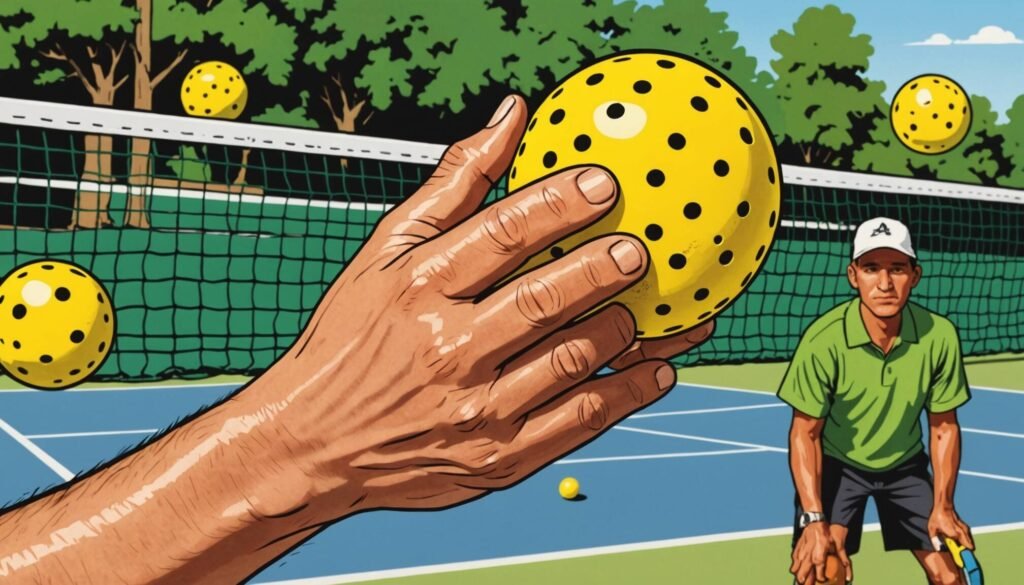
One of the most effective ways to overcome the tension response is through deliberate exposure in a controlled environment. This might sound counterintuitive, but the solution to flinching when balls come at you is to practice having balls come at you while consciously choosing not to flinch. This kind of drill rewires your nervous system’s response pattern.
The concept is simple but not easy. You stand in position while someone throws or hits balls at you at various speeds and trajectories, including straight at your body and face. Your only job is to stay relaxed and not flinch, even as your instincts scream at you to protect yourself. You’re not trying to hit the balls back at first. You’re just training your body to recognize that these balls aren’t actually dangerous and that staying calm is both possible and beneficial.
This type of training works because it separates the emotional response from the physical situation. Your brain begins to learn that a ball coming at you quickly doesn’t require a tension response. Over time and with repetition, you can stand in the face of a hard-driven ball and maintain the relaxed, ready position that allows for proper shot execution. Once you’ve removed tension from the equation, the technical aspects of resetting and dropping become much more accessible.
Mastering the Reset Shot
The reset is one of the most important shots in modern pickleball, yet it’s one that many recreational players never properly develop. A reset is what you use when your opponent has hit an aggressive shot that’s put you on defense, and you need to neutralize their advantage by taking pace off the ball and dropping it into the kitchen. It’s the shot that allows you to survive attacks and get back into neutral rallies where you can compete for the advantage.
The mechanics of a reset are deceptively simple. When a ball comes at you with pace, you want to present your paddle face to the ball and absorb the speed rather than adding to it. Your paddle should be up in front of your body in a ready position. As the ball makes contact, you’re essentially catching it on your paddle and redirecting it softly over the net and into the kitchen.
The specific technique varies slightly depending on where the ball is coming. When a drive comes straight at your body, the most reliable reset is a two-handed shot where both hands on the paddle provide stability and control. When the ball comes to your forehand side, you should take it with your forehand rather than reaching across with your backhand. When it comes to your backhand side, use your backhand. This might seem obvious, but many players instinctively try to take every ball with their stronger side, which puts them out of position and reduces their control.
You also need to develop the ability to reset both off the bounce and out of the air, depending on the situation. Taking balls out of the air allows you to control them at a higher contact point before they drop below the net, which gives you more options. However, letting certain balls bounce can give you more time to read the spin and trajectory. Knowing which option to choose comes with experience and court awareness.
The key to developing reliable resets is repetition. You need to hit hundreds, if not thousands, of reset shots before the pattern becomes automatic. Your brain needs to build the neural pathways that allow your hands to move into position without conscious thought. There’s no shortcut here. You can’t think your way through a reset in real time during a fast rally. The movement has to be trained into your muscle memory through dedicated practice.
The Third Shot Drop
If the reset is about neutralizing your opponent’s offensive shots, the third shot drop is about creating offensive opportunities for yourself. After the serve and return, the serving team is typically back at the baseline while their opponents are already at the kitchen line. The third shot drop is what allows the serving team to advance to the net by hitting a soft, arcing shot that lands in the kitchen and forces the opponents to hit up rather than drive down.
Most players struggle with the third shot drop because they approach it with the wrong mindset. They think of it as a shot that needs spin or pace or some kind of offensive quality. They try to brush the ball forward with topspin like they would on a groundstroke. This approach leads to inconsistent drops that either don’t clear the net or land too deep and give opponents an attackable ball.
The real goal of a drop shot is simple: clear the net and land the ball softly in the kitchen. That’s it. You’re not trying to hit a winner or force an error. You’re trying to create a neutral ball that allows you to move forward and establish position at the net. To achieve this, you need to get under the ball and lift it up and over the net rather than driving it forward.
Think of the motion as similar to a dink. You’re not swinging aggressively or trying to generate power. Instead, you’re using a compact motion where you get your paddle under the ball and guide it upward with control. The ball should have an arcing trajectory that takes it safely over the net and drops it gently into the opponent’s kitchen.
The Geometry of the Drop Shot
Once you understand the basic concept of getting under the ball, the next element is controlling the trajectory so the ball doesn’t just go up but also moves forward into the kitchen. This is where paddle angle becomes crucial. A 45-degree paddle angle is the key to successful drops for most players and situations.
When you hold your paddle at approximately 45 degrees while getting under the ball, the ball naturally takes on a trajectory that combines upward lift with forward momentum. The ball clears the net with room to spare but still drops down into the kitchen rather than sailing deep. You’re not creating this trajectory through power or spin. You’re creating it through geometry and paddle positioning.
This is a fundamental shift in thinking for players who come from tennis or who have developed their pickleball game around power. The drop shot isn’t about how hard you can swing or how much spin you can generate. It’s about understanding angles and trajectories and having the touch to execute them consistently. A player with good hands and proper technique can hit better drops with a compact motion than a powerful player using a big swing.
The challenge is that this touch and feel only develop through practice. You need to hit drop after drop, adjusting your paddle angle, your contact point, and your swing path until you develop an intuitive sense of what works. You need to practice from different positions on the court and with different incoming ball speeds and spins. Over time, your hands learn to make the subtle adjustments necessary to execute drops reliably in game situations.
Decision Making: Drive vs. Drop
Once you’ve developed both the ability to drive the ball with pace and the ability to drop it with touch, the next level of development is knowing when to use each shot. This is where pickleball becomes a chess match rather than a physical contest. The best players aren’t necessarily those with the most power or the softest hands. They’re the players who consistently make the right decision about which shot to hit in any given situation.
The decision between driving and dropping depends on several factors: your position on the court, your opponent’s position, the quality of the ball you’re receiving, and the overall flow of the rally. Generally speaking, you want to drive when you’re in an offensive position with a ball you can contact above the net, and you want to drop when you’re in a defensive or neutral position where driving would give your opponent an advantage.
However, these aren’t hard and fast rules. Sometimes dropping from an offensive position is the right play because it disguises your intent and catches opponents off guard. Sometimes driving from a defensive position is correct because it changes the rhythm and disrupts your opponent’s timing. Developing this decision-making ability requires court awareness, pattern recognition, and the confidence that comes from having both shots in your arsenal.
This is why former bangers who develop soft game skills often see rapid improvement in their overall game. It’s not just that they’ve added new shots. It’s that they’ve added options and with options comes the ability to make strategic choices. When you can only hit the ball hard, you’re predictable and your opponents can position themselves accordingly. When you can hit hard or soft depending on the situation, you become much harder to defend against.
The Practice Progression
Developing soft game skills requires structured practice. You can’t just play games and hope these skills emerge. You need to create situations where you’re forced to execute resets and drops repeatedly until the movements become automatic. One effective progression is to alternate between drives and drops during drilling.
Have a practice partner feed you balls from across the net. On the first ball, drive it back with pace. On the second ball, drop it softly into the kitchen. Keep alternating between the two shots. This trains not just the mechanics of each shot but also the mental switching between different types of execution. You’re teaching your brain to quickly shift gears between power and touch, which is exactly what you need to do in real games.
As you get more comfortable with this alternating pattern, add decision-making elements. Have your partner vary the type of ball they feed you, and you decide in the moment whether to drive or drop based on the ball’s height, pace, and position. This moves you from pure mechanical practice toward game-like situations where you’re reading and reacting.
Another valuable drill is to play points where you’re not allowed to drive. Every ball must be a drop or a dink. This forces you to rely entirely on your soft game and removes the crutch of being able to bail out with a hard hit when you’re not sure what to do. It’s uncomfortable at first, especially for bangers, but it accelerates the development of touch and control.
For Those New to These Concepts
If you’re relatively new to pickleball or you’re trying to understand why this shift from power to control matters so much, it helps to understand the unique characteristics of the sport. Unlike tennis, where you’re hitting from a distance and have more time to react, pickleball is played on a smaller court with players often standing just feet apart at the kitchen line. At these close distances, raw power actually becomes a liability rather than an asset.
When both teams are at the net, the rallies become a test of control, placement, and patience rather than power. The team that can keep the ball low and force their opponents to hit up is the team that eventually gets an attackable ball and wins the point. This dynamic rewards soft hands and precise placement over hard hitting.
The “banger” style works at beginner levels because opponents haven’t yet developed the ability to handle pace. They pop balls up when you drive at them, giving you easy put-aways. But as you advance and face opponents with better resets, that strategy stops working. Suddenly your drives are being neutralized and you’re the one scrambling to handle soft balls that you’re not comfortable with.
This is the wall that many players hit in their development. They’ve gotten to a certain level through power and athleticism, but they can’t advance further without developing finesse. The transition from banger to complete player requires humility and patience. You have to be willing to work on skills that feel awkward at first and that might actually make you play worse before you play better. But on the other side of that uncomfortable development period is a game with much more depth, strategy, and ultimately satisfaction.
Why Soft Game Wins
At the highest levels of pickleball, you’ll notice that the pace of play is often slower than at intermediate levels. This seems counterintuitive. Shouldn’t better players hit the ball harder? But what’s actually happening is that elite players understand that control beats power. They’re comfortable in long, patient rallies where they’re probing for weaknesses and waiting for the right ball to attack.
These players have such good soft game skills that they can neutralize almost any aggressive shot. They can reset drives, they can re-drop drops, and they can dink consistently from anywhere in the kitchen. This defensive prowess means that trying to blast winners past them is usually futile. Instead, points are won through pattern construction, where you’re moving opponents around, creating angles, and setting up shots that can’t be defended.
This style of play is more mentally demanding but also more rewarding. Instead of relying on whether your power shot happened to get past an opponent, you’re relying on your ability to outthink and outmaneuver them. You’re building points with intention, and when you win them, it’s because you executed a plan rather than because you got lucky with a hard hit.
The transition from banger to strategic player also makes the game more sustainable over time. Power hitting is physically demanding and can lead to injuries, especially as players age. Soft game skills, on the other hand, rely more on timing, positioning, and technique than on physical force. Players can maintain and even improve these skills well into their later years, which is part of why pickleball is such a great sport for all ages.
The Mental Shift Required
Beyond the physical skills, stopping being a banger requires a mental shift. You have to let go of the immediate gratification that comes from hitting the ball hard and trust that patient, controlled play will lead to better results. This is difficult for competitive people who want to impose their will on the point and feel like they’re being aggressive.
The reality is that good soft game play is aggressive, just in a different way. You’re not being passive when you reset a drive or execute a perfect drop. You’re actively controlling the point and putting yourself


