Stop Popping the Ball Up: Modern Pickleball Hand Speed and Paddle Positioning
The modern pickleball game demands a different kind of player than it did just a few years ago. If you’re still approaching the kitchen with the same techniques and strategies you used in 2023, you’re going to find yourself consistently outpaced and outmaneuvered by opponents who’ve adapted to the evolution of the sport. This isn’t about working harder or hitting with more power. It’s about understanding the fundamental mechanics that separate players who control rallies from those who constantly find themselves defending pop-ups and giving their opponents easy put-aways.
The transformation of pickleball from a recreational pastime to a fast-paced competitive sport has been nothing short of remarkable. What was once a game defined by patience and consistency has become a battle of quick reflexes, precise positioning, and technical mastery. The players dominating courts today aren’t necessarily stronger or more athletic than their predecessors. They’re simply playing a more refined, mechanically sound version of the game. And at the heart of this evolution lies a critical skill set that most recreational players haven’t fully developed: modern hand speed combined with intelligent paddle positioning.
A recent breakdown from Building Pickleball cuts through the noise and identifies exactly why so many players struggle with popping the ball up during quick exchanges at the net. More importantly, it offers concrete solutions that anyone can implement immediately. The video, though just over two minutes long, packs in more actionable advice than most hour-long clinics. It addresses the speed problem that nobody wants to talk about, introduces the concept of the coil as a secret weapon in kitchen exchanges, and breaks down the geometry of paddle angles in a way that makes immediate sense.
The Speed Problem That’s Holding You Back
Quick hands in pickleball aren’t simply about having fast reflexes. If that were the case, younger players would dominate the sport entirely, and we know that’s not true. Instead, quick hands are the result of proper body mechanics, intelligent positioning, and training that specifically targets the demands of modern gameplay. The problem is that most recreational players are still training for a game that no longer exists at competitive levels.
When you watch players struggle during fast exchanges at the kitchen line, there’s usually a common denominator: isolated movements. Their paddle arm does all the work while the rest of their body remains static. The left arm stays locked against their side, their upper body doesn’t rotate, and their paddle becomes the only moving part in what should be a coordinated full-body response. This approach looks rigid because it is rigid. And rigidity is the enemy of speed.
The consequences of this mechanical inefficiency are immediate and obvious. Without proper body mechanics supporting your paddle movements, you’re constantly playing catch-up. The ball arrives faster than you can comfortably respond, forcing you to make last-second adjustments that inevitably lead to poor contact. That poor contact manifests as pop-ups, balls that sail long, or weak returns that give your opponents easy opportunities to attack. You know you need quicker hands, but simply trying to move your arm faster doesn’t solve the underlying problem.
What separates players with genuinely quick hands from those who are just swinging fast is the integration of movement. When your entire upper body works together, when your non-paddle hand flows naturally with your movements, when your core engages to support your paddle positioning, suddenly you have time. Not because the ball is moving any slower, but because your body is mechanically capable of responding efficiently to high-speed exchanges. This is what training for the modern game actually looks like.
Understanding the Coil: Creating Space in Tight Exchanges
The concept of the coil represents one of those technical adjustments that immediately transforms how you handle quick-hands situations. It’s not complicated, it’s not exotic, and you don’t need professional coaching to implement it. But its impact on your game is substantial and immediate.
Think of your upper body as a coiled spring during kitchen exchanges. There’s a slight rotation, a loading of energy that happens naturally when you allow your torso to turn slightly as you prepare for each shot. This isn’t a big wind-up or an exaggerated movement. It’s a subtle coil that creates just a few extra inches of space for your paddle to work with. In the geometry of pickleball, where balls are traveling fast and your reaction time is measured in fractions of a second, those few inches make all the difference.
When your body is locked in a static position, your paddle has a fixed range of motion. You can only take it back so far before you run out of space or compromise your ready position. But when you incorporate a slight coil, you effectively expand your range of motion without actually changing your court position. Your paddle can move through a larger arc, which gives you more time to prepare for contact and more control over the direction and pace of your return.
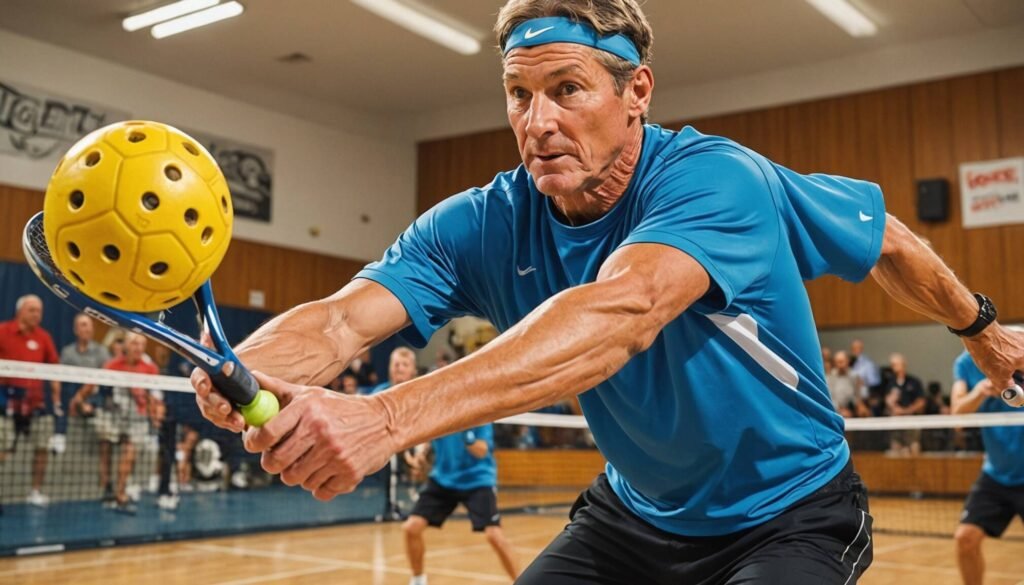
The Building Pickleball demonstration makes this concept crystal clear. By showing the difference between a static position and a coiled position, you can immediately see how much more paddle movement becomes available. In quick-hands situations, that additional movement isn’t a luxury. It’s a necessity. It’s what allows you to take balls that would normally force a defensive pop-up and turn them into controlled, offensive responses that keep pressure on your opponents.
What makes the coil so effective is that it’s a natural movement pattern. Your body already knows how to coil and uncoil. You do it every time you throw something, every time you swing a bat or a golf club, every time you rotate to look behind you. The challenge in pickleball is simply recognizing that this same movement pattern applies to kitchen exchanges. Once you give yourself permission to incorporate that slight rotation, your hands automatically become quicker because your body is mechanically supporting what your paddle is trying to do.
The Role of Your Non-Paddle Hand in Modern Pickleball
There’s a subtle but crucial distinction that many players miss when it comes to the non-paddle hand: it doesn’t need to be on the paddle during quick exchanges, but it absolutely needs to flow with your movements. This is where the philosophy of natural, integrated movement becomes practical and actionable.
When you isolate one part of your body, keeping it static while other parts move, you create mechanical inefficiency. Your movements become jerky and disconnected. But when everything flows together, when your left hand moves naturally as your upper body coils and uncoils, suddenly your entire system operates more smoothly. Your paddle movements become more fluid, your positioning adjusts more naturally, and your ability to respond to fast balls improves dramatically.
Think of your left hand as a counterbalance and a guide. It doesn’t need to grip the paddle during rapid-fire exchanges, but it should hang out nearby, moving in coordination with your upper body rotation. As you coil slightly to prepare for a shot, your left hand naturally moves with that rotation. As you uncoil through contact, your left hand flows back to center. This coordinated movement isn’t something you need to force or think about consciously. It’s what your body wants to do naturally if you simply stop locking parts of it in place.
The challenge for most players is unlearning years of isolated movement patterns. Many of us were taught to keep our non-paddle hand still, to minimize unnecessary movement, to focus exclusively on paddle control. That advice made sense in an era when pickleball was slower and more methodical. But in today’s game, that kind of isolation creates more problems than it solves. Modern pickleball rewards integrated, flowing movement patterns that allow your body to respond naturally to the increased pace of play.
Retraining this muscle memory takes conscious effort and repetition. You need to actively remind yourself to let your left hand flow, to let your upper body rotate naturally, to stop isolating your paddle arm from the rest of your movement system. But once those patterns become second nature, you’ll immediately notice the difference in your hand speed and your ability to control fast exchanges at the kitchen line.
Paddle Positioning: The Geometry That Changes Everything
The final piece of the puzzle involves understanding the geometry of paddle positioning during different types of exchanges. This is where many players make a critical error that costs them control and efficiency.
During standard rallies, your paddle should generally sit relatively low and parallel to the ground. This positioning gives you the best range of motion for most shots you’ll encounter at the kitchen line. But here’s where players get into trouble: when the ball comes up higher, many try to maintain that parallel paddle position by simply raising their entire arm upward. This approach is exhausting, inefficient, and mechanically unsound.
Instead, the solution is to angle your paddle relative to the ground when defending higher balls. This small adjustment, a matter of degrees rather than dramatic repositioning, makes defending high balls significantly easier. Rather than fighting gravity by trying to keep your paddle parallel while raising it, you’re working with natural mechanics by allowing the paddle angle to adjust based on where the ball is arriving.
The Building Pickleball video demonstrates this principle in action, and once you see it, the logic becomes undeniable. An angled paddle allows for quicker, more natural responses to balls that pop up. You’re not straining to maintain an unnatural position. You’re simply adjusting your paddle angle to match the geometry of the incoming shot. This adjustment happens quickly and intuitively once you understand the principle behind it.
This is fundamentally a geometry lesson disguised as a pickleball tip. The angle of your paddle determines the angle of your return. The position of your paddle relative to the incoming ball determines how much control you have over that return. When you try to force a single paddle position to work for every type of shot, you’re fighting against basic physics. When you allow your paddle positioning to adjust intelligently based on the incoming ball, you’re working with physics rather than against it.
The practical application is straightforward: pay attention to where balls are arriving and adjust your paddle angle accordingly. High balls get a more angled paddle. Low balls get a more parallel paddle. Fast balls approaching at mid-height might require a slight angle adjustment mid-exchange. This isn’t complicated, but it does require awareness and practice. The more you consciously work on adjusting your paddle angle based on ball height, the more automatic that adjustment becomes.
The Two-Minute Warm-Up That Actually Matters
If you have limited time to warm up before a match, where should you focus your energy? Most players default to serves, maybe some volleys, perhaps a few dinks to get a feel for the ball. But according to the Building Pickleball approach, there’s a better use of those precious minutes: hands.
Spending your warm-up time on quick-hands exchanges forces you to practice all three core concepts simultaneously. You’re working on your coil, integrating your left-hand flow, and adjusting your paddle positioning all at once. This isn’t just a physical warm-up. It’s a technical rehearsal of the exact mechanics that matter most in modern pickleball.
The beauty of this recommendation is its simplicity and its efficiency. You’re not warming up different aspects of your game in isolation. You’re warming up the integrated movement system that modern pickleball demands. Two minutes of focused hands practice does more to prepare you for competitive play than ten minutes of serves and casual volleys.
This kind of specific, intentional practice is what separates players who are serious about improvement from those who just show up and play. It’s not flashy. It doesn’t look impressive on the court. But it directly targets the mechanical patterns that determine success in quick exchanges at the kitchen line. And those quick exchanges are where most points are won or lost at higher levels of play.
Why These Changes Matter Right Now
The professionalization of pickleball has accelerated the pace of technical evolution in the sport. What worked at the recreational level five years ago doesn’t cut it anymore, even in casual competitive play. The gap between players who’ve adapted their mechanics to match modern demands and those still playing with outdated techniques continues to widen.
For recreational players aspiring to compete at higher levels, this presents both a challenge and an opportunity. The challenge is that you can’t simply copy what the pros do. You need to understand the mechanical principles behind their techniques and then practice those principles until they become automatic. The opportunity is that these mechanical improvements are accessible to anyone willing to put in focused, intentional practice.
The speed of play isn’t going to decrease. The technical standards aren’t going to regress. If anything, the gap between recreational and competitive play will continue to grow as the sport matures. The question isn’t whether pickleball will continue evolving. The question is whether you’re going to evolve with it or get left behind playing a version of the game that no longer exists at the levels you’re trying to reach.
Making Sense of Modern Pickleball Mechanics
If you’re relatively new to pickleball or haven’t spent much time thinking about the technical side of the game, concepts like coiling, integrated movement, and paddle geometry might sound more complicated than they actually are. Let’s break this down in simpler terms.
Imagine you’re trying to catch a ball that’s being thrown at you quickly. Your body naturally does several things at once: you rotate slightly toward where the ball is coming from, both your hands move together even if only one is doing the catching, and you automatically adjust the angle of your hand based on whether the ball is coming high or low. You don’t think about these adjustments. They happen naturally because your body understands the mechanics of catching.
Modern pickleball mechanics are asking you to do the same thing with a paddle that your body already does naturally in other contexts. The coil is just that slight rotation toward the ball. The left-hand flow is just letting both sides of your body work together instead of locking one side in place. The paddle angle adjustment is just tilting your paddle the same way you’d tilt your hand to catch a high ball versus a low ball.
The reason these concepts need to be taught explicitly in pickleball is that many players learned the game when it was slower and less demanding. They developed habits that worked fine for that version of the game but don’t translate well to the faster, more technical modern version. Relearning how to move naturally, how to let your body do what it already knows how to do in other contexts, is the core of improving at modern pickleball.
When coaches talk about quick hands, they’re not talking about superhuman reflexes. They’re talking about efficient mechanics that give you more time to respond because your body isn’t fighting against itself. When they talk about paddle positioning, they’re not asking you to memorize dozens of different positions. They’re asking you to pay attention to one simple thing: adjust your paddle angle based on where the ball is coming from, just like you’d naturally adjust your hand to catch that ball.
The pop-up problem that this article addresses is usually a symptom of these mechanical inefficiencies. When you can’t get your paddle in the right position quickly enough, when you’re fighting against your own static posture, when you’re trying to force one paddle angle to work for every shot, you end up making contact at awkward points that send the ball upward instead of where you want it to go. Fix the mechanics, and the pop-ups largely solve themselves.
Implementing These Changes in Your Game
Understanding these concepts intellectually is one thing. Implementing them in actual gameplay is another. The gap between knowing what you should do and actually doing it consistently under pressure is where most improvement efforts stall out. So how do you bridge that gap?
Start with awareness. Before you can change a movement pattern, you need to recognize what you’re currently doing. Next time you’re playing, pay attention to what happens during quick exchanges. Is your left hand locked against your body? Is your upper body static? Are you trying to raise your entire arm to defend high balls instead of adjusting your paddle angle? Simply noticing these patterns is the first step toward changing them.
Then introduce one change at a time. Don’t try to fix everything simultaneously. Maybe spend a week focusing exclusively on letting your left hand flow naturally with your movements. Once that feels more automatic, add in the coil concept. Once you’re comfortable with both of those, start paying attention to paddle angle adjustments. This incremental approach might feel slower, but it’s actually more effective than trying to overhaul everything at once.
Use drilling time intentionally. If you’re doing practice drills, make them specific to these mechanical patterns. Set up quick-hands exchanges where you and a partner volley rapidly at the kitchen line. Focus on your coil, your left-hand flow, your paddle angles. Don’t worry about winning the drill or making perfect shots. Worry about ingraining the correct movement patterns. The perfect shots will come naturally once the mechanics are sound.
Record yourself playing if possible. Video doesn’t lie. What feels like a big coil might barely be visible on video. What feels like natural flow might actually show your left arm locked in place. Having objective visual feedback accelerates the learning process because it eliminates the gap between what you think


