
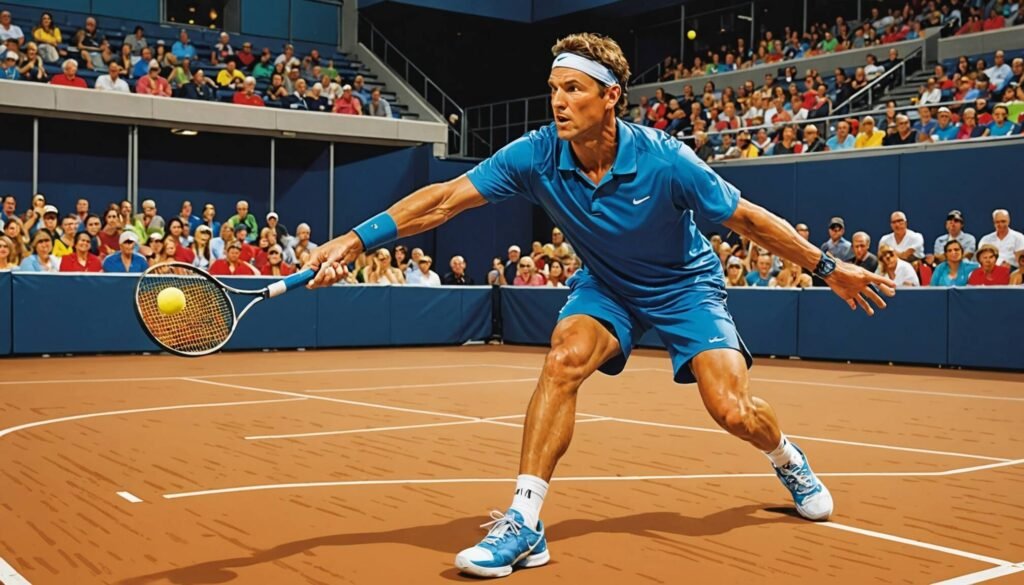
The Pivot Trick: How to Quickly Turn Defense Into Offense in Pickleball
Pickleball at the kitchen line can feel like controlled chaos. Balls are flying at your body, reflexes are tested, and split-second decisions determine whether you win or lose the rally. In these high-pressure moments at the net, most recreational players find themselves stuck in survival mode, desperately blocking balls back and hoping for the best. But what separates intermediate players from advanced competitors isn’t just paddle speed or reaction time. It’s the ability to pivot effectively and transform defensive scrambles into offensive opportunities.
The pivot technique represents one of those foundational skills that doesn’t get enough attention in casual play, yet it makes an enormous difference when you’re facing aggressive opponents who know how to attack the middle and jam you with body shots. When you master the pivot, you’re not just reacting to speed-ups anymore. You’re anticipating them, creating space where none existed, and counterattacking with purpose and precision. This single technique can elevate your game from reactive to proactive, from defensive to offensive, and from frustrating to exhilarating.
Understanding the Pivot Technique
The pivot isn’t simply about moving your feet around or taking a step to the side. It’s a coordinated rotational movement that engages your entire body, starting from your core and extending through your hips, shoulders, and ultimately your paddle. When you execute a proper pivot, you’re essentially creating a biomechanical advantage that allows you to handle incoming balls that would otherwise jam you or force awkward defensive blocks.
Think about how a baseball player rotates their hips to generate power when hitting, or how a tennis player turns their shoulders to prepare for a groundstroke. The pickleball pivot works on similar principles. You’re using rotation to accomplish multiple goals simultaneously: generating space between your body and the ball, positioning your paddle for an aggressive return, maintaining balance throughout the exchange, and setting up your weight transfer for maximum power.
According to instructional insights shared in the pickleball community, the pivot functions as one of the most powerful defensive tools available to modern players. Yet despite its effectiveness, the technique remains underutilized and often misunderstood by recreational players who haven’t been exposed to proper instruction or haven’t recognized its importance in match situations.
The mechanics of a proper pivot involve several coordinated movements. As you see the ball speeding toward your body, you initiate the rotation from your core, turning your hips and shoulders away from the incoming ball. Your outside foot becomes the pivot point, remaining relatively stationary while your inside foot steps back and around, creating the rotational movement. Your paddle follows naturally, staying in front of your body throughout the rotation so you maintain control and contact point consistency. Your eyes stay locked on the ball, tracking it through the entire sequence until contact.
What makes the pivot so effective is that it transforms a cramped, defensive position into an offensive stance. Instead of reaching awkwardly across your body or backing up and losing court position, you’re rotating into a power position where you can drive the ball back aggressively. You’re not just surviving the point anymore. You’re taking control of it.
Right-Side Pivoting: Creating Space for Forehand Attacks
Right-side pivoting becomes especially critical when the ball is screaming toward your body or when you need to create space on your forehand side. For right-handed players, this means pivoting counterclockwise to open up your forehand. For left-handed players, the direction reverses, but the principle remains the same. You’re rotating away from the incoming ball to create the room you need for an offensive shot.
This scenario plays out countless times in competitive pickleball: you’re engaged in a fast exchange at the kitchen line, both teams are attacking and defending in rapid succession, and suddenly your opponent identifies an opening and speeds up the ball directly at your midsection. You’ve got maybe half a second to react. Most intermediate players will do one of two things in this situation. They’ll either reach awkwardly across their body with their backhand, resulting in a weak defensive pop-up, or they’ll try to back up quickly, losing their court position and often hitting the ball late and off-balance.
The right-side pivot offers a third option, one that advanced players use instinctively. As soon as you recognize the speed-up coming toward your body, you initiate your pivot. Your right foot (for right-handed players) becomes your anchor point. Your left foot steps back and around, rotating your hips and shoulders counterclockwise. This rotation accomplishes several things simultaneously. It moves your body away from the ball’s path, creating the space you need. It positions your forehand paddle face toward the ball naturally. It keeps you balanced and stable throughout the movement. And it allows you to transfer your weight forward into the shot, generating pace and power on your return.
The timing of the pivot makes all the difference between success and failure. You need to initiate the movement early enough that you’re already rotated and set when the ball arrives. If you wait until the ball is almost on you before starting your pivot, you’ll be rotating mid-swing, destroying your balance and consistency. Watch elite players during hand battles at the net, and you’ll notice something remarkable. They’re already moving before the ball leaves their opponent’s paddle. They’re reading body language, paddle angle, and weight transfer to anticipate where the ball is going, and they’re initiating their pivot during their opponent’s swing, not after.
This anticipatory movement requires practice and court awareness, but it’s learnable. Start by focusing on your opponent’s paddle during exchanges. Notice how their paddle face angle telegraphs where they’re attacking. Pay attention to their body position and weight distribution. These visual cues give you the split-second advantage you need to start your pivot early enough to execute it properly.
Once you’ve rotated and created space, the follow-through becomes crucial. Don’t just block the ball back defensively. You’ve created an offensive opportunity with your pivot, so take advantage of it. Drive the ball back aggressively at your opponent’s feet or find an open angle. The pivot has transformed a defensive situation into an offensive one, but only if you complete the sequence with an attacking shot.
Why This Technique Transforms Your Game
If you consistently struggle to defend body speed-ups, or you find yourself getting jammed during fast exchanges at the kitchen line, the pivot represents the missing piece in your technical arsenal. It fundamentally transforms how you handle pressure at the net. Instead of being reactive and defensive, you become proactive and offensive. Instead of just trying to keep the ball in play and hoping your opponent makes the next mistake, you’re actively setting up your next offensive opportunity and putting pressure back on your opponents.
The pivot’s impact on balance cannot be overstated. Balance represents the foundation of consistency in pickleball. When you’re off-balance, everything suffers. Your paddle control diminishes. Your shot selection becomes limited. Your recovery for the next ball slows down. Your ability to generate pace disappears. But when you execute a proper pivot, you maintain your balance throughout the entire exchange. Your feet are set, your core is stable, your weight is balanced, and you’re in complete control of your body and paddle.
This balanced position gives you options. You can drive the ball aggressively. You can roll it softly to your opponent’s feet. You can redirect it crosscourt or down the line. You’re in control, not your opponent. This shift from reactive to proactive, from defensive to offensive, represents the difference between intermediate and advanced play.
The pivot also improves your court positioning over the course of a rally. When you back up to handle body shots, you’re surrendering court position and moving away from the kitchen line where you want to be. When you reach awkwardly without pivoting, you’re often pulled off-balance and out of position for the next shot. But when you pivot properly, you maintain your position at the kitchen line. You stay in the offensive zone of the court. You’re ready for the next exchange immediately, without having to recover or reposition.
Beyond the immediate tactical advantages, mastering the pivot builds confidence. When you know you can handle body speed-ups effectively, you play more aggressively overall. You’re not worried about getting jammed, so you can position yourself more assertively at the net. You can take more risks offensively because you trust your defensive technique. This confidence feeds on itself, elevating every aspect of your game.
For players who are working to reach the next level, the pivot often represents that breakthrough technique that suddenly makes everything click. You realize you don’t have to be afraid of fast exchanges anymore. You understand how to create space and time even when the ball is coming hard at you. You see opportunities for counterattacks where you previously only saw problems. This shift in perspective and capability can accelerate your improvement dramatically.
Explaining the Pivot for Beginners
If you’re relatively new to pickleball or you haven’t focused much on advanced techniques yet, the concept of pivoting might seem complicated or unnecessary. After all, can’t you just hit the ball back however you can when it comes at you fast? While that approach works at the beginner level, you’ll quickly find its limitations as you face better opponents who know how to attack strategically.
Think of the pivot this way: imagine someone is tossing a ball directly at your chest. Your natural instinct might be to back up or reach out awkwardly to push it away. But what if instead, you turned your body to the side? Suddenly, the ball isn’t coming at your chest anymore. It’s coming to your side, where you have much more room to swing and hit it properly. That’s essentially what the pivot does in pickleball.
When an opponent hits the ball hard at your body during a net exchange, you don’t have much time to think or react. If you try to back up, you’ll probably hit the ball late and weak, and you’ll lose your position at the net. If you try to block it without moving your feet, you’ll feel cramped and unable to generate any power. But if you pivot, turning your body to create space, you suddenly have room to swing properly and hit an aggressive shot back.
The key is learning to turn your whole body, not just reaching with your arms. Your feet move, your hips rotate, your shoulders turn, and your paddle follows naturally. It’s a coordinated movement that takes some practice, but once you get the feel for it, it becomes automatic. You’ll start pivoting without even thinking about it when balls come at your body.
Start practicing the pivot slowly, without a ball. Just work on the footwork and rotation. Plant one foot and step back and around with the other, feeling your body rotate. Do this several times until the movement feels natural. Then have a partner toss balls gently at your body and practice pivoting and hitting them back. As you get comfortable, have them speed up the pace gradually until you’re handling fast exchanges confidently.
The pivot might feel awkward at first, especially if you’re used to just reaching and blocking when balls come at you. But stick with it. Once you’ve mastered this technique, you’ll wonder how you ever played without it. Suddenly, those body shots that used to give you trouble become opportunities for aggressive returns. You’ll feel more confident at the net, more balanced during fast exchanges, and more capable of controlling rallies instead of just surviving them.
Practical Drills to Master the Pivot
Understanding the pivot conceptually is one thing, but developing the muscle memory and timing to execute it consistently under match pressure requires dedicated practice. The good news is that the pivot is highly trainable with the right drills and practice structure. You don’t need to wait for perfect game situations to develop this skill. You can work on it systematically through focused repetition.
Start with shadow pivoting without a ball. Stand at the kitchen line in your ready position. Have a partner point to where a ball would be coming, directed at your body. Practice initiating your pivot early, rotating your body, and positioning your paddle where you would make contact. Focus on smooth, balanced movement rather than speed. Do sets of ten repetitions, alternating between forehand and backhand side pivots. This foundational drill builds the basic movement pattern without the distraction of actually hitting a ball.
Once the basic movement feels natural, progress to slow-feed pivoting drills. Have a partner stand across the net and toss balls underhand directly at your body at a moderate pace. Practice pivoting and hitting controlled returns. Focus on initiating your pivot as soon as you see the ball leaving your partner’s hand, not when it’s already close to you. This drill develops your timing and anticipation while still keeping the pace manageable.
As your comfort level increases, move to dinking-to-speed-up pivot drills. Start a dinking exchange with your partner, then have them randomly speed up balls at your body. This drill simulates actual game situations where you transition suddenly from slow, controlled dinking to fast, aggressive exchanges. The randomness forces you to stay alert and react quickly, just like in real matches. Practice this drill extensively because it replicates match conditions most accurately.
For more advanced practice, try competitive hand battle drills where both players at the net are actively attacking and defending in rapid succession. Set a goal of keeping the rally going for a certain number of shots while both players are allowed to speed up whenever they see an opportunity. This drill develops your ability to pivot repeatedly during extended fast exchanges, building the stamina and consistency you need for actual match situations.
Video analysis can accelerate your learning significantly. Have someone record your pivot technique from several angles during drill work. Watch the footage and compare your movement to professional players performing the same technique. Look for differences in timing, rotation completeness, balance, and follow-through. Often, seeing yourself from an outside perspective reveals technical issues you weren’t aware of during play.
Common Pivot Mistakes and How to Fix Them
Even players who understand the pivot conceptually often make execution mistakes that limit the technique’s effectiveness. Recognizing and correcting these common errors can dramatically accelerate your mastery of the pivot and its application in match situations.
The most frequent mistake is initiating the pivot too late. Many players wait until the ball is already close before starting their rotation. By that point, they’re pivoting during their swing rather than before it, destroying their balance and consistency. The fix requires developing better anticipation. Watch your opponent’s paddle and body language to predict where they’re attacking before the ball leaves their paddle. Start your pivot during their swing, not after.
Another common error involves incomplete rotation. Players often turn their feet but keep their shoulders facing forward, or they rotate their upper body but leave their feet planted. The pivot requires full-body rotation for maximum effectiveness. Your feet, hips, shoulders, and paddle should all rotate together as one coordinated unit. Practice in front of a mirror or on video to ensure your entire body is rotating together.
Some players pivot correctly but then fail to capitalize on the offensive opportunity they’ve created. They go through the rotational movement, create space, and then block the ball back defensively anyway. Remember that the pivot’s purpose is to transform defense into offense. Once you’ve executed the pivot and created space, drive the ball aggressively back at your opponent. You’ve earned the right to attack, so attack.
Pivoting too far represents another mistake, particularly for players new to the technique who overdo the rotation. You want to create enough space to swing freely, but you don’t want to rotate so far that you’re hitting from an extreme angle or off-balance position. The optimal pivot rotation is usually 45 to 90 degrees, enough to clear your body from the ball’s path while keeping you in a strong, balanced hitting position.
Some players also make the mistake of pivoting away from every body shot regardless of speed or trajectory. Not every ball requires a full pivot. Sometimes a small step or weight shift is sufficient. Learn to read the ball’s speed and trajectory and scale your defensive movement accordingly. Full pivots are most necessary for hard-driven balls directly at your midsection. Softer shots or balls with more angle might require less dramatic adjustments.
Integrating the Pivot Into Your Overall Game Strategy
The pivot doesn’t exist in isolation. It’s one component of a comprehensive approach to net play and fast-exchange management. Understanding how the pivot fits into your broader tactical framework helps you deploy it more effectively and recognize when other techniques might be more appropriate.
The pivot works best in combination with proper court positioning. When you’re positioned correctly at the kitchen line, slightly offset to cover your side of the court with your partner, you create angles that make pivoting easier and more effective. Good positioning means you’re not getting attacked from extreme angles that require desperate defensive measures. You’re in a balanced, ready position where pivoting feels natural and efficient.
Your grip also influences pivot effectiveness. A continental grip or something close to it allows you to handle both forehand and backhand pivots without changing your grip mid-exchange.


