Pickleball Reaction Time: Why Younger Players Are Taking Over the Sport
There’s a shift happening in professional pickleball that not everyone has fully processed yet. For years, the assumption was that experience ruled the court. Put in the hours, develop your court sense, read the game deeply enough, and you’d peak somewhere in your late twenties when physical ability and tactical knowledge finally aligned. That made sense on paper. It’s how most racket sports have worked historically.
But pickleball is rewriting that story fast, and the driving force behind the change is something most people don’t immediately think about when they picture elite athletic performance: raw reaction time. As the professional game accelerates to speeds that were unimaginable just a decade ago, the ability to process and respond in fractions of a second is becoming the single most important weapon a player can bring onto the court. And biologically, that weapon belongs to the young.
The Science Behind Reaction Time in Pickleball
When we talk about pickleball reaction time, we’re not just talking about how fast your hands move. That’s part of it, but it’s a simplification. What we’re really talking about is the entire chain of events that happens between the moment an opponent makes contact with the ball and the moment your paddle makes contact with it. Your eyes capture the movement, your brain processes what it means, your nervous system sends a signal, and your muscles execute a response. Every link in that chain matters, and the speed of the whole process is what separates players who survive fast exchanges from players who control them.
According to Zane Navratil, longtime pro and host of The Dink’s PicklePod, raw reaction speed peaks in the late teens and then begins a slow but steady decline throughout adulthood. This isn’t a dramatic cliff — it’s a gradual slope — but at the highest levels of professional play, where the margins are measured in milliseconds, even a small decline has real consequences.
Navratil also points to neuroplasticity as a second biological factor that shapes this picture. Neuroplasticity is your brain’s ability to form new patterns, recognize sequences, and adapt to unfamiliar situations. It’s strongest from birth through around age 12, and it continues to decline gradually from there. What that means in practical terms is that younger players don’t just react faster to what they see — they learn the game’s patterns faster too. They absorb tactical information more readily, internalize tendencies more quickly, and adjust to opponents more fluidly than older players who have been playing for much longer.
When you combine peak raw speed with peak neuroplasticity, you get a genuine biological window that younger players are sitting inside right now. Understanding how to develop faster hands in pickleball starts with recognizing that this window exists and that the players currently exploiting it are the ones climbing the rankings fastest.
What This Looks Like on the PPA Tour Right Now
This isn’t theoretical. You can watch it playing out in real time on the PPA tour if you know what you’re looking for. Players like Anna Leigh Waters, Dylan Frazier, J.W. Johnson, Jorja Johnson, Hayden Patriquin, and Gabe Tardio aren’t just competitive at the professional level — they’re winning. Consistently. Against players who have been playing the sport longer, who understand strategy more deeply, and who have accumulated more competitive experience.
The reason those things aren’t enough to close the gap is simple: when the ball is traveling at elite speed and the exchanges at the kitchen line are happening faster than conscious thought, experience can only take you so far. At a certain point, you either have the reflexes to keep up or you don’t. The younger players have them. And because their neuroplasticity is also higher, they’re learning the rest of the game quickly enough to compete on every other dimension too.
The 25 biggest stories in pro pickleball from 2025 were dominated by this exact shift. Young players weren’t just showing up to tournaments — they were dictating the terms of play and walking away with hardware. That trend has accelerated into 2026 rather than leveling off.
The PPA has read the room. The league has been actively signing junior talent — players like Will MacKinnon, Thomas Shima Bukuro, Andre Marcado, and Elsie Hendershot — as part of a deliberate effort to build around the next generation. Junior pickleball is set to break new records in 2025, and Navratil expects several of these young players to break out in a significant way before 2026 is over. That’s not wishful thinking. That’s a pipeline producing results.
When you look at the best PPA pros ranked by 2025 medal counts, the skew toward younger players at the top of the leaderboard is hard to ignore. A player who processes an incoming speed-up in 150 milliseconds instead of 200 milliseconds wins that specific exchange more often than not. Scale that over hundreds of points in a multi-day tournament, and the advantage compounds into something that shows up clearly in the standings.
For People Who Are New to Pickleball: Here’s Why This Matters to You
If you’re newer to pickleball or haven’t followed the professional scene closely, let’s step back and explain what’s actually going on here in plain terms, because it’s genuinely fascinating and it affects recreational players just as much as pros.
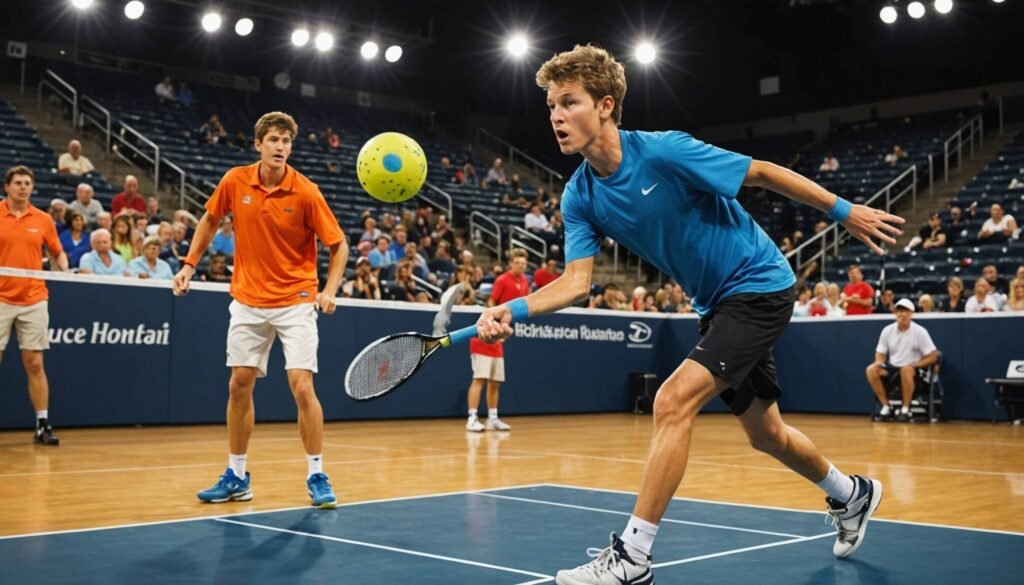
Pickleball is played on a smaller court than tennis, and the kitchen — the no-volley zone near the net — is where most points are ultimately decided. When two skilled players are both at the kitchen line, the exchanges can be incredibly fast. We’re talking about the ball traveling back and forth multiple times per second. At that speed, you physically cannot think your way through the exchange. Your body has to react before your brain has finished processing what’s happening.
That’s reaction time. And here’s the part that surprises most people: it peaks when you’re a teenager. Not when you’re 30 with a decade of experience. Not when you’ve played 10,000 hours. When you’re 17 or 18 years old, your nervous system is operating at its fastest, and your brain is at its most flexible for learning new patterns.
So when a 16-year-old beats a 35-year-old professional at pickleball, it’s not just an upset. It might actually make complete biological sense. The teenager is running faster hardware. The veteran has better software — more experience, more tactical knowledge, more court sense — but if the hardware gap is large enough, the software advantage can’t fully compensate.
For recreational players, this means something practical. If you’re an older player wondering why you can’t seem to speed up your hands despite hours of practice, part of the answer is physiological. But the good news is that smart training, better positioning, and sharper pattern recognition can close the gap significantly. You may not be able to change your reaction ceiling, but you can absolutely get closer to it than you currently are.
The Fortnite Connection: Video Games as Reaction Training
Here’s one of the more surprising angles in this conversation. Ben Johns, Hayden Patriquin, and a growing number of professional pickleball players have openly talked about playing hours of video games every day. And the response from most people is somewhere between skepticism and confusion. How does playing Fortnite make you better at pickleball?
The answer lies in what first-person shooters actually demand from a player’s brain. These games require constant visual scanning, rapid threat assessment, split-second decision-making, and the ability to recognize patterns in a dynamic environment — all under time pressure that doesn’t allow for deliberate thinking. Sound familiar? That’s exactly what elite pickleball demands at the kitchen line.
The cognitive load of a fast FPS game is remarkably similar to the cognitive load of a fast pickleball exchange. You’re training your visual processing system to pick up information faster. You’re training your pattern recognition to work more efficiently. You’re training your brain to move from stimulus to response with less hesitation. All of that transfers directly to the court.
Navratil’s argument is that the next generation of pickleball players will cross-train with video games more intentionally than any generation before them, and that this will produce measurable performance advantages. The four key strategies to winning in 2026 all require fast cognitive processing at their core. You can know the right strategy perfectly and still lose because your brain executed it half a second too late.
This isn’t just a pickleball phenomenon. The intersection of esports, cognitive training, and traditional athletic performance is a growing area of sports science, and the data keeps pointing toward the same conclusion: training the brain’s speed and pattern recognition capacity improves on-court performance in ways that purely physical training cannot replicate alone.
How to Actually Train Your Pickleball Reaction Time
The natural follow-up question is: if reaction time is this important, how do you actually improve it? The answer is more nuanced than just drilling more hours on the court, though deliberate practice absolutely matters.
The first thing to understand is that hand speed and paddle positioning are two sides of the same coin. Moving your hands faster without your paddle being in the right position just creates chaos. The players who look effortlessly fast at the kitchen line aren’t just reacting quickly — they’re also reducing the distance their paddle has to travel to reach the ball by keeping it in optimal positions between shots. Less distance means less time needed, which effectively acts as a multiplier on whatever raw reaction speed you have.
Targeted reflex drills move the needle faster than general rallying. The 12 drills you need to play your best pickleball in 2026 include specific exercises designed to shorten the gap between stimulus and response rather than just improving general ball-striking consistency. There’s a meaningful difference between practicing your forehand and practicing your reaction to an unexpected ball, and most recreational players spend far too much time on the former and not enough on the latter.
Pattern recognition training is another layer. The more situations your brain has seen and filed away, the faster it can identify a new situation as familiar and execute a pre-programmed response rather than having to reason through a novel problem in real time. This is one area where experience genuinely helps older players — not because their raw reaction speed is better, but because their library of recognizable patterns is larger, which reduces the cognitive load of each exchange.
Video game cross-training, as discussed, is a legitimate tool here. Specific reaction time apps and tools exist for this purpose too. A structured training plan for competitive players should account for all of these elements rather than defaulting to more court time as the universal solution to every performance gap.
What This Means for the Future of Professional Pickleball
Zooming out, the implications of this shift are significant for how the sport develops over the next decade. If reaction time is increasingly the decisive factor at the professional level, then the traditional pathway to becoming a pro — transitioning from tennis, spending years building experience, peaking in your late twenties — may not be the dominant pathway for much longer.
The talent pipeline is already changing shape. Top juniors are signing with professional leagues at ages that would have seemed premature just a few years ago. The PPA is investing in junior development not just as a feel-good community initiative but as a genuine talent strategy. The players with the best reaction profiles are getting identified younger and developed more deliberately.
There’s also an interesting question about where future talent will come from. Tennis players transitioning to pickleball have been a major talent source historically, but if the sport increasingly values raw reaction speed and pattern recognition developed through gaming and dedicated pickleball-specific training, the next great pro might have a background in esports rather than tennis or table tennis.
The comparison between pickleball in the 1980s and pickleball in 2025 is almost shocking when you see it side by side. The game has transformed completely. What was once a leisure sport played at moderate speeds is now a professional athletic competition where the pace at the kitchen line rivals or exceeds what you see in elite table tennis. That transformation has fundamentally changed who the sport rewards, and the sport will continue to evolve in the same direction.
The 26 pro pickleball predictions for 2026 include multiple scenarios where young, fast players break through in ways that surprise the broader pickleball community. But to anyone paying close attention to the science, those outcomes won’t be surprising at all. They’ll be the logical result of a structure that has been building for years.
The Bigger Picture: Speed Is the New Currency
What Navratil is articulating isn’t just an interesting observation about a few talented teenagers. It’s a fundamental reorientation of what athletic dominance looks like in pickleball. The 3 patterns that separate good players from great ones all carry a reaction component at their core. Greatness in this sport is increasingly defined by how fast you can process information and convert it into the right action, not just by how many years you’ve been playing.
Experience still matters. It will always matter. Court awareness, composure under pressure, tactical creativity, and the ability to construct points intelligently — none of that becomes irrelevant because reaction time is important too. But when two players are close in all those other dimensions, the one with faster pickleball reaction time wins the close exchanges, and the close exchanges are what decide close matches.
The players who internalize this early — who invest in actually training their reaction speed and cognitive processing rather than just accumulating court hours — will carry a meaningful edge into every competition they enter. That might look like specific reflex-focused drills. It might look like deliberate video game cross-training. It might look like a completely new approach to athletic preparation that pickleball pioneers before any other sport fully embraces.
What’s already clear is that the era of the late-career peak in pickleball is ending, and the players who understand why will be the ones still competing at the top when the next generation arrives to challenge them.
Frequently Asked Questions
What is pickleball reaction time and why does it matter?
Pickleball reaction time is the speed at which your brain processes an incoming shot and tells your body how to respond. As the professional game continues to accelerate, the margin between a


