14 Pickleball Wall Drills That Build Real Game Skills
If you think a wall is only useful when you have no other options, you are genuinely leaving improvement on the table. Solo wall work is one of the most underrated training tools in pickleball, and most players either skip it entirely or treat it as a last resort when they cannot find a partner. That is a mistake.
A pickleball wall drill done with intention will stress your hand speed, touch, and pattern recognition in ways that even structured partner drilling often cannot replicate. The wall never goes easy on you, it never misses, and it is available any time you are willing to show up. These 14 drills cover everything from controlled dinking warm-ups to deceptive inside-out shots and short-hop winners. Work through all of them consistently and your game will genuinely look different within a week.
What This Means If You Are New to Pickleball
Pickleball is a paddle sport played on a smaller court than tennis, with a plastic wiffle-style ball and an emphasis on soft, controlled shots near the net as much as power. The kitchen, or non-volley zone, is the seven-foot area on either side of the net where players cannot volley the ball out of the air. A huge portion of high-level pickleball is played right there, which means touch, hand speed, and the ability to react quickly are some of the most important skills you can develop.
Wall drills are simply practice sessions where you hit a ball against a wall and respond to whatever comes back. Because the wall never tires and never adjusts for you, it forces you to stay sharp on every single touch. You do not need a court, a partner, or any special equipment beyond your paddle and a ball. That makes wall drills one of the most accessible and effective ways to improve regardless of your current skill level.
Start Slow: The Warm-Up Drills That Actually Matter
Most players rush to speed the moment they pick up a paddle. That instinct is wrong, and it slows development over time. Every wall session should begin with controlled dinking so you can calibrate your grip pressure and your feel for the center of the paddle face. You should be able to feel exactly where the ball contacts your paddle on every single touch. If you cannot, you are moving too fast and training imprecision rather than skill.
Start with the ball bouncing high and your pace comfortable. Then slowly increase tempo as your body warms up. Keep your knees bent, move your feet rather than reaching with your arm, and pay attention to your grip throughout. This warm-up phase is also an ideal time to work in less common shots like the chicken wing and two-handed dinks, so those mechanics begin to feel natural before you ever bring them into a match. The same principles that govern a solid pre-match warm-up apply here: do not skip it, and do not rush through it.
Drill 1: Simple Dink Alternation
Hit forehand, then backhand, letting the ball bounce each time. Your only focus is contacting the center of the paddle and keeping your wrist quiet through the swing. This sounds simple, and it is, but doing it well at low pace builds the foundation that every other drill depends on. Count your consecutive controlled touches and try to beat your own record each session. Anna Leigh Waters, one of the most dominant players in the game, reportedly hit 100 dinks to the same spot as part of her early development. Ask yourself honestly when you last did something like that.
Drill 2: Chicken Wing and Two-Handed Dinks
Deliberately work in the chicken wing shot and two-handed variations during your warm-up. These are shots most players only encounter reactively in a match, which means they never feel fully comfortable with them. The wall gives you a controlled environment to build these into muscle memory before the pressure of a real rally. Spending even five minutes on these during your warm-up will pay off the first time an opponent attacks your body and your response is automatic rather than awkward.
Volleys: Where Wall Training Pays Off Fastest
Wall volleys are the single fastest way to build hand speed for kitchen exchanges. Once you are warmed up and your touch feels calibrated, move into continuous volleys and start pushing the pace. Stay disciplined about watching the ball contact your paddle even at higher speeds. If you are looking ahead to where you want to send the ball before you have actually hit it, your contact suffers and the wall will punish you for it immediately.
Two things matter most during your volley phase. First, keep your swings compact. A long follow-through leaves you unprepared for the next ball, and the pace of wall volleys will expose that immediately. Second, reach straight out to contact the ball early. Extending your arm directly to meet the ball rather than waiting for it to come to you gives you more control and more range. The closer your shoulder is to net height, the more of the court you can effectively cover.
Drill 3: Continuous Fast Volleys
Start at a pace you can control with clean contact, then slowly push faster over the course of the drill. Your goal is to stay balanced and compact throughout, not to swing harder. Speed should come from acceleration through the hitting zone, not from bigger backswings. If you lose control, back off the pace slightly rather than muscling through sloppy contact.
Drill 4: Two-Handed Volley Integration
Force yourself to hit a percentage of your volleys with two hands on the paddle. Keep your non-dominant hand ready on the grip between shots rather than letting it hang loose at your side. This builds the two-handed backhand counter reflex that wins hands battles at the kitchen line. If you want to understand the mechanics more deeply, Connor Garnett’s breakdown of the two-handed backhand is worth your time and will give you a clearer picture of how to use this shot in different situations.
Adding Topspin and Pattern Combinations
Once you are in a groove with your volleys and dinks, bring in topspin shots off the bounce and start thinking in combinations. This is where wall training stops feeling like isolated skill work and starts feeling like genuine game preparation. The pattern worth drilling repeatedly is topspin speed-up, counter, reset. Run that loop over and over. It trains your brain to recognize what the ball is doing and respond with the right shot rather than just the first shot that comes to mind.
Drill 5: Topspin Speed-Up Off the Bounce
Drive the ball into the wall with topspin, then respond to whatever comes back. Take as many balls out of the air as you can rather than waiting for the bounce. This simulates an opponent sitting back after a weak return, giving you time to load up and attack. The topspin creates a heavier, more unpredictable return off the wall, which in turn forces you to read and adjust rather than just reacting to a flat ball.
Drill 6: Speed-Up, Counter, Reset Combination
Speed the ball up, counter the return, then reset if the ball gets too difficult to attack. Cycle through this pattern without stopping between reps. The more you run this combination, the more automatic your decision-making becomes in real rallies. That kind of shot recognition is central to modern pickleball strategy and it is what separates players who react instinctively from those who are always a half-second late.
Is Your Wall Flat? Why an Uneven Wall Is Actually Better
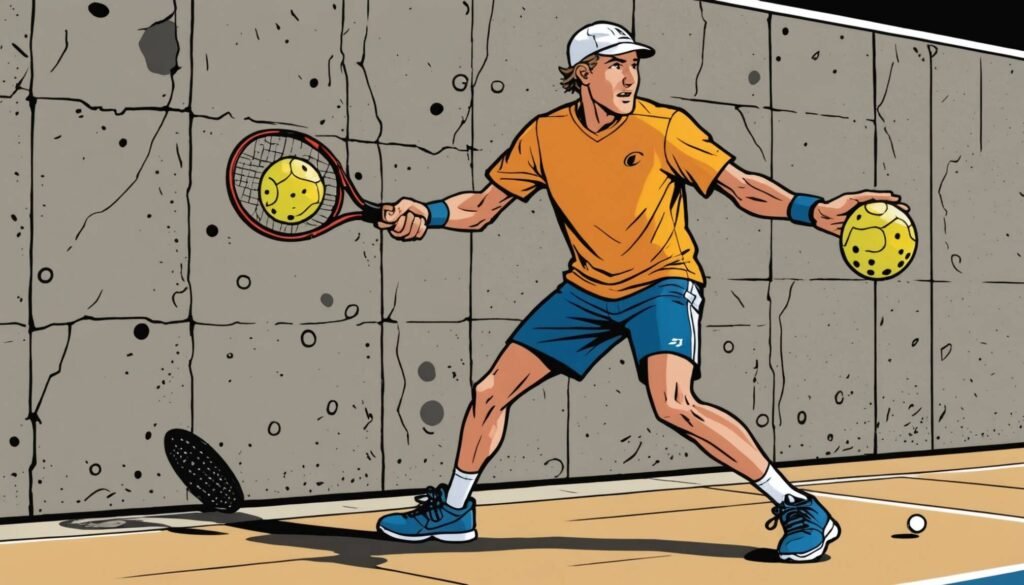
A smooth wall is easier to practice on, but an uneven surface is actually more valuable for developing real game skills. When the ball does not bounce back at a predictable angle, you are forced to read the ball and adjust your footwork in real time. That is exactly what happens in a match. A perfectly predictable wall can create habits that do not transfer to the court because real opponents do not give you perfectly predictable balls.
Whatever wall you use, aim for at least 10 feet of height. If you can find one closer to 13 feet, even better, because that gives you room to practice topspin lobs and generate overhead opportunities for yourself within the same session.
Drill 7: Topspin Lob Practice
From your dink position at the wall, disguise the lob as long as possible so the setup looks identical to a standard dink, then send the ball up and off the wall. Step back, let it come down, reset the next shot, and work your way back into your dinking rhythm. The goal is not just to hit a high ball, it is to make the lob look like a dink until the very last moment. That deception is what makes the lob a genuine weapon rather than a desperation shot.
Drill 8: Inside-Out Forehand and Backhand
The inside-out shot is one of the most deceptive tools in pickleball. You turn your body as if going crosscourt, then redirect the ball back across your body at the last moment. The wall is a perfect training partner for this because you get immediate feedback on whether your redirection was clean and controlled. For forehands, keep the paddle closer to your body. Your wrist cannot generate enough bend when you are fully extended, so the inside-out only works when you have maintained some compactness in your swing. This shot has applications from dinking exchanges to transition zone attacks and belongs on any serious player’s list of essential shots to master.
Slice, Drop, and Reach Drills
Slice shots are underused at most recreational levels. Even though the pros have largely stepped back from the slice as a primary weapon, it still has real value as a change of pace and a way to generate awkward low balls. A wall drill lets you build both forehand and backhand slices without needing a partner to feed you.
Drill 9: Slice Forehand and Backhand
Turn sideways to the wall, generate a slice, and hit slightly harder than you would in a standard dink to simulate crosscourt pace. For backhands, start with two hands on the paddle. This gives you the option to transition to different shots within the same motion, which adds deception and also helps you feel the correct path through the ball. Slice contact should feel like you are cutting under and through the ball, not scooping it.
Drill 10: Third Shot Drop Simulation
The third shot drop is one of the most important shots in pickleball, and it is one that most players overcomplicate. Think of the drop as a dink hit just a bit harder. Mechanically, it does not need to be a completely different shot. If you frame it that way, your technique becomes far more consistent because you are drawing on feel you already have from dinking rather than trying to execute something that feels foreign. Hit the drop higher and slower rather than driving it, which gives you more time to advance toward the kitchen after the shot. The pressure comes from following a quality drop quickly, not from hitting the drop hard. For the technical specifics, the science-backed approach to perfect drops is a useful reference.
Drill 11: Reach and Neutralize
Set up a shot with some pace or spin, then practice straightening your arm and taking the ball early before it gets into an uncomfortable position. Sometimes you add a little spin on your response. Sometimes you push it flat to a corner. The point is to get comfortable contacting the ball when it is not sitting perfectly, because in a real match it almost never is. This drill builds the quiet confidence of knowing you can handle a ball that is not gift-wrapped for you.
Flicks, Short Hops, and the Drills That Win Fast Points
Flick shots are a weapon most players practice far too rarely, and the wall is a perfect environment to develop them. Because the ball comes back quickly off the wall, you are forced to keep your swing compact. A long follow-through on a flick means the next ball arrives before you are ready, and the drill immediately falls apart. That built-in consequence is exactly what makes wall training so honest.
Drill 12: Flick Shots Out of the Air
Once the ball rises above net height, flick it. Practice going crosscourt, down the line, and at different heights within the same drill. If the ball drops low, transition to a roll rather than forcing the flick. Stay compact on every swing, every time. If you want to understand the mechanics behind this shot more fully, the breakdown of mastering the pickleball flick covers the step most players consistently skip, which is worth knowing before you build repetitions on top of a flawed pattern.
Drill 13: Short Hop Dink Winner
This is a more advanced drill and a genuinely satisfying one to develop. Take the ball extremely early, almost off the bounce,


