
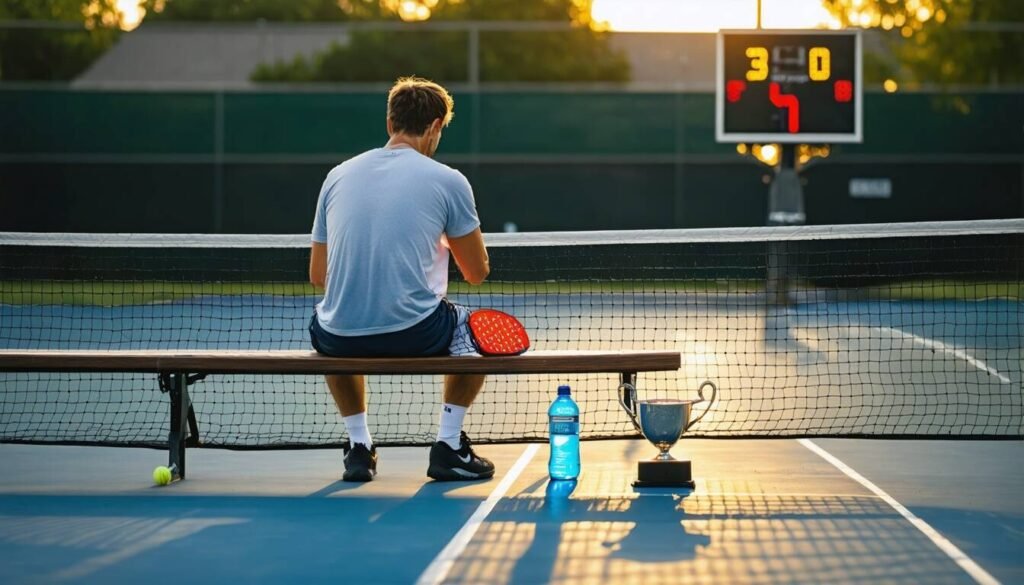
7 Pro Pickleball Lessons That Change How You Compete
Every pro pickleball lesson worth keeping usually arrives after a loss, not a win. You walk off the court replaying the same three points, wondering why your game fell apart when it mattered most. That feeling is universal, from the 3.0 rec player in a Saturday ladder to the touring pro on a stadium court. What separates people who improve from people who stall is what they do with that feeling.
These seven lessons come from Kyle Koszuta, who shares his experience on YouTube as ThatPickleballGuy. He spent five years climbing from 4.0 tournaments to the professional ranks, and his career DUPR record sits at 242 wins and 170 losses. That is a lot of losing, which is exactly why his takeaways are useful. Below, we walk through the mindset, partner, and practice habits that matter most, and how you can apply each one this week.
Why Is Losing Part of Getting Better?
Losing is the price of entry for anyone who puts themselves in a pressure situation. If you only play where the stakes are low, you will rarely lose, and you will rarely grow. Pressure exposes the habits you cannot see in casual play: rushed decisions, shaky footwork, a partner connection that falls apart when points get tight.
Kyle’s first pro event is the perfect example. It ended with an 11-0 loss in mixed doubles, followed by a 15-0 deficit in the backdraw within five minutes. Imagine standing on that court. Most people would have deleted the tournament app and gone back to rec play. Instead, he kept entering. Years later, he won his first pro tournament in the same city. That full-circle moment only exists because he kept showing up after being humbled.
Give yourself credit for signing up for the league, the tournament, or the bracket where people are watching. Nerves, doubt about whether your partner thinks you are good, and fear of a bad result are all normal. They do not mean you are not ready. They mean the result matters to you.
If you have ever wondered whether a defeat was useful or just painful, read our breakdown of a good loss versus a bad loss. And if tournament jitters are the real issue, here is how to beat tournament nerves.
The practical takeaway: treat each loss as data. Write down two things that went wrong and one thing that went right. Then move on. A loss you learn from is worth more than a win you do not examine.
Are You Wasting Someone Else’s Two Hours?
Yes, if you show up to a game and give low effort, you are wasting the time of everyone else on the court. That is an uncomfortable sentence, but Kyle learned it the hard way. After a flat night at a rec game, one of the other players texted him afterward. That player had two kids and a full workday. Those two hours of pickleball were what he looked forward to all day, and Kyle’s body language and effort had cost him that.
It is easy to forget that the people across the net are not just opponents. They carved out time, arranged childcare, skipped something else, and drove to the courts for this. When you treat a casual game as not worth your energy, you take something from them.
You will have off days, and that is fine. Everyone does. The standard is not perfection. The standard is this: when you accept a game, bring the energy and effort you would want from the other three people. Call the ball clearly, move your feet, talk to your partner, and compete honestly. You do not need to be your best, only present.
Try this before your next session: take thirty seconds in the parking lot to decide what kind of player you want to be tonight. It sounds small, but it changes how you walk onto the court.
Need new gear while you are at it? You can get up to 15% off select paddles, shoes, and more with code THEDINK at Midwest Racquet Sports.
How Do You Become the Best Partner on the Court?
The best partner makes everyone around them play better by creating emotional safety. Kyle heard about a player in Seattle that everyone loves partnering with because she never rolls her eyes and always picks you up after an error. She may not be the strongest player in the room, yet her calendar is full. People want to play with someone who makes them feel safe to take risks.
Here is the interesting part: when you stop living inside your own frustration and focus on the environment you create for your partner, your own play usually improves too. Tension tightens your grip and shortens your swing. Calm keeps you loose. Slouched shoulders, gasps, and unsolicited corrections after a miss almost never help. Your partner already knows they missed.
Here are four habits that build a great partner:
- Respond to every miss with encouragement, not body language.
- Keep corrections short, constructive, and saved for between games.
- Celebrate your partner’s good shots out loud.
- Stay level after your own mistakes so your partner does not feel the weight of them.
If you are working with someone new, our guide to pickleball partnership etiquette goes deeper, and these six questions to ask your partner are a fast way to get aligned before the first serve. If you are the stronger player in the pairing, see how to play with a weaker partner without taking over. And if you are the one getting targeted, learn how to be a good partner as the weaker player, with return, reset, and positioning habits that keep your side in the point.
What Is a Mistake Response?
A mistake response is what you do in the three to five seconds immediately after an error. It determines whether one miss stays one miss or snowballs into a losing run. Most players have never planned theirs, so they default to whatever their emotions dictate: a sigh, a muttered comment, a replay of the shot in their head while the next serve is already coming.
Kyle uses a three-part framework called feel, fix, forward. You have roughly seven to twelve seconds between points, so the process is quick.
- Feel it. Take two to three seconds to acknowledge the frustration. It is human, and suppressing it only makes it louder.
- Fix it. Spend three or four seconds asking what you would change if you could replay the point. Better footwork, a different shot choice, a cleaner contact point.
- Move forward. Take a deep breath and use a physical cue, like a paddle tap on your leg, to close the chapter.
The best players do not avoid mistakes. They simply refuse to let one turn into three. Pair this routine with a consistent pre-point habit, the way Quang Duong resets between points.
For a bigger reset, here is the six-second mental reset for getting past a bad mistake. If the slump has lasted weeks, try resetting your game and reclaiming your confidence. After a tough match, you can also learn how to rebuild pickleball confidence with a fast, honest audit instead of a week of replaying the same two points.
How Do You Crush a Limiting Belief?
A limiting belief is a story you tell yourself about why something is not possible for you. It feels like fact, but it is only a habit of thought. Kyle spent over two years convinced he would never own a two-hand backhand dink. He avoided it in games, missed it in practice, and eventually decided to just win without it.
He saw the same pattern in a member of his online school who wrote that her “cement feet will never be as smart as my brain.” He challenged her on it, because struggling with a skill for a long time does not mean you are incapable of improving it. Struggle usually means the approach needs to change, not that the ceiling has been reached.
His replacement belief is simple: I can learn this. It will be frustrating and slow, but it is possible. Notice that it does not promise ease or speed. It just removes the false verdict.
Take a moment and identify your own. Maybe it is “I can’t hit a forehand drive,” “I’m too slow for the kitchen,” or “I choke in tournaments.” Write it down, then rewrite it as a statement about learning. If a backhand dink is your sticking point, start with these seven backhand dink fixes. And to avoid drilling the wrong shot for months, check how to improve at pickleball in the right skill order.
What Is the Fastest Way to Improve at Pickleball?
The fastest way to improve is to combine focused drilling with outside coaching. Both give you something open play cannot: high-quality repetition and an honest set of eyes.
Kyle recommends new players skip drilling at first and just play open play for two or three months. Once you understand scoring and


