3 Pickleball Reset Fixes That Actually Stop the Pop-Up
There is one shot in pickleball that separates players who survive pressure from players who hand the point away on a silver platter. It is not the smash. It is not the speed-up. It is the reset — and most recreational players have never been taught how to do it correctly.
If you have ever been caught in the middle of the court, watched a hard ball come at you fast, and either dumped it in the net or floated it up for an easy putaway, you already know the problem firsthand. The pickleball reset is the answer to that problem, and it is a learnable skill — but only if you understand what actually makes it work.
Coach Austin Hardy of Pickleball Playbook broke the reset down from first principles: the exact technique, the footwork, and the drills that make it hold up when the game gets fast and the score matters. This article covers all of it, including an explanation for anyone newer to the game who wants to understand why this shot is such a big deal.
What Is a Pickleball Reset, and Why Does It Matter So Much?
Let’s start with the basics, because even experienced players sometimes have a fuzzy definition of what a reset actually is and what it is supposed to accomplish.
A pickleball reset is a soft, controlled shot that takes pace off a fast incoming ball and drops it back into the non-volley zone — the kitchen — so your opponent cannot attack it. That is the entire job description. You are not trying to win the point with a reset. You are trying to neutralize it, survive the pressure, and get yourself back into a position where you can compete.
When the ball lands low and soft near your opponent’s feet inside the kitchen, they have no angle to drive it down at you. The point resets to neutral. That is exactly what you want.
For players who are newer to pickleball, think of it this way: in this sport, the player who controls the kitchen line has a massive advantage because they can hit down on the ball. If you are stuck in the middle of the court and your opponent is at the net, you are at a disadvantage. A well-executed reset is how you work your way back to the kitchen without getting blown off the court in the process. It is not a glamorous shot. There is no highlight reel moment when you hit a perfect reset. But it is the foundation of smart defensive pickleball, and it is what allows you to eventually get back to the net and take control.
This is the backbone of what coaches call the soft game — the patient, strategic side of pickleball that relies on touch, angles, and positioning rather than raw power. Mastering the reset under pressure is what lets you climb the rating ladder, because it is the skill most players at the 3.5 and 4.0 level either skip entirely or never practice correctly.
3 Habits Every Clean Reset Has in Common
Before you even think about stroke mechanics, Hardy points to three habits that appear on every quality reset. If you miss these, it does not matter how good your technique is — the shot will fall apart when it counts.
1. Loose Grip Pressure
This is the single most important adjustment most players need to make, and it is also the one that feels the most counterintuitive. When a hard ball is coming at you, your natural instinct is to tighten your grip and brace for impact. That reflex is exactly what causes pop-ups.
A firm, tense grip rebounds the ball. It adds energy back into the shot instead of absorbing it. If you want the ball to die softly into the kitchen, your hand needs to be relaxed enough to act like a cushion, not a wall. Think of catching an egg. You would not stick your hand out stiff and rigid. You would give a little as the egg arrived. That is the exact feeling you are after.
If you only fix one thing in your reset game, soften your grip pressure. The improvement will be immediate and noticeable.
2. Get Low Before the Ball Arrives
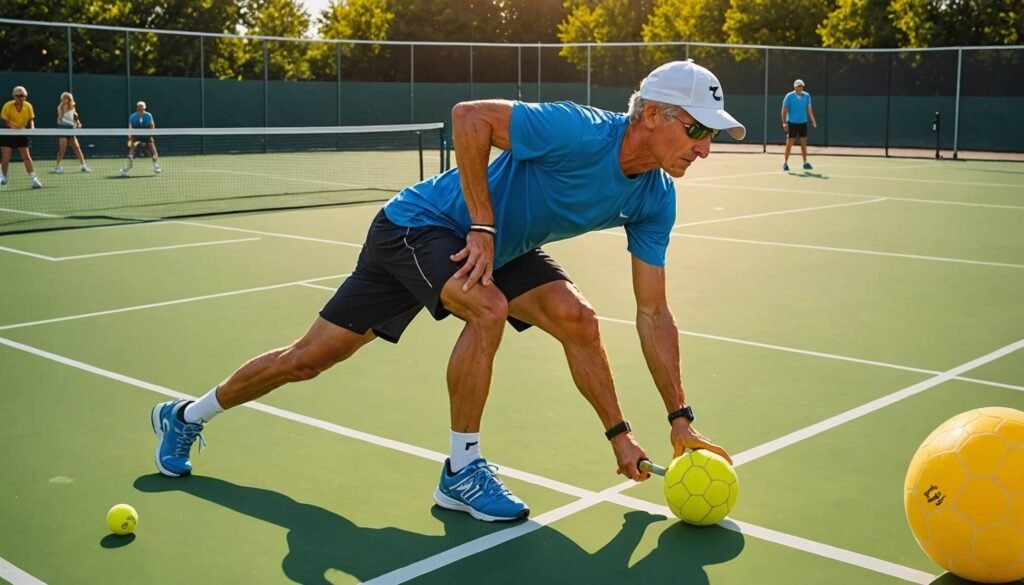
Almost every midcourt reset, and plenty of resets at the kitchen line, requires bent knees. This is not about getting low after the ball is on its way — it is about sinking into your athletic stance before contact so you are already loaded and ready.
When you are low, you can push upward through the ball with your legs on midcourt resets to generate the lift you need to clear the net. When you are standing upright and flat-footed, you are forced to use your arm and wrist to create that lift, which introduces way too many variables and makes the shot inconsistent.
Get your knees bent early. Keep your chest up so you can see the ball clearly. Let your lower body do the heavy lifting.
3. Always Assume the Ball Is Coming Hard
The reset usually happens because you are out of time. You did not choose to be in a defensive position — you got put there. That means you almost never have the luxury of waiting to see how hard the ball is coming before you decide how to respond.
If you assume the ball is coming fast and it arrives slower than expected, you can always adjust and add a little more touch. The reverse — assuming a soft ball is coming and getting caught by a hard drive — almost never works out. Default to defensive readiness. Be prepared to reset any ball that comes at you, and treat a slow ball as a bonus you get to work with rather than the plan you were counting on.
Notice that none of these three habits are about the swing itself. A great reset is mostly a state of readiness and intention. The stroke follows naturally once you have these fundamentals locked in.
The Technique: Set the Angle and Catch the Ball
The actual mechanics of a pickleball reset are simpler than most people expect. The move is small and controlled, not large and aggressive.
Hardy describes it as setting your target, absorbing a little of the ball’s speed, and adding a slight cut. You are not swinging at the ball. You are meeting it. The difference matters enormously.
Set your paddle angle before the ball arrives. Let the face stay slightly open — tilted back just a few degrees. Then pretend you are going to catch the ball with your paddle rather than strike it. That mental image alone will change the quality of your contact. The slice that makes the ball die softly comes naturally from that open face and soft touch. You do not need to manufacture it with a deliberate cutting motion.
At the kitchen line, that is genuinely all the technique you need. You are so close to the net that a soft, slightly open face will carry the ball over with room to spare. The risk at the kitchen line is not dumping the ball in the net — it is over-absorbing and leaving the ball floating up where your opponent can attack it. That requires its own awareness, and it is a real skill when you are trading fast exchanges right at the line.
Watch how elite players like Ben Johns handle a speed-up directed at their feet. The backswing is almost nonexistent. The hands are quiet. The paddle face is open. The ball comes off soft and lands low in the kitchen, and suddenly what looked like an attacking opportunity for the opponent has turned into nothing. That is the picture to build toward: quiet hands, open face, a ball that lands where it cannot be hurt.
Is a Kitchen Line Reset Different From a Midcourt Reset?
Yes, and understanding the difference will clean up a lot of errors.
At the kitchen line, you are close to the net and the geometry works in your favor. A gentle touch with an open face is enough to carry the ball over. Your job is mostly to absorb and redirect — keep the face open, stay soft, and do not overdo it.
From the midcourt, which is often called the transition zone, you are farther from the net and lower in the court relative to the net height. You need to add a little upward push from a low, loaded position to carry the ball over safely. That push comes from your legs and your upward swing path, not from muscling it with your arm.
The transition zone reset is widely considered one of the hardest shots in pickleball to execute consistently, precisely because players try to do too much with it. They swing too hard, they stand up too early, or they rush forward before the ball they just hit has proven itself safe. The result is usually a pop-up or a wide error. Slow down, stay low, and trust the touch.
Why Your Feet Determine Your Reset Before Your Paddle Even Moves
This is where a lot of players lose the shot before it even starts. You can have perfect grip pressure and a textbook paddle angle, but if your feet are wrong, the ball is already past you before you react.
The critical footwork habit for resetting is the split step. The timing is precise: you split — a small hop that lands you in a wide, balanced stance — right before your opponent makes contact with the ball. Not after. Not at contact. Right before.
That hop stops your forward or lateral momentum so you can react in any direction: left, right, forward, backward. It also loads your legs slightly so you are ready to push through the reset rather than falling into it.
Hardy makes the base width point visually obvious. Stand with your feet close together and someone can tip you over with a light push. Stand with your feet spread and you are a wall. It sounds obvious, but under pressure most players narrow their stance because it feels like they can move faster that way. In practice, a narrow stance makes you unstable and slow to react.
Wide feet, split step timed to your opponent’s contact, and a low center of gravity. Get those three things right and your reset will already be in a much better position before your paddle does anything. The split step is one of those fundamentals that coaches repeat constantly because it matters on literally every shot, and most recreational players skip it entirely.
Move Forward One Zone at a Time — Not All at Once
One of the most common mistakes after a reset is rushing forward too aggressively, arriving off balance, and getting punished at the feet by the next shot. The transition zone is unforgiving when you charge into it without a safe shot clearing the way.
The correct sequence is patient and deliberate: reset, read your shot, step up one zone only if your reset was genuinely low and safe, reset again if needed, step up again, until both you and your partner are back at the kitchen with angles and the ability to hit down.
A good reset functions the same way a well-placed third shot drop does — it signals to your partner that the ball is low and the coast is clear enough to advance. A bad reset, usually the result of being off balance or handcuffed by a great return, traps you in the middle with nowhere to go.
The patience to hold your position in the transition zone and earn your way to the kitchen one zone at a time is what coaches call reset patience, and it is what separates 4.0 players from 4.5 players more than almost any other habit. Stop trying to cover the whole court in a single sprint. Reset from where you are, evaluate honestly whether your shot was low enough to advance on, and move only when it was.
3 Drills That Build a Reset That Holds Up Under Pressure
Technique practiced in cooperative, low-stakes rallies will disappear the moment the score matters and someone is actually trying to beat you. Hardy structures his reset training in three stages that progressively add game pressure until the shot is stress-tested in conditions that mirror real play.
Drill 1: The Cooperative Reset Drill
One player feeds controlled pace. You reset every ball back into the kitchen. No score, no pressure, no consequences. This is purely about reps — building the muscle memory for the loose grip, the low base, and the soft catch. You are training your hands and your body to default to the correct mechanics automatically.
Do not rush through this stage. The repetitions here are what make the technique available to you later when there is no time to think. Hundreds of clean reps in a cooperative setting wire in the movement pattern so it becomes instinctive rather than effortful.
Drill 2: The Cooperative Competitive Drill
Same setup as the first drill — controlled feeds — but now you must land three clean resets before the point goes live and you can move forward. Once the point is live, the feeder can no longer speed up. You play out the point from wherever you are after your third successful reset, and you play to 11.
Run this drill from each of the four court positions. This is the bridge between pure drilling and real match play. You are adding a consequence — the point matters — while still controlling the variables enough to keep the reps productive. It forces you to execute the reset with purpose rather than just going through the motions.
Drill 3: The 711 Competitive Drill
This one is fully live and scored, designed to feel like a tournament situation. You play to 7 from the defensive resetting role. Your partner plays to 11 from the attacking side. Then you switch roles.
The uneven scoring creates real psychological pressure. You are playing with actual consequences, against someone who is actively trying to beat you, from a position where you have to execute your reset game or lose. That asymmetry forces you to compete under conditions that mirror what you will face in a real match.
These three pickleball drills work because they build on each other. You are not jumping straight into competitive pressure before the mechanics are there. You are earning the right to face pressure by first building the skill in a controlled environment and then gradually increasing the stakes until the shot is truly match-ready.
Why Most Players Never Fix Their Reset
The honest answer is that most players practice their reset in friendly cooperative rallies and never push it into pressure situations. The shot works fine when nobody is keeping score and nobody is trying to end the point. The moment a real game starts and someone targets a weak reset with a hard drive, the shot falls apart.
Training under pressure is the point. The drill only works if the consequence is real. If you want a reliable reset that survives tournament conditions, you have to practice it in tournament conditions — or as close to them as you can create on a practice court.
With focused reps on the three drills above, most players see real improvement within a few weeks. The grip softens. The footwork becomes automatic. The paddle angle stops being something you have to consciously remember. The shot starts to feel like a tool you actually trust rather than something you hope works when the pressure is on.
Quick Answers to the Most Common Reset Questions
Why does my reset keep popping up? Almost always because your grip is too tight or your paddle face is too closed at contact. Loosen the grip, open the face slightly, and think about catching the ball rather than blocking it.
Should I reset or keep driving from the transition zone? If


