How to Fix the Chicken Wing in Pickleball: 5 Fixes That Actually Work
If you’ve played pickleball for any amount of time at the kitchen line, you know exactly what the chicken wing feels like. A ball comes screaming at your body, your elbow flies up, your paddle turns sideways, and the shot either dumps into the net or sprays wide. It’s one of the most frustrating things to experience mid-rally because it feels completely out of your control — like your body just failed you in real time.
Here’s what most players get wrong about it: the chicken wing is not a reaction speed problem. You’re not just too slow. It is a paddle position problem, and that distinction matters enormously because it means the fix is entirely within your control. You don’t need faster reflexes. You need better habits before the ball even arrives.
These five fixes address the root causes of the chicken wing from the ground up, starting with the single most common mistake behind almost every case of getting jammed at the body.
What Is the Chicken Wing in Pickleball? (For Those New to the Game)
If you’re newer to pickleball, here’s a plain-English explanation of what we’re talking about. When you’re standing at the kitchen line — the non-volley zone line closest to the net — your opponents will sometimes hit the ball directly at your body rather than to your left or right. This is called a body shot or a body bag, and it’s a deliberate strategy to jam you up and force an error.
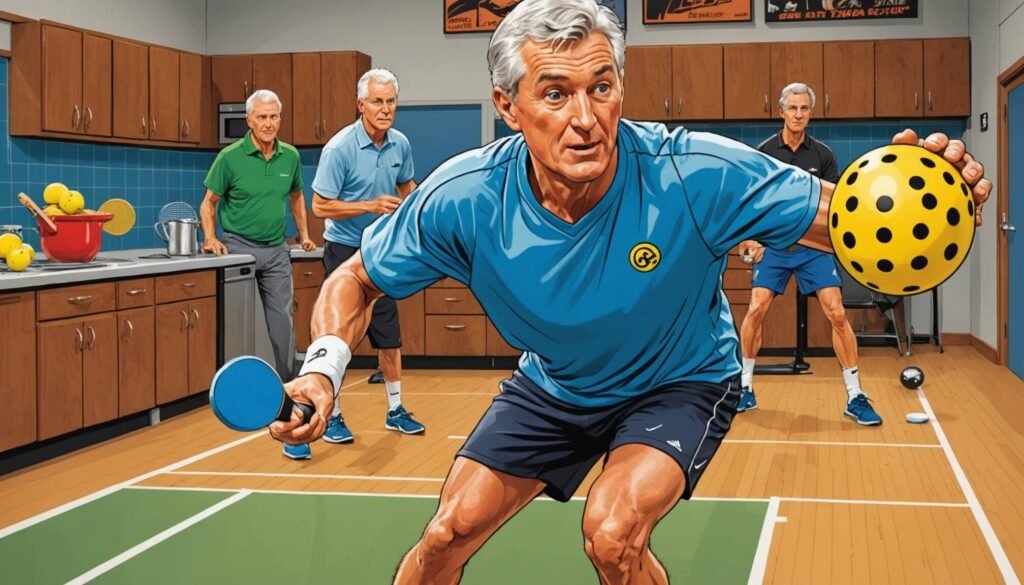
When a ball is hit hard at your midsection, your natural instinct is to raise your elbow to try to get your paddle on the ball. The result looks exactly like what it sounds like — your elbow flares out like a chicken wing, your paddle face turns sideways or even backward, and you end up making contact with the ball near your ribs or hip with almost no control over where it goes.
The chicken wing shows up at the kitchen line most often because that’s where balls arrive the fastest and you have the least time to react. But as you’ll see below, the solution isn’t about reacting faster. It’s about being in the right position before the ball gets there.
Fix 1: Point Your Paddle Tip at the Ball
This is the single most important fix, and it addresses the root cause of nearly every chicken wing you will ever hit. Bad paddle tracking. Watch your paddle in the instant right before your opponent makes contact with the ball. If the tip is pointing sideways, off to the side, or down toward the ground, you are already behind. The paddle face is no longer square to the incoming ball, and when a fast drive arrives at your body, there is simply no time to reorient it. Your elbow shoots up in a panic and the chicken wing happens.
The fix is to keep your paddle tip pointed at the ball at all times, tracking it as it moves. When your paddle tip follows the ball, your paddle face stays naturally square to it. A ball aimed at your body then meets a ready, flat blade rather than a folded, jammed elbow. You catch it out in front, you have control, and the exchange stays competitive instead of ending in an error.
This sounds simple, and it is — conceptually. But building the habit takes intentional drilling. Have a partner stand at mid-court and feed balls directly at your body while you focus on one thing only: keeping that paddle tip up and tracking the incoming ball. Don’t try to swing or generate pace. Just meet the ball and block it. Ten minutes of this kind of focused drilling rewires the habit faster than hours of casual live play, because it isolates the exact movement pattern you need and repeats it without distraction.
The moment this becomes automatic — the moment your paddle tip instinctively tracks the ball before you consciously think about it — you will notice the chicken wing disappearing from your game almost entirely. Everything else on this list builds on top of this foundation.
Fix 2: Move Your Contact Point in Front of Your Body
Even with good paddle tracking, you can still get chicken winged if the ball beats you to your chest. The solution is to win the race to contact by taking the ball earlier and further out in front of your body. Specifically, you want to make contact in front of your lead hip, not beside your torso, not near your ribs, and definitely not behind you.
A contact point out in front gives your arm the physical space it needs to swing or block effectively. When the ball is in front of you, your paddle face naturally points at your target. When the ball is even with your body or behind it, your mechanics fall apart — the elbow lifts, the wrist torques, and the shot goes nowhere useful.
This is the same principle that makes clean forehand counters so effective. Elite counterpunchers don’t swing harder than everyone else. They simply take the ball sooner and redirect the pace their opponent already put on it. The contact point is the secret. Take the ball early and you’re in control. Let it come to you and you’re a passenger.
Why do so many recreational players make contact late? Because they have a passive stance at the kitchen line. They stand flat-footed, they wait and see, and by the time a hard drive arrives at their body, the ball has already won the race. The fix is staying on the balls of your feet with a slight forward lean, ready to step into the ball rather than absorb it. Think of yourself as moving forward to meet the shot rather than bracing for impact. That one mental shift changes your body positioning in a way that naturally moves your contact point out in front where it belongs.
Fix 3: Reset the Body Shot Instead of Fighting It
Not every ball that comes at your body deserves a counter-attack. In fact, trying to fire back on a ball that’s got you jammed is one of the fastest ways to lose the point. The smarter play in many situations is to reset the ball — to absorb the pace and drop it softly back into your opponent’s kitchen so they can’t attack again.
To reset effectively, soften your grip. A tight grip transfers pace and sends the ball flying. A relaxed grip absorbs it. Think of your hand and paddle as a catching mechanism rather than a hitting one. Meet the ball out in front with a loose grip and let it deflect softly over the net and into the kitchen. Your opponent provided all the power — you just redirected it downward.
This turns a terrifying body shot into a manageable hands battle that you control. The ball goes low into the kitchen, your opponent has no angle, and the rally resets to a neutral state where you’re back on equal footing.
Knowing when to reset versus when to counter is its own skill that develops with experience. The general rule is this: if the ball is on you and you feel jammed, reset. If you get a clean look with the ball out in front and at a hittable height, you can consider speeding up. The players who stop getting hurt at the kitchen are the ones who default to the reset when in doubt rather than swinging for the counter and popping the ball up for an easy put-away.
Fix 4: How to Protect Your Body at the Kitchen Line
Protecting your body at the kitchen is about making yourself a smaller, harder target while keeping your paddle in an optimal position to respond to whatever comes. Picture a bullseye on your chest and think about how to make it as difficult to hit as possible. That means making a small adjustment with your core — a slight rotation that narrows your profile — and keeping your non-hitting hand up and in front of your body. That free hand does more than most players realize. It provides balance, it protects your chest, and it gives your paddle arm a reference point for where to be.
Footwork is equally important here. Players who get repeatedly attacked at the body are often reaching across themselves instead of shuffling to a balanced position where both hands are out in front. When you reach, your paddle is behind your body and your contact point is late. When you shuffle and stay square, you stay in a ready position where your paddle can meet the ball early and with control. That’s why controlling the kitchen is as much about footwork as it is about hands.
Run through this pre-shot checklist before every rally at the net and make it a ritual until it becomes second nature:
- Paddle up and out in front, tip tracking the ball at all times
- Grip relaxed and ready to either counter or absorb
- Non-hitting hand up to protect your chest and keep you balanced
- Feet active and moving so contact always happens in front of your lead hip
These four checkpoints address the body mechanics that prevent the chicken wing before the ball ever gets to you. The chicken wing is a reaction — but it’s a reaction to poor positioning. Fix the positioning and the reaction changes automatically. Smart defense at the kitchen line is about getting back to neutral footing quickly, and this checklist does exactly that.
Fix 5: Build the Hand Speed That Buys You Time
Better paddle position will eliminate the vast majority of chicken wings from your game. But there’s still a category of shots — the truly fast, hard-driven ball at your midsection — where even good positioning isn’t quite enough on its own. For those, you need faster hands. And faster hands are trainable. You just need to put in the reps.
The most efficient tool for building hand speed in pickleball is a wall. Wall drills force your hands to process and respond to a fast-moving ball in a tight window with no time to reset between shots. They replicate the urgency of a kitchen line exchange without requiring a partner, a court, or a full practice session. Ten minutes of focused wall drilling per day produces measurable improvement in hand speed faster than almost any other method.
The progression is simple: alternate forehand and backhand blocks against the wall, keeping your elbow down throughout. After each shot, actively reset your paddle to the ready position — tip up, face square — before the ball comes back. Start slow and controlled. Then gradually increase your pace into the wall and practice blocking the faster rebound. You can check out drills to play your best pickleball for a more complete structured approach to this kind of training.
One small technical adjustment that makes a noticeable difference in tight exchanges: choke up slightly on your grip. Moving your hand a half inch up the handle makes the paddle feel lighter and more maneuverable in your hand. When a ball is coming at your body at speed, a slightly shorter lever is easier to redirect quickly. It’s a small thing but in the context of a fast hands battle, small things matter.
Watch Anna Leigh Waters at the kitchen line and you’ll see all five of these fixes operating simultaneously in real time. Her paddle tip is always on the ball. Her contact is always out in front. Her grip softens and tightens with perfect timing depending on the situation. And her hands are already set before the ball arrives. That’s why she almost never gets chicken winged even against the hardest speedups in the game. The habits are so deeply ingrained that they don’t require conscious thought. That’s the goal — and with focused drilling on these five fixes, it’s completely reachable for players at any level. You can also study modern pickleball strategies to see how these principles apply across the whole game.
Frequently Asked Questions
What does chicken wing mean in pickleball?
The chicken wing is the awkward, jammed shot you make when a ball is hit hard at your body and you’re forced to raise your elbow and turn your paddle sideways to get it on the ball. The name comes from the raised elbow, which looks like a wing. It almost always results in a loss of control and a weak shot that your opponent can easily put away.
Why do I keep getting chicken winged in pickleball?
Almost always because your paddle is in the wrong position before the ball arrives. If your paddle tip is pointing sideways or downward when your opponent makes contact, you cannot get the face square in time. The ball jams you at the body, your elbow flies up, and the chicken wing happens. Fix your paddle tracking and the problem largely solves itself.
How do I stop getting jammed at the kitchen line?
Keep your paddle up and out in front with the tip tracking the ball at all times, and focus on making contact in front of your lead hip rather than beside or behind your body. Add a relaxed grip so you can absorb and reset soft body shots rather than fighting them with a swing that gives you no margin for error.
Is the chicken wing a backhand or forehand problem?
It most commonly shows up on balls aimed at your dominant shoulder and hip, where the instinct is to lift the elbow to protect yourself. Building a reliable backhand counter gives you a cleaner option on those balls rather than defaulting to the chicken wing as a survival shot.
What drill fixes the chicken wing fastest?
Wall drills. Alternating forehand and backhand blocks against a wall trains your paddle to stay in front, stay square, and reset quickly between shots — which is the exact position and habit that prevents the chicken wing from happening in the first place. Ten focused minutes a day will produce results faster than you expect.


