
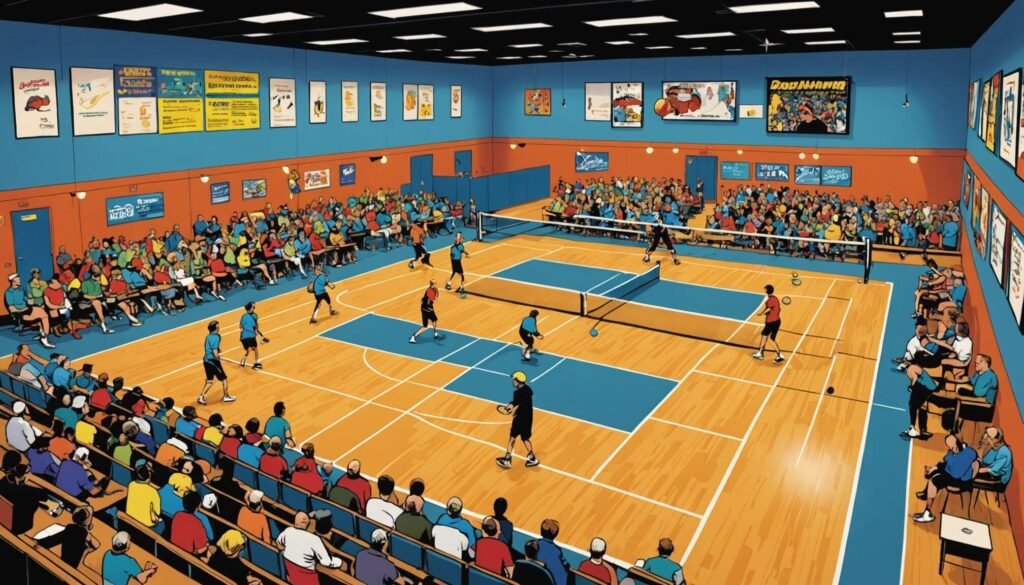
5 Things the Best Pickleball Clubs in the U.S. Get Right
After visiting more than 75 pickleball facilities across 19 states and seven countries and territories, writer and pickleball content creator Kaitlyn Kerr has seen it all — the good, the bad, and the acoustically catastrophic. Her ongoing series, The Joy of Pickleball, has taken her through a former Macy’s in Richmond, a 1930s Times Square theater where Frank Sinatra once performed, a sleek mid-century modern club in Beverly Hills, Michigan, and a 50,000-square-foot “urban country club” in St. Petersburg, Florida that sold out 800 memberships before it even opened its doors.
Every single one of those clubs looked different on the surface. Different layouts, different vibes, different price points. But the ones where players were genuinely happy — where people stuck around, came back, and told their friends — got the same five things right. Here’s what those things are, why they matter, and what you should look for whether you’re choosing a club to join or building one from the ground up.
A Quick Primer: What Makes a Pickleball Club Different from Just Having Courts?
If you’re newer to pickleball or just getting into the scene, you might wonder what the big deal is. Can’t you just show up, grab a paddle, and play? Technically, yes. But a great pickleball club is something different entirely. It’s a place built intentionally around the game and the people who play it. Think of the difference between eating a meal at a fast food counter versus sitting down at a restaurant where someone actually thought about the lighting, the acoustics, the food, and whether you feel comfortable enough to stay for another hour after you finish. The courts are the food. Everything else is the experience. And increasingly, players are choosing clubs the same way they choose restaurants — based on how the whole thing feels, not just whether the courts are open.
The pickleball club landscape in the U.S. has exploded over the last several years. Some facilities are thriving. Others are closing because of brutal economics — bad leases, oversized footprints, and business models that couldn’t survive the post-boom shakeout. The clubs that are making it share a clear set of priorities. Here they are.
1. Build for the Player First — Not the Spreadsheet
This one sounds obvious, but it’s surprisingly rare in practice. Players will forgive a lot of things about a club — a mediocre snack bar, a slightly dated logo, limited parking. What they will not forgive is a court that feels wrong to play on. And the things that make a court feel wrong are almost always decisions that were made during construction to save money or squeeze in an extra court.
Run-off space behind the baseline matters enormously. You need room between courts for an ATP attempt. And ceiling height is not optional — if the ceiling is too low, a good lob dies in the rafters, and the game feels truncated. These are things you absolutely cannot fix after the lease is signed. The layout is baked in.
The clubs that get this right make a choice that looks painful on paper. Sam Sood, owner of Pickleball Kingdom in Hamilton, NJ, put just 14 courts into more than 40,000 square feet of space. He could have fit more courts. He chose not to. He decided that players who love the game deserved room to actually play it.
Ceiling height follows the same logic. CityPickle founders Erica Desai and Mary Cannon have said that when they walk into a space with high ceilings and no load-bearing columns interrupting the floor plan, they immediately know it’s right for pickleball. It’s one of the first things they look for.
Lighting is where most facilities quietly fall apart, and most players never consciously identify it as the problem — they just know something feels off. The design firm JDC, founded by Ben and Collin Johns, calls lighting the number one player complaint in clubs they consult with. The typical failure is gym-style fixtures mounted directly overhead and pointed straight down at the court, which creates shadows and hotspots. JDC recommends mounting lights beyond the court’s edge and angling them inward, distributing illumination evenly so there’s no such thing as a “good court” and a “bad court” based on where the light falls. Fixtures that are too bright also cause squinting and eye fatigue, which hurts your game whether you realize it or not.
Pickleball Kingdom brought in engineers with light meters to calibrate every court evenly, mounting fixtures along the sidelines rather than above. Zero Zero Two in Fort Collins kept lights off the courts entirely and used reflectors to cut glare. Down the Line in Annandale, Virginia, painted the walls behind the courts dark so the bright ball pops visually against the background. None of this is flashy. None of it shows up in marketing materials. But all of it shows up in how you play.
2. You Should Be Able to Hear Yourself Think
Pickleball is inherently loud. Hard paddles, a hollow plastic ball, a dozen courts all running simultaneously — put that inside a big box building with concrete floors and a metal roof, and you get something that sounds less like a sports facility and more like a construction site. This is one of the most underrated problems in club design, and it’s one of the most fixable when addressed from day one.
If you can’t hear your partner call “yours” from ten feet away, or hold a normal conversation at the bar between games, you’re not going to want to stay. Nobody lingers in a space that requires shouting. The social side of pickleball — which is a huge part of why people love the game — depends on being able to actually talk to each other.
The clubs that solved acoustic problems treated sound as a design constraint, not an afterthought. Paddle + Par in Beverly Hills, Michigan, lined its walls with acoustic panels and installed ceiling “clouds” — sound-absorbing panels suspended overhead — so that 11 courts of continuous play still feel relatively calm inside. The result is a club comfortable enough that people come in just for lunch or dinner and sit near the courts to enjoy the atmosphere without being overwhelmed by it.
Zero Zero Two wrapped its walls in a thick vinyl material that absorbs and breaks up sound waves rather than reflecting them back into the room. In their conference spaces, the noise from the courts all but disappears. St. Pete Athletic went so far as to build a soundproof phone booth on the premises so members can take work calls without their boss knowing they’re at a pickleball club mid-afternoon. It’s apparently so popular they’re adding a second one.
Sound is the most underrated line item in a facility budget. Players may not be able to articulate what’s wrong when the acoustics are bad, but they feel it — and they leave. According to reports on why busy clubs still lose money, missed opportunities around the member experience are a major hidden cost, and poor acoustics are a prime culprit in members not staying or not renewing.
3. Give People a Reason to Stay Off the Court
Not every club needs to be a full restaurant. Some owners are laser-focused on building the best possible pickleball facility, and that’s a completely legitimate vision. The team at PickleBOS in Boston made it clear: pickleball players want to play pickleball, and everything else is secondary to that. But even they built a bar and an open lounge that flows directly onto the courts, and they hand out free balls so nobody has to pay to borrow equipment. Even the most play-first clubs understand that people need somewhere to exist when they’re not actively on the court.
At other clubs, food and beverage are genuinely part of the draw. At Performance Pickleball in Richmond, Kaitlyn encountered a group of women whose regular routine is two hours of play followed by drinks at the bar — and the second half of that equation matters just as much as the first. SPF in Chicago sources its coffee, pastries, and sourdough from local neighborhood businesses rather than generic suppliers. Paddle + Par bakes its own bread. St. Pete Athletic makes its own ketchup. These are not accidental details. They’re intentional signals that the club takes the full experience seriously.
The business case for this is straightforward. One club featured in the series hosted three events of more than 500 people in its first week. Almost every club Kaitlyn visited books birthday parties and corporate outings regularly. SPF members have reportedly planned events as significant as rehearsal dinners there. A court rents for an hour. A place people genuinely want to be in can book the whole evening and charge accordingly.
The clubs that miss on this don’t fall in one clear direction — they just fail to commit to either option. A front desk, a row of courts, and nowhere comfortable to sit afterward feels like renting a gym. People leave the minute their session ends, and they don’t develop any attachment to the space. Compare that model to what’s happening at the clubs that are thriving, and the difference is obvious. The challenges that brought down The Picklr were multifaceted, but a lack of compelling reasons for members to stay and spend was part of the picture.
4. Tech on Every Court, Not Just the Showcase Court
A few years ago, video replay and digital scoring were reserved for a single feature court — the one with good lighting and a camera pointed at it for special events. That era is over. Every facility Kaitlyn visited for The Joy of Pickleball now has replay and digital scoring on every court, and players notice when it’s missing. As one owner put it, there’s no good reason why only a couple of courts get the full experience.
The obvious use case for court technology is entertainment — being able to pull up a highlight of your best shot and share it immediately is genuinely fun, and it creates social media content that markets the club for free. But the more important use case is player development. Coaches across multiple clubs made the same observation: players can hear an instruction a hundred times, but they don’t actually absorb and correct until they see themselves doing it wrong. A replay closes that gap in seconds. A coach at Performance Pickleball in Richmond said it changed how she teaches — instead of trying to describe what a student did with their body, she just shows them the footage, and they get it immediately.
This extends to data. Running match footage through tools like PB Vision gives players specific, actionable information they couldn’t get any other way. Kaitlyn discovered through her own analysis that only half her serves were landing in the deep third of the service box — and that she should be targeting 75 to 80 percent. She had no idea before seeing the numbers. That kind of insight doesn’t happen without court technology.
The operational benefits are real too. At PickleBOS in Boston, the tournament director said the club’s court management system handles standings and court assignments so completely that he gets to be a viewer at his own tournaments rather than running around with a clipboard. And the highlight clips that members generate have real reach — one club reported that member content has generated over 875,000 impressions for its partners. Courts with good tech become content machines, and content drives membership.
5. People Build the Community — Not the Building
You can replicate a floor plan. You can copy the acoustic panels, the lighting setup, the court dimensions, and the menu. You cannot copy a culture. And culture is ultimately what separates the clubs players are fiercely loyal to from the ones they drift away from when something shinier opens down the street.
Every club that Kaitlyn would genuinely want to return to had owners and staff who were present, intentional, and personally invested in the people walking through the door. PickleBOS operates on what it calls a “one member at a time” policy — every single member gets personally welcomed and heard, and the owners would rather be on the floor during open play than behind a desk running reports. At Zero Zero Two, the front desk staff greeted members by name. The ownership team surveys members regularly, acts on the results, and deliberately caps membership so courts are always available. One member described the atmosphere as being like a family picnic — but without the weird uncles.
At Down the Line in Annandale, Virginia, founder Jenni Bae talked about one of the reasons she kept playing pickleball in the early days: her dad got hooked on the game, and it became their shared activity. That’s not a marketing angle. That’s what pickleball actually does to people when the right environment surrounds it.
Courts, sound design, space, and technology are all table stakes now. They get people through the door once. But as analysis of the post-boom market makes clear, community is the real moat. You can pour concrete in 90 days. You cannot manufacture belonging. The clubs that understand this are the ones that are still full two years after opening.
The Bottom Line: The Bar Has Moved
A warehouse with nets stretched across some painted lines isn’t really a pickleball facility anymore. It’s a placeholder — something players use until something better opens nearby. And in most U.S. markets, something better has either already opened or is coming soon.
Players in 2025 and beyond are showing up with real expectations. They expect courts that are actually built for the game — with proper run-off, ceiling clearance, and even lighting. They expect to be able to hear themselves think. They expect somewhere to be when they’re not playing. They expect technology that makes every match more useful. And they expect to be known by name by at least one person on staff.
The clubs that are checking all five of those boxes are the ones with waitlists for memberships, full event calendars, and the kind of organic word-of-mouth that no marketing budget can buy. The ones that aren’t are learning that full courts on a Tuesday afternoon don’t guarantee a solvent business — a reality that detailed reporting on club economics has made increasingly clear.
There’s one last unofficial test Kaitlyn runs at every club she visits: she asks to see the bathrooms. A club that takes its bathrooms seriously almost always takes everything else seriously too. CityPickle Times Square passed with art deco details that nod to the building’s history as the Paramount Theater. St. Pete Athletic has the best member locker rooms she’s seen anywhere, down to the sink faucets. It sounds like a quirky heuristic, but it holds up: the clubs that sweat the small stuff tend to get the big stuff right too.
The pickleball club landscape is maturing fast. The era of opening anything with courts and calling it good is over. What’s replacing it is genuinely exciting — facilities that take the game and its players seriously, built by people who understand that the best clubs aren’t just places to play. They’re places people actually want to be.
Watch every episode of The Joy of Pickleball on YouTube to see these clubs up close for yourself.


