How to Hit a Pickleball at Your Feet Without Popping It Up
There’s one shot that shows up constantly in pickleball and almost never gets taught properly: the ball at your feet. You’ll face it on nearly every single game you play — after a serve, in the middle of a transition, scrambling near the baseline — and yet most players handle it the same wrong way every single time. They panic, swing too hard, and float a gift right to their opponent at the kitchen line. Then they shake their heads and blame their hands.
It’s almost never the hands. The problem runs deeper than that, and the fix is simpler than you’d think. Knowing how to handle a ball at your feet is genuinely one of the highest-leverage skills you can develop in pickleball, and it comes down to three things: getting your feet there before your hands need to do anything, shortening your swing dramatically, and using your paddle face to absorb pace rather than redirect it.
This article is going to walk through all of it — the mechanics, the mindset, the drills, and the decision-making — in a way that makes sense whether you’ve been playing for two months or two years.
What’s Actually Happening When a Ball Lands at Your Feet
Before getting into the fixes, it helps to understand what’s going wrong mechanically when this shot goes sideways. Picture the scenario: you serve, your opponent rips a flat return that skids deep and stays low. You’re mid-shuffle somewhere around the baseline or in the transition zone, the ball is already below your knees, and your paddle is nowhere near in position.
The immediate instinct for most players is to reach for it. One big lunge, arm extended, paddle arriving late and still partially closed. The ball catches the face at the wrong angle and flies upward instead of forward. Now your opponent is looking at a ball sitting above net height — what coaches call the attack zone — and they’re about to put it away.
Here’s what’s really going on in that moment. A hard return traveling inside fifteen feet gives you a reaction window measured in fractions of a second. A full backswing simply does not fit in that window. The paddle arrives late, the face is wrong at contact, and the result is a pop-up. And when you reach for it rather than stepping to it, you lose your balance before you even make contact. Once your chest drifts past your front foot, you are hitting off a broken base and the shot is basically already lost.
There’s also a safety dimension worth mentioning. Research on pickleball injuries has identified lunging forward and planting the foot as one of the most common injury mechanisms, with falls being the leading cause overall. A five-year injury study pointed to explosive, off-balance maneuvers as the pattern that kept showing up in the data. Moving your feet properly isn’t just better technique — it’s genuinely safer than throwing your body at a low ball and hoping for the best.
For Someone New to Pickleball: Here’s What All of This Means
If you’re newer to the game and some of this terminology is a bit unfamiliar, let’s slow down and explain it plainly. In pickleball, the kitchen is the non-volley zone right at the net — the area where a lot of the game gets decided. The transition zone is the middle part of the court between the baseline (the back line) and the kitchen line. It’s a difficult area to be standing in because you’re neither far back enough to have time to react, nor close enough to dominate the net.
When the ball lands at your feet in this middle zone, you’re in a tough spot. The ball is low, which means you have to get your paddle under it to hit it back over the net — but the more you angle your paddle upward to clear the net, the more likely the ball is to sail too high and give your opponent an easy put-away. This is the core challenge of the shot, and it’s what makes it so tricky for recreational players.
The good news is that the solution isn’t about developing lightning-fast hands or superhuman reflexes. It’s about positioning, grip, and making smart decisions about what kind of shot to attempt based on where you’re standing. Any player at any skill level can get meaningfully better at this with a little focused practice.
Your Feet Are the First Fix, Not Your Hands
This is the most important thing to understand about handling low balls: your feet are doing the real work, not your hands. Players who are consistently good at absorbing pace on low balls have usually solved the footwork long before the shot arrives. They get to the ball with small adjustment steps rather than one desperate lunge, which means they’re never stretched out and off balance at contact.
The footwork in the transition zone is something that transforms this shot more than anything else. Players who fix their feet stop needing spectacular hands because they’re never out of position in the first place.
Three small adjustment steps beat one big lunge every single time. A lunge is a commitment — you plant and you’re stuck. Three small steps keep you adaptable as the ball dips and skids, which matters because a low hard return rarely ends up exactly where you first read it. It moves, it skids differently depending on the court surface, and it forces you to keep adjusting your read throughout its flight.
Start from a genuine ready position: feet a touch wider than shoulder width, knees flexed, hips pushed back so your chest stays stacked over your base. When you move to the ball, bend at the knees, not the waist. Bending at the waist drops your head, and when your head drops, your posture and balance go with it. Knees down, chest up, and move your feet first.
Where the Ball Should Be at Contact
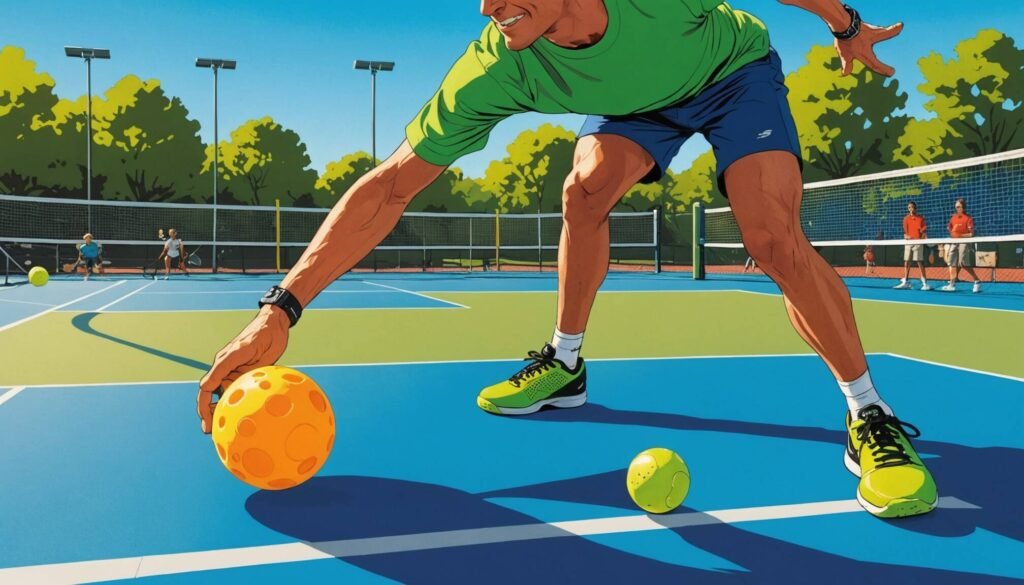
Once your feet have done their job, your contact point needs to be right. The target is to catch the ball slightly in front of your body, somewhere around knee height. That’s the whole thing. Coaching guidance on the return of serve puts the ideal contact point at about knee level and just ahead of the body, and the exact same geometry applies to any low ball you’re forced to absorb mid-rally.
Contact behind your hips is what causes the jammed feeling most players hate. When the ball gets behind you, your elbow folds, your wrist takes over trying to compensate, and you get what coaches call the chicken wing — that awkward, cramped motion where your arm is stuck at an angle that gives you almost no control. If you find the ball is consistently landing behind you, step back first, then swing. A half step backward creates the contact window. It sounds counterintuitive, but a half step back is worth more than any amount of extra arm strength.
If you’re regularly late against a hard-hitting opponent, the problem is likely upstream. Learning to read and anticipate shots earlier buys you that extra fraction of a second that makes all the difference at the contact point.
Grip Pressure and Paddle Face: The Contact Recipe
Here’s where most players make their second big mistake, right after the footwork issue. When a ball comes in hot, the competitive instinct is to tighten up and swing harder. Both of those responses actively make the shot worse.
A tight grip turns your paddle face into a trampoline. The ball rebounds off it with all the pace your opponent put on it, amplified, and now it’s flying high. A loose grip pressure lets the paddle give slightly at impact, absorbing pace instead of returning it. This is the same principle behind a good reset shot — it’s just executed under more pressure and from a lower contact point.
In practice, you want your grip pressure somewhere around a three or four out of ten when handling a low, fast ball. Firm enough that the paddle doesn’t twist on impact, loose enough that your forearm is relaxed and not bracing. Most recreational players are gripping at around an eight or nine without realizing it, and that tension travels up the arm, through the shoulder, and kills any chance of a soft, controlled response.
A continental grip helps here because it lets you open the paddle face slightly without needing to rotate your wrist during the shot. Open the face, hold it steady, and let the ball come to it. You are not swinging. You are presenting a surface. Think of it as a push block — a controlled, compact deflection rather than an aggressive strike. That mentality applies to any ball below net height, including a soft shot dropping right at your feet near the kitchen line.
If your swing goes past your hip, the ball is almost certainly going up. Keep the motion compact — shorter than feels natural — and the ball stays low.
What to Actually Do With the Ball Once You’ve Absorbed It
The contact is only half the equation. The other half is choosing the right shot based on where you’re standing on the court. This is where a lot of players go wrong even after they’ve sorted out the mechanics — they try to do too much with a defensive situation and end up giving away the point anyway.
Three positions cover almost every scenario you’ll face:
Deep in the court, behind the baseline: Don’t try to drop from back there. A controlled drive is far more reliable and gets you out of trouble more effectively. There’s good reason coaches consistently say don’t drop from deep — a drop from the baseline is a very low-percentage shot that requires exceptional touch to execute well, and in a pressure situation, it’s almost always the wrong call.
Mid-court, inside the transition zone: Reset it soft into the kitchen and keep moving toward the net. The two-position reset strategy is built exactly for this moment. Your goal from mid-court is neutralization — get the ball low, get it into the kitchen, and advance. Don’t try to win the point from here.
Close to the kitchen line: Block it low back at their feet and make them solve the same problem you just handled. A low, compact block keeps the ball out of the attack zone and shifts the pressure back to your opponent.
The overarching mindset shift is this: a low ball at your feet is almost never a moment to counterattack, especially against a hard hitter. The best play is often to give them nothing. That’s the core idea behind the strategy for beating bangers and why understanding when to block versus counter is more valuable than raw speed in the hands.
A Simple Drill You Can Do Alone Right Now
You don’t need a partner to get better at this. Stand about six feet from a wall, hit low balls into the bottom two feet of it, and return every rebound below knee height with a compact block. No full swing — if the paddle goes past your hip, it doesn’t count. Try to do twenty in a row on the forehand side, then switch to the backhand.
Wall drills are genuinely underrated for this specific problem because the ball comes back fast and low every single time. There’s no letup, no friendly bounce, just constant pressure — which is exactly the condition you’re training to handle. The quick repetitions build the compact swing habit far faster than most forms of partner drilling can.
Add it to whatever solo routine you’re already running. Two minutes, three times a week, and you’ll notice a difference in a surprisingly short amount of time. A proper warm-up that includes dynamic movement also makes the deep knee bend more available early in a session — and injury researchers have pointed to dynamic warm-ups and balance work as sensible ways to reduce risk during these lower-body-intensive movements.
Once you’re consistently absorbing the ball cleanly, the next evolution is getting forward behind it. That’s where the return plus one concept and a well-executed third shot drop turn what started as a defensive scramble into a rally you’re actually controlling.
Key Takeaways
- The ideal contact point for a ball at your feet is slightly in front of the body at roughly knee height — not level with your torso, and definitely not behind your hips.
- Bend at the knees, not the waist. Bending at the waist drops your head and kills your balance before contact happens.
- Use three small adjustment steps instead of one big lunge. Falls and forward lunging are among the most frequently reported pickleball injury mechanisms according to research.
- Drop grip pressure to around three or four out of ten so the paddle absorbs pace rather than rebounding it back high.
- Open the paddle face slightly and block. Any swing longer than hip-level creates pop-ups on low balls.
- Choose your shot by position: drive from deep behind the baseline, reset from mid-court, block low when you’re close to the kitchen line.


