
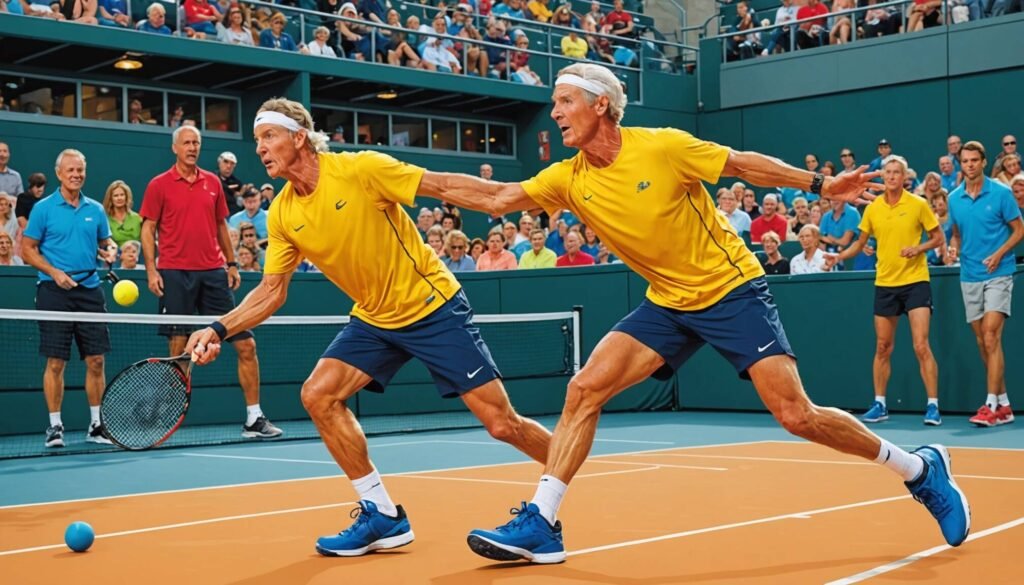
Want to Play Better Pickleball? Stop Thinking So Much
There’s a good chance the biggest thing standing between you and better pickleball isn’t your backhand, your footwork, or your paddle. It might actually be your own brain.
That’s the takeaway from an unlikely source — an NHL goalie — whose postgame interview recently went viral and sparked a conversation that every pickleball player, from beginner to pro, should pay attention to.
What a Hockey Goalie Can Teach You About Pickleball
Calgary Flames goalie Devin Cooley sat down after a standout performance and gave one of the most genuinely insightful athlete interviews in recent memory. He talked openly about the psychology behind his game, specifically the role of the unconscious mind in elite athletic performance. His core message was simple but profound: he plays his best hockey when he stops consciously directing every movement and instead lets his body do what it’s been trained to do. He reacts, he trusts, and he gets out of his own way.
In the viral interview, Cooley put it plainly: “I have to let my unconscious brain do the work because it reacts a lot quicker.”
That line landed hard for a lot of people, and for good reason. Whether you’re a goalie tracking a puck at 90 miles per hour or a pickleball player in the middle of a lightning-fast hands battle at the kitchen line, the principle is exactly the same. Conscious thought is slow. The unconscious mind is fast. When the game speeds up, your thinking brain simply cannot keep up — and trying to force it to do so will almost always make things worse.
Professional pickleball player Alex Crum, who competes on the PPA Tour and in Major League Pickleball, reflected on Cooley’s words and made the connection to pickleball explicit. The lesson translates almost perfectly, and it’s something that recreational and competitive players alike would do well to internalize.
The Kitchen Line Is Where Overthinking Goes to Die
If you’ve ever been in a real fast hands battle at the non-volley zone, you already know this intuitively even if you’ve never put it into words. The ball is moving at incredible speed. Exchanges happen in fractions of a second. There is literally no time to run through a mental checklist — keep your paddle up, watch the ball, stay balanced, maintain grip pressure, reset your feet — while someone is firing speedups directly at your chest.
If you try to think your way through it, you’re already behind. By the time your conscious brain has processed the situation and started formulating a response, the ball has already passed you. That’s just the reality of how fast modern pickleball is played, especially at the kitchen line where the game compresses into an almost reflex-driven back-and-forth.
The players who thrive in those moments are not the ones who think faster. They’re the ones who have practiced enough that they don’t have to think at all. Their hands move where they need to move. Their paddle finds the right angle. Their feet shift automatically. It’s not magic — it’s repetition that has been so thoroughly drilled that it’s moved from conscious effort into unconscious habit.
Athletes across sports describe this experience as being “in the zone” or achieving a flow state. It’s that feeling where everything clicks, where you’re not grinding through decisions but simply playing, where your body seems to know exactly what to do without your brain having to issue any instructions. It’s one of the most satisfying experiences in any sport, and pickleball is absolutely no exception. The goal should be to get there as often as possible — and understanding what actually gets you there is the first step.
Here’s the Catch: You Have to Earn the Right to Stop Thinking
Here’s where a lot of players get this concept wrong. They hear “think less” and they take it to mean “practice less” or “just relax and it’ll come.” That’s not it at all. The ability to play on instinct is not something you can just decide to do. It’s something you build through an enormous amount of deliberate preparation.
The more time you put into consistent practice, the more your body internalizes the mechanics of each shot. The dink, the reset, the third shot drop, the ATP — none of these feel natural at first. They require conscious effort and active concentration in the early stages of learning. But with enough repetition, they start to shift. They move from the front of your mind into something deeper, something more automatic. And that’s when the game really opens up.
What you’re essentially doing through practice is building trust. Not just trust in your mechanics, but trust in yourself. Trust that your body will do the right thing even when your conscious mind isn’t directing every move. That trust is what allows you to stay calm and loose in high-pressure moments instead of tensing up and trying to manually control every action.
Crum spoke honestly about what happens when that practice foundation isn’t there. He’s dealt with injuries over the past year that limited his ability to train consistently, and he noticed the difference — not in whether he could physically execute shots, but in the depth of his belief that he would execute them when it mattered most. There’s a real gap between knowing you’re capable of something and genuinely trusting that you’ll come through when a match is on the line. Practice is what closes that gap. Without it, even the most talented players can feel a little untethered under pressure.
Breaking It Down for the Newer Player: Why This Matters for You Too
If you’re relatively new to pickleball, or if you’ve been playing casually for a while without thinking too deeply about the mental side of the game, this concept might feel a little abstract. So let’s ground it in something concrete and relatable.
Think about learning to drive a car. When you first started, it was genuinely overwhelming. You had to consciously think about every single thing — checking mirrors, managing the gas pedal, steering smoothly, watching other cars, reading road signs, all at the same time. It required massive mental effort and felt exhausting. But after months and years of driving, you stopped having to think about any of it. You just drive. Your hands and feet know what to do. You can hold a conversation, listen to music, and navigate a busy highway without consciously processing each individual action.
That’s exactly what happens in pickleball with enough practice. The mechanics of your shots, your court positioning, your reaction to different ball speeds and spins — these all gradually stop requiring conscious thought and start happening automatically. And when that happens, your mind is free to focus on higher-level things, like reading your opponent, identifying patterns, and making strategic decisions. Or, in the fastest moments of a point, your mind is simply free to get out of the way entirely and let your training take over.
For newer players, this should actually be incredibly encouraging. You don’t need to figure everything out right now. You don’t need to master the mental game before you’ve built the physical foundation. What you need to do is put in the reps, be patient with yourself as the mechanics slowly become more automatic, and trust that the mental ease will follow the physical preparation. It always does.
The experience you accumulate on the court is genuinely valuable. Every drill, every rec game, every competitive match adds another layer to your unconscious competence. Even when it doesn’t feel like you’re improving, your nervous system is quietly cataloging information and building the kind of deep pattern recognition that eventually shows up as instinct.
Practice with Your Brain. Play with Your Body.
The practical takeaway here is worth stating clearly because it’s easy to misapply this idea. Practice is absolutely the right time to think consciously and analytically about your game. Work through your mechanics in drills. Identify weaknesses and spend focused time on them. Be deliberate, be attentive, be willing to slow things down and really examine what you’re doing and why.
But when you step into a real competitive point, especially a fast or high-pressure one, your job shifts. Your job is no longer to analyze and correct. Your job is to trust and react. Let the work you’ve done in practice do its job. Don’t override it with conscious interference. Give your body the space to do what it’s been trained to do.
This is genuinely one of the harder skills in pickleball to develop, not because the concept is complicated but because it requires a kind of mental surrender that doesn’t come naturally to a lot of people, especially competitive ones. When things go wrong in a point, the instinct is to tighten up, to think harder, to try to consciously fix whatever went wrong. And that instinct almost always makes things worse. The better response — the one that elite players have learned — is to breathe, reset, and trust the process all over again.
The next time you’re in a tense rally, on game point, or facing a fast hands exchange that feels like it’s moving too fast to handle, don’t reach for your mental checklist. Reach for your training instead. Trust that it’s there. React to what’s in front of you. Let your unconscious brain do the work it’s been quietly preparing to do.
The Bigger Picture: Mental Performance Is a Real Part of the Game
What Devin Cooley’s viral moment really highlights is that mental performance isn’t some soft, secondary concern in sports. It’s central. At every level of pickleball — from beginners struggling to keep the ball in play to professionals competing for titles on the PPA Tour — the mental dimension of the game shapes outcomes in very real ways.
Understanding how your brain works under pressure, and specifically understanding the relationship between conscious thought and unconscious reaction, gives you a real edge. Not because it’s a shortcut, but because it helps you direct your energy in the right places. Work hard in practice, build real confidence through genuine repetition, and then when it’s time to compete, get your brain out of the way and let your preparation speak for itself.
That’s the lesson. And it applies whether you’re stopping pucks in an NHL arena or dinking it out at your local recreational courts on a Tuesday evening. The unconscious mind, properly trained, really is faster and smarter than conscious thought in the heat of competition. The goal is to earn the right to use it.
Keep putting in the work. Trust the reps. And next time you step on the court, give yourself permission to just play.


