
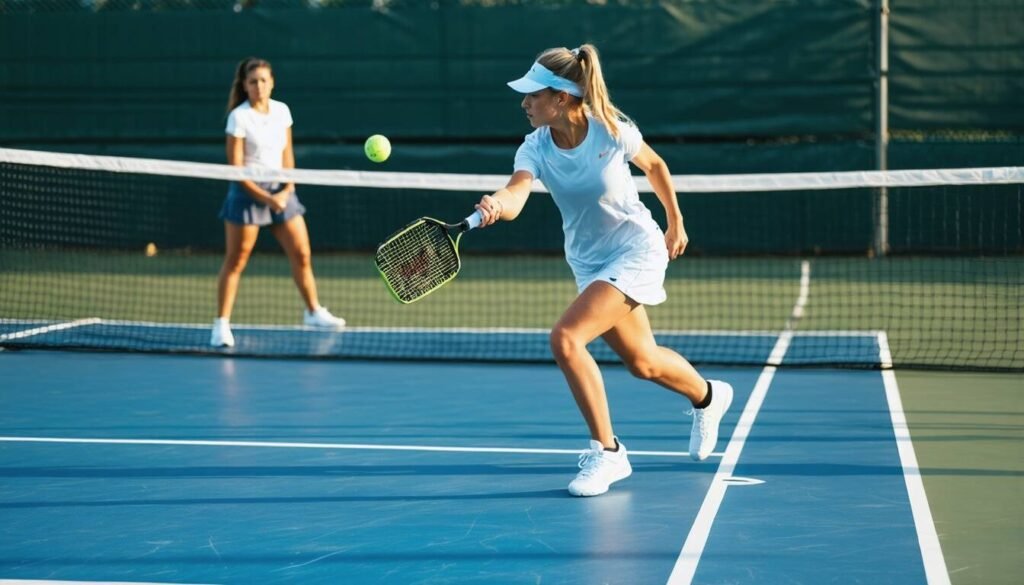
Backhand Return Fixes: How to Turn a Passive Push Into a Drive That Pressures the Server
Most pickleball players spend hours working on their serve, their third shot drop, and their dinks. The return of serve gets far less attention, even though it happens on every single point the receiving team plays. A weak backhand return is one of the quietest ways to lose rallies. It can land deep, look perfectly fine, and still hand the serving team a free, comfortable third shot.
That was the exact problem in a recent coaching session from Cori Elliott, shared by The Dink. Her student described her returns as “deadish.” Cori saw why right away: half topspin, half push, with nothing committed to either one. What follows is a reflective look at the six adjustments Cori used to turn that passive shot into a drive that makes servers uncomfortable, plus a plain-English section for anyone newer to the game.
Why a Deep Backhand Return Can Still Feel Dead
There is a common belief in recreational pickleball that depth is everything. Get the return to the baseline and you have done your job. That is partly true, but depth by itself is not a weapon. If the ball arrives with no pace and no purpose, the server can step in and attack it. The return may be deep, but it is still easy.
Cori’s diagnosis was blunt. Her student was pushing the ball instead of driving it. A pushed ball tends to sit up, land closer to mid court than intended, and never forces the serving team to react. If you want to understand why this habit costs points, this breakdown of weak returns explains how a passive return gives away free time.
The fix is to pick a lane. You want real pace and a little topspin, so the ball dips and jumps off the bounce instead of sitting up. If you want more detail on creating that spin, these drive fixes for topspin are a useful companion.
One caution matters here. A scarier return only works if it stays in. If you already struggle to keep backhands in play, start with ways to stop missing before you add pace. Consistency first, then pressure.
What I find most interesting about this diagnosis is how common it is. Plenty of players hit a return that is neither a confident drive nor a purposeful soft shot. It is a hesitant hybrid. The ball goes over, the point continues, and the player never realizes the return was the moment control shifted to the other team. Committing to a clear intention, even a modest one, is often the biggest improvement available.
Fix 1: Step Out and Draw the Paddle Back
Cori told her student that her footwork on the return was already fine, so she should keep it. The change was what the paddle did while she stepped. Step out, then bring the paddle back a little, almost like loading a drive. This lets you absorb the pace of the serve instead of driving through it.
It sounds like a tiny detail, but it changes the timing of the whole shot. Many players take the paddle straight from a ready position to the ball, which leaves no room to organize the swing. A small draw back gives the paddle a path to travel and gives you a bit of space to control the ball.
Cori pointed out that this matters most against big serves. The more pace the server has, the more room you need behind the ball to control it. If deep, heavy serves give you trouble, this guide to beating deep servers is worth reading alongside this fix.
The takeaway is that good footwork alone is not enough. Your feet and paddle need to work as a pair. Stepping into position with a paddle that is still frozen in front of your chest leaves you reacting instead of hitting.
Fix 2: Make Contact Out in Front
The ball should meet your paddle out in front of your body, not beside it or behind it. Contact out front gives you leverage and keeps the paddle face stable through the hit. When you let the ball get too close to your hip, you end up jamming the shot, and a jammed shot is almost always a push.
After contact, finish toward your shoulder, similar to how you finish a backhand dink. You are not swinging wild. You are guiding the ball through a short, controlled arc. That image is helpful because it removes the urge to muscle the ball. The paddle path stays compact, and the pace comes from timing rather than force.
This front contact point is the same idea behind a harder pickleball drive that stays in. If you can only change one thing about your return today, moving the contact point forward is a strong candidate. For the paddle angle side of this, see this topspin paddle angle fix.
Contact point also matters on other shots. If you want to see how it shapes a different stroke, The Dink’s piece on the third shot drop covers a contact point hack that improves consistency.
Fix 3: Stop Extending Your Right Arm Past Your Left
This was the specific flaw Cori caught. Her student was pushing the paddle out with her right arm like a shove. Cori’s advice was to avoid extending the right arm more than the left.
On a two-handed backhand return, both arms work as a unit. When the dominant arm pokes out alone, the shot becomes a push and the topspin disappears. Think of it as a two-handed backhand drive. The top hand guides, and the bottom side snaps through.
This is a good example of how a flaw can feel natural. Shoving the paddle forward feels like you are doing something with the ball. In reality, it flattens the swing and removes the brushing motion that creates dip. Keeping both arms matched gives the stroke shape.
If your two-handed backhand falls apart under pressure, these two-handed backhand counter fixes pair well with this adjustment.
Fix 4: Snap Through With the Left Side
For a right-handed player hitting a two-handed backhand, the rotation comes from the left side pulling through the ball. Cori told her student to snap through more with the left while staying low.
Staying low matters because it keeps your contact point consistent and lets you drive up slightly through the ball. Stand up too early and you pop the ball into the air. Once you hit, you can move through the shot and use your body weight to push the ball deeper. The momentum finishes the job, so you do not need to arm it.
Here is the sequence in order:
- Use a split step and read the serve.
- Step out and draw the paddle back.
- Meet the ball out in front.
- Snap the left side through and finish near the shoulder.
- Move through the shot with your body weight.
Five small steps, and none of them require extra power. If you want to see how left side mechanics show up in attacking play, these left side offense moves are a natural follow-up.
Fix 5: Lock the Wrist at Contact
A floppy or popping wrist adds variability, and variability on a return means misses. Cori noticed her student kept popping the right wrist out, which she said creates variability that may be negative.
Her rule is simple. Keep a slightly relaxed wrist as you prepare, then lock everything at contact for a stable paddle face. For a deeper look at how the wrist works, see this explanation of wrist lag in pickleball.
Cori described this as trapping the ball. You hit it out front, lock, and go through, which is what makes the shot feel like a true backhand drive. The relaxed-then-locked idea is worth remembering because many players make one of two mistakes: a wrist that is tense the whole time, or one that stays loose through contact. You need both phases.
Wrist control also shows up in other shots, like the one covered in backhand roll fixes. For the soft game, this wrist fix for the drop makes a similar point.
Fix 6: Get the Paddle Prepped Earlier and Lower
Most late returns are really late preparation. Cori kept repeating the same cue: get your paddle prepped a little earlier. Even on a short serve, you want the paddle ready as you get lower. If your paddle is already set, you can get through the ball much more cleanly.
She also told her student to drop the paddle down “just a tad more.” A slightly lower starting point lets you drive up through the ball, which creates that topspin dip. The student noticed the difference immediately. Remembering to drop the paddle was the single biggest change she felt.
I like this fix because it is so easy to check. You do not need video or a coach to notice whether your paddle is up and late or down and ready. It is a habit you can build in warm-ups.
What Is a Backhand Return Drive? A Plain-English Explanation for Newer Players
If you are newer to pickleball, here is the simple version. Every point starts with a serve, and the receiving team hits the return. The return is your first chance to take some control. A backhand return is simply when the ball comes to the side of your body opposite your paddle hand, so you swing across with the back of your hand leading.
A backhand return drive is a firm, topspin return hit out in front that travels deep with pace instead of floating or pushing. Topspin means the ball spins forward, which makes it dip down faster and bounce forward. It is not a wild swing, and it is not a soft block. The goal is a ball that lands deep, dips, and forces the server to defend or hit up.


