
Open Play Pickleball: Why Showing Up and Taking the Next Spot Can Change Your Life
Nobody walks into open play expecting their life to change. You show up, put your paddle in the queue, and hope for a decent game. Maybe you want a little exercise, maybe you want to work on your third shot drop, maybe you just want an hour away from your phone. That is the entire plan, and for most of us, that plan works out exactly as expected. Then once in a while, it doesn’t.
That is the quiet lesson inside a story DUPR shared about a couple named Liv and Kyle, which was later highlighted by The Dink. It is a short story on the surface, but it says a lot about what makes pickleball different from most other sports, and why the open play rotation matters more than most players give it credit for.
The Story of Liv and Kyle at Shaw Park
Kyle moved to Georgia from Connecticut a few years ago. Like a lot of people who relocate to a new city, he didn’t arrive with a ready-made social circle. What he did have was a paddle and a sport that has built-in places to meet people. He started going to open play at Shaw Park almost every day.
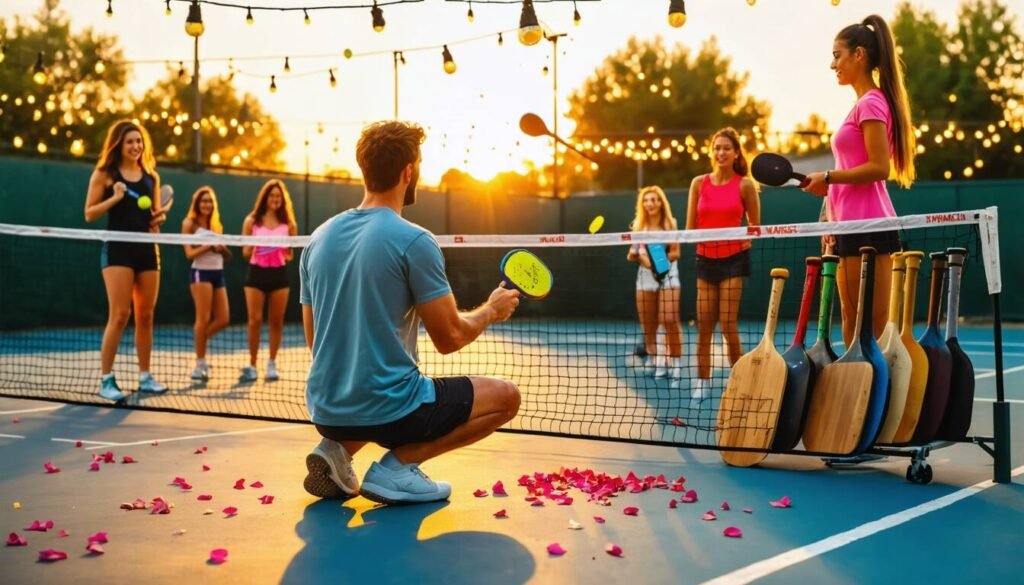
Not once a week. Not when it was convenient. Almost every day. That kind of consistency is the quiet engine behind this whole story. Months later, those same courts were covered in flowers and lights for his proposal.
The Dink deliberately leaves the details of how Kyle met Liv to DUPR, and that is a smart editorial choice. The specifics of their meeting are not really the point. The point is the pattern: a person shows up repeatedly, plays with whoever is next in the rotation, and eventually something meaningful grows out of an ordinary routine. If you want the full proposal story, DUPR’s original post is the place to go. There is also an Instagram post showing the moment.
Why the Rotation Is the Point
It is easy to treat the rotation as an obstacle. You want to play with your friends, or with people at your level, or with someone whose style matches yours. The queue feels like a delay between the games you actually want to play. But that mindset misses what open play really offers.
Open play mixes you with people you wouldn’t pick. Most of them will be perfectly fine. A few will be a lot of fun. And now and then you will get someone who is rude, or who tries to coach you between points when you did not ask for coaching. That is simply the price of admission.
Think about what that price buys you. In a normal week, how many times do you spend twenty minutes working toward a shared goal with a complete stranger? At work, you collaborate with the same colleagues. At home, you see the same family. Socially, you tend to stick with people who already share your tastes. Open play breaks that pattern in a low-stakes, friendly way. You are handed a partner and an opponent, and the only requirement is to play.
The Upside Is Hidden in the Variety
The upside is that every so often a stranger turns out to be a great partner, a good laugh, or the person who introduces you to someone you should know. You cannot predict which game that will be. You cannot schedule it or optimize it. You only find out by playing.
That unpredictability is what makes the rotation valuable. If you could identify in advance which games would lead somewhere, you would only show up for those. Since you can’t, the only reliable strategy is to keep showing up and say yes to the next spot.
Playing Only with Your Usual Four
There is nothing wrong with having a regular group. Familiar partners are comfortable, the games are consistent, and the conversation is easy. But a group that never changes also never grows. The same four people hit the same shots, tell the same jokes, and drift toward the same habits.
Stepping out of that safe stack, even occasionally, exposes you to different playing styles, different personalities, and different social circles. It is how a new player at the park becomes a familiar face, and how a familiar face becomes a friend.
Two Pieces of Advice
The Dink boils the takeaway down to two simple suggestions, and both are worth taking seriously.
1. Skip the Safe Stack and Take the Next Open Spot
When there is an opening, take it. Do not wait for the perfect combination of players. Do not hold out for your friends to rotate in. Put your paddle in, step onto the court, and play with whoever is there.
This does a few things at once. It keeps the courts moving, which everyone appreciates. It makes you easier to approach, since people are more likely to talk to someone who is open to playing with anyone. And it quietly stretches your game, because adapting to unfamiliar partners makes you a more flexible player.
2. Say Yes to the Invite
The second piece of advice is just as practical: say yes to the invitation. A league, a clinic, a Saturday run, a mixed doubles tournament. These invitations tend to arrive after you have been around long enough for people to know you.
Many players decline because they feel they are not good enough, not available enough, or not sure they will fit in. But the invite is usually a sign that the door is already open. Saying yes turns a casual connection into a repeated one, and repetition is how acquaintances become friends.
The Unexpected Part
Some open play games fade from memory the moment you leave the court. You will not remember the score, the partner, or the shots. That is normal and it is fine.
Others turn into friends, doubles partners, or, in this case, an engagement. You cannot tell in advance which kind of game you are in. That is the unexpected part, and it is also the appeal. Every game carries a small, invisible chance of leading somewhere you did not plan.
Open Play Explained for Anyone New to Pickleball
If you have never set foot on a pickleball court, some of this may sound like insider language. Here is a plain-English guide to what open play is and why it matters.
What Is Open Play?
Open play is a casual, drop-in format at local courts. There is usually no registration, no fee beyond whatever the facility charges, and no set teams. You arrive, and you join the games already happening.
How Does the Rotation Work?
Pickleball is typically played in doubles, which means four people per court. When a game ends, some players step off and new players step on. Many parks use a paddle rack or a line of paddles to keep track of who is next. You place your paddle in the line, wait your turn, and then get matched with whoever is up. That is the rotation. It is simple, and it is the reason strangers end up playing together.
Do You Need to Be Good?
No. Pickleball is known for being easy to learn, and open play is built for a range of abilities. Some courts organize by skill level, and many players are happy to help newcomers. If you are nervous, showing up during a quieter hour can help.
Why Is It Also a Social Scene?
Between games, players stand around, wait, cheer each other on, and chat. The game is short and the pace is friendly, so conversation comes naturally. Many players describe pickleball as a sport where they met a surprising number of new friends. Kyle’s story is a heartfelt example of how far that can go.
What About DUPR?
DUPR is a rating system many players use to measure their skill. It appears in this story because DUPR was the one to share it. You do not need a rating to enjoy open play, but it is one of many tools the community uses to find fair matchups.
What to Expect When You Show Up
Most open play sessions follow a similar rhythm, and knowing it ahead of time makes the first visit less intimidating.
- Bring a paddle and water. Some facilities have loaner paddles, but having your own helps you join the line quickly.
- Learn the local system. Every park handles the queue a little differently. Watch for a minute or ask someone.
- Introduce yourself. A simple “Hi, I’m new here” is usually all it takes to be welcomed.
- Be a good partner. Encourage, don’t coach, unless someone asks. This is the quickest way to avoid being the person others dread being paired with.
- Stay a little longer. The conversations after games are often where the connections form.
Dealing with the Less Fun Partners
It would be dishonest to pretend every game is pleasant. As The Dink points out, you will occasionally land with someone rude or someone who tries to coach you between points. That comes with the territory.
The good news is that the rotation works in your favor here too. A frustrating game ends in a few minutes, and you move on to the next one. The same mechanism that places you with a stranger you might not enjoy also takes you away from them quickly. Treat it as a small cost for the larger possibility of meeting someone great.
Why This Matters Beyond Pickleball
It is tempting to read Liv and Kyle’s story as a romantic one-off, but there is a broader reflection here. Adults often struggle to make new friends, especially after a move, a career change, or a shift in life stage. Friendships rarely come from a single dramatic moment. They come from repeated, low-pressure contact in a shared place.
Open play offers exactly that setup. The same faces appear again and again. The activity gives you something to do together so you are not forced into awkward small talk. And the rotation keeps widening your circle. Kyle was a newcomer in Georgia who showed up almost every day. The result was a community, and eventually a proposal on the same courts.
Practical Ways to Get More Out of Open Play
- Pick a home court. Familiar surroundings and familiar people make it easier to keep coming back.
- Go at consistent times. Regular schedules help you meet the same crowd repeatedly.
- Mix up your partners. Leave your usual group now and then and take the next open spot.
- Accept invitations. Leagues, clinics, weekend runs, and mixed doubles events all deepen connections.
- Stay curious. Ask people how they started playing. Most love to tell the story.
Final Thoughts
Open play is easy to treat as filler: a way to burn an hour, get some steps in, and maybe hit a few good shots. But as Liv and Kyle’s story shows, it can be a lot more than that. Showing up and playing with whoever is next in the rotation opens doors you cannot plan for.
So the next time there is an open spot, take it. And the next time someone invites you to a league, a clinic, or a Saturday run, say yes. Most games will be forgettable. Some will turn into friendships. And every now and then, one of them will end with flowers and l


