
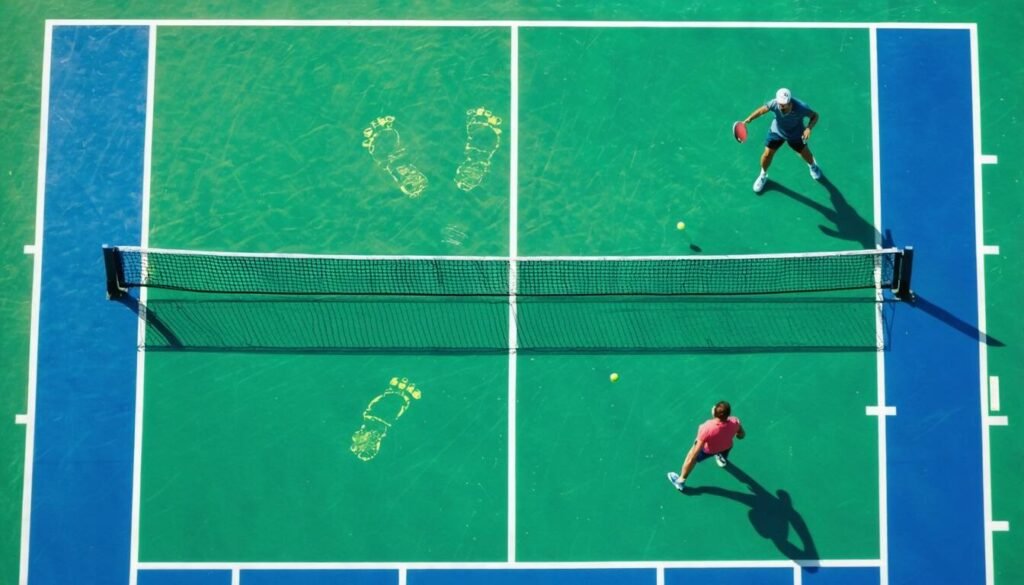
Dinking Footwork: 5 Fixes That Start With One Figure-Eight Drill
Most pickleball players who pop the ball up or dump it into the net at the kitchen blame their hands, their paddle, or their touch. The real problem is usually lower down. Your dinking footwork is likely the reason your soft game keeps falling apart. You are reaching for balls when you should be moving your feet to meet them. This article walks through a simple figure-eight drill, popularized by Richard Pickleball on YouTube, and the five movement habits it builds. It also includes a plain-English section for anyone new to the game.
What Is the Figure-Eight Dinking Drill?
The figure-eight dinking drill is a two-person exercise. One player feeds dinks to alternating sides while the other moves behind each ball and rolls it back to the middle of the court. The name comes from the path your feet travel. You shift from backhand to forehand and back again, tracing a loose figure eight along the kitchen line.
The setup is simple. Your partner dinks to your backhand. You get behind the ball and roll it back to the middle. Then they send one to your forehand, and you do the same thing again. Every one of your returns goes to the center of the court. That gives your partner a predictable target, and it quietly trains the same dink placement discipline you need in real rallies.
Your partner has a job too. They take the balls out of the air or off a short hop and move them back and forth. That keeps the pace quick and the feeds consistent. Because the ball keeps changing sides, you cannot rely on your arm to bail you out. You have to get behind the ball every time, and the drill leaves no room to cheat. That is exactly why it fixes footwork faster than hand-focused drills do.
Think about how most of us practice dinking. We stand in one spot, trade soft balls straight ahead, and feel productive. The ball comes to us, so our feet never have to learn anything. The figure-eight drill removes that comfort. Once the feed alternates, lazy habits show up immediately. You find out quickly which side you reach on, which foot you drag, and how often you forget to recover.
Dinking Explained for Someone New to Pickleball
If you are new to the sport, here is the short version. Pickleball is played on a court a bit smaller than a badminton court, with a paddle and a plastic ball with holes. Near the net there is a seven-foot zone called the kitchen. Players cannot hit the ball out of the air while standing in that zone. This rule shapes the whole game.
A dink is a soft shot that lands in your opponent’s kitchen. The goal is not to win the point with power. The goal is to keep the ball low enough that nobody can attack it. Players trade dinks back and forth, waiting for someone to make a mistake, usually by hitting the ball too high. A high ball gets smashed, and the point is usually over.
Footwork matters because the ball is small, light, and slow. When it comes at you, you have a little time to choose between reaching with your arm or moving your body. Reaching feels natural, but it is unreliable. Your paddle face tips open, the ball floats up, and your opponent pounces. Moving your feet so your body sits behind the ball gives you a steady platform. Think of it like catching a ball with a glove. You do not stretch your arm out at an awkward angle if you can step in front of it instead.
So when you hear “get behind the ball,” it simply means positioning your body so the ball arrives in front of your hitting shoulder, not off to the side. That one idea explains most of what follows.
Why Does Getting Behind the Ball Matter So Much?
Getting behind the ball lets you swing through the shot with a stable body instead of reaching with your arm. When you stay beside or ahead of the ball, you are forced to flick your wrist and guess at contact. That is how you end up with a pop up or a net cord.
When you set your feet behind the ball, your paddle path stays smooth. You can roll the ball with topspin and control the height with your legs instead of your hand. Hands are fast but twitchy. Legs are slower but far more repeatable, which is what you want when the margin for error is only a few inches over the net.
This is the same idea behind a good roll dink versus a topspin dink. Both shots depend on clean contact, and clean contact depends on your footwork. A beautiful swing means very little if you arrive late and cramped.
If the backhand side is where you struggle most, pair this drill with these backhand fixes. Movement and technique improve fastest when you train them together. Fix the feet, and the technique work finally has something solid to build on.
Need new gear while you work on this? The Dink lists up to 15% off select paddles, shoes, and more with code THEDINK at Midwest Racquet Sports.
The 5 Dinking Footwork Fixes This Drill Builds
The figure-eight drill trains five specific habits that make your footwork reliable under pressure:
- Move your feet first, then swing. Take the step before you think about the paddle.
- Take small, quick adjustment steps. Big lunges throw off your balance and timing.
- Cross step on the backhand side. It gets your body behind the ball and keeps your shoulders square.
- Stay low through the legs. Bend your knees so your head does not dip and your posture does not collapse.
- Reset to the middle after every ball. Your feet need a home base between dinks.
Let’s break each one down so you know what to feel on the court. If you are working toward higher levels, you may also like these 4.0 drills.
Fix 1: Move Your Feet Before You Swing
Your feet should arrive at the ball before your paddle does. Most players watch the ball and let their arm chase it. Good court positioning starts with the opposite order: legs first, hands second.
The drill breaks the arm-chasing habit because the ball keeps changing sides, and an arm reach simply cannot cover that distance. As the ball leaves your partner’s paddle, take your first step right away. Then settle behind it and swing. It helps to say “step, settle, swing” in your head during the first few minutes. It sounds silly, but it slows your brain down enough to rebuild the sequence.
A common trap is stepping late. You watch the ball cross the net, decide where it is going, and only then move. By that point you are already behind. Start reacting to your partner’s paddle, not the ball’s bounce. The earlier your first step, the more time you have to make small corrections afterward.
Fix 2: Use Small Adjustment Steps
Small steps give you control, and big steps give you wobbly contact. Dinks travel a short distance, so you rarely need to cover much ground. A few tiny shuffles put you in position without throwing off your balance. That matters beyond shot quality too, since lower-body strain can creep into recreational play when movement is sloppy.
Think of it like tuning a radio. You nudge your feet until the ball sits right in front of your hitting shoulder. You are not lunging across the court. You are making small corrections until the picture is clear. Players who take giant steps often end up stuck in a stretched position, unable to adjust if the ball skids or bounces differently than expected.
A useful check is to ask yourself whether you could stop mid-step and still stay balanced. If the answer is no, your steps are too big. Shorten them until every movement feels controlled.
Footwork problems often show up specifically on one side. If your forehand is the weak link, this guide on why your forehand dink fails pairs well with this fix.
Fix 3: Cross Step on the Backhand
On the backhand side, use a cross step so your body ends up behind the ball instead of beside it. Many players slide sideways and then reach across their body. That pulls the paddle face open and makes the ball float, which is the exact outcome you are trying to avoid.
The cross step solves it. Your trailing foot crosses in front, your hips rotate, and the ball lands right where you can roll over it. Rotation is the key piece. Without it, you are just stepping sideways with a twisted upper body. With it, your shoulders and hips work as one unit.
Every time your partner feeds your backhand in the drill, step across and rotate. Do not let yourself cheat with a reach, even when the ball is close enough that you could. The point is to rewire the pattern, and that only happens if you repeat the correct movement even when a shortcut is available.
For a deeper look at the shot itself, read the breakdown of the two-handed backhand dink. There is also a dedicated piece on fixing the cross step. After a few minutes, the cross step starts to feel natural,


