
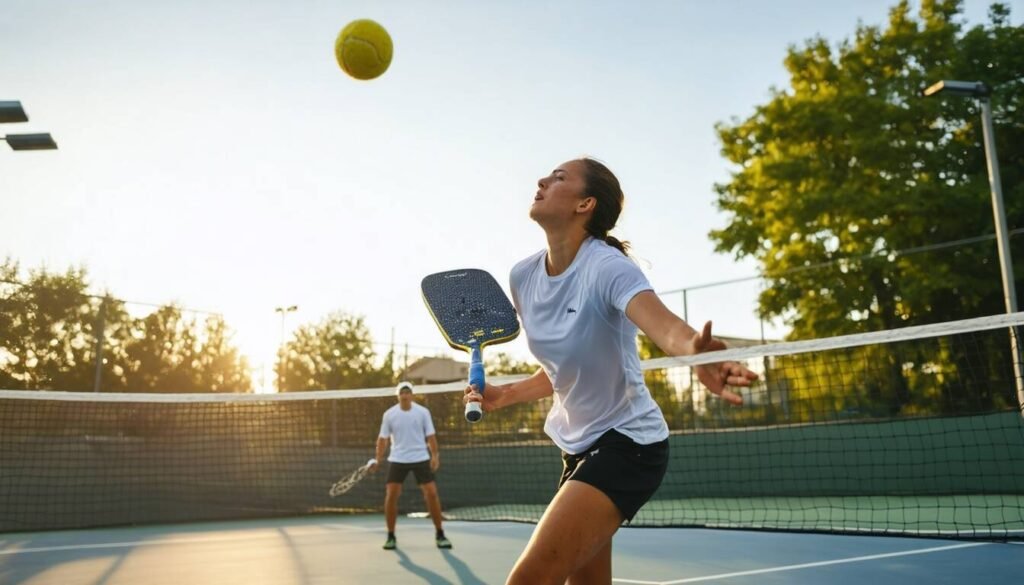
Stop Flicking High Balls in Pickleball: 5 Fixes That Turn Wrist Taps Into Real Smashes
You see the ball floating up high, your heart jumps a little, and you flick it with your wrist. The ball dribbles over the net, your opponent strolls right up to the kitchen, and suddenly you are the one on defense. It is one of the most common mistakes in amateur pickleball, and it is also one of the easiest to fix once you understand what is going wrong. These ideas come from tanner.pickleball on YouTube, who breaks down exactly why the flick fails on high balls. Below, we look at why it fails, what to do instead, and how to train it until smashing becomes your default.
Pickleball Smashing Explained for Newer Players
If you are newer to the game, here is the short version. In pickleball, a high ball is one that bounces or floats up above your shoulder, usually after a lob or a weak shot from your opponent. That ball is a gift. You get to hit down on it, and hitting down is how you end points or at least take control of them.
A flick is a quick wrist snap. It is a useful shot in the right spot, but it is small and light. A smash is a full swing that uses your legs, hips, core, shoulder, and arm. Think of the difference between flicking a pebble with your fingers and throwing a baseball. Both move something, but only one moves it with real speed.
The kitchen, also called the non-volley zone, is the area close to the net where players want to stand to dominate rallies. Whoever gets to the kitchen line first usually has the advantage. When you flick a high ball weakly, you give your opponents time to walk up there. When you smash it, they are pushed back or jammed, and you keep the position. That is the whole story: a smash protects your spot on the court, and a flick hands it away.
You do not need to hit it like a pro. You just need to commit to swinging with your body instead of tapping with your hand. The rest of this article shows you how.
Why Is Flicking a High Ball a Mistake?
Flicking a high ball is a mistake because your wrist muscles cannot generate enough power to put real pressure on your opponent. The result is a soft, slow ball that gives them time to walk forward and take over the kitchen line. The cost of the flick shows up in the next shot, not just this one, which is why it is easy to miss as a habit.
Think about what you are asking one small muscle group to do. Your wrist is built for fine control and quick adjustments, not for producing pace on a ball above your shoulder. When you try to make it do the job of your whole body, the ball loses speed, depth, and direction. If you want to see how this plays out at the kitchen, there is a useful breakdown of flick fixes that covers the lower-ball version of the problem.
You also lose your target. A wrist-only swing has almost no structure behind it, so the ball lands short, sits up, or sails long with no warning. A shot with no structure is a shot you cannot repeat. You may get away with it once or twice, but over a full match it leaks points.
The bigger issue is positional. A weak flick lets your opponent move in, and once they own the kitchen, you are the one getting attacked. You went from having the advantage to defending in a single shot. That swing in momentum is the real price.
Here is the fix in one line: if the ball is high, swing like it is high. A proper overhead smash is an attack, not a placement shot, and it is one of the essential shots to master for anyone who wants to move up in level. Learning to read a high ball early is the first step toward treating it that way.
What Should You Do Instead of Flicking?
Instead of flicking, you should load your entire arm and core and smash through the ball. A high ball is an invitation to swing big, not to tap it over. When you use your whole body, you create pace, depth, and pressure all at once, and that is the same principle behind body rotation in every powerful shot in the game.
That pressure is what makes it difficult for your opponent to get into the kitchen after you hit. A fast ball arriving at their body or feet forces them to defend, and players who are defending cannot also be advancing. You are not trying to hit a perfect shot. You are trying to take away their time.
The mindset shift matters as much as the mechanics. Many players see a high ball and feel nervous, because it seems like a shot they should not miss. That tension tightens the arm and pushes them toward the safe-feeling flick. Treat it as an attack, not a placement shot, and the nerves have a job to do: they become energy for the swing.
If you want a little help on the gear side while you rebuild your overhead, you can browse Pickleball Central for paddles and equipment with discounts applied to your cart.
5 Fixes to Stop Flicking and Start Smashing
These five adjustments take you from a wrist flick to a full body smash. Work through them in order, because each one builds on the last.
- Get your paddle up early. The moment you read a high ball, raise your paddle above your shoulder so you are never scrambling to catch up. Late preparation is the main reason players default to the flick. When the paddle is already up, you have options. When it is not, you panic and tap.
- Turn your shoulders sideways. Rotate so your non-paddle shoulder points toward the net, which sets up your core to do the work. Facing the net square on makes it almost impossible to use your torso, which leaves only the wrist.
- Load your arm back. Pull your elbow back and bend it slightly, like cocking a throwing arm, before you accelerate. This is the same loading pattern pros use across the key strategies to winning in modern pickleball. The load is what stores energy for the release.
- Swing through the ball, not at it. Aim past the contact point so your arm keeps accelerating instead of stopping at impact. Players who swing at the ball tend to slow down right when they need to be fastest.
- Finish across your body. A full follow through tells you the swing was complete and not just a wrist snap. If your paddle stops at contact, you probably decelerated.
If any of those steps feel rushed, you are probably still flicking. Slow your preparation down before you speed your swing up. Smooth early preparation is what allows an aggressive swing to feel calm instead of frantic.
How Does Your Core Create Power on Overheads?
Your core creates power by rotating your torso and transferring energy up through your shoulder and arm into the paddle. The wrist only adds a small finishing touch at the very end. This is a kinetic chain: energy starts in your legs and hips, moves through your torso, and exits through your paddle.
The science backs this up. According to a 2025 study on overhead smash mechanics published in Frontiers in Sports and Active Living, just three coordinated muscle synergies account for more than 90 percent of the shoulder activity in an explosive overhead swing, with the trapezius and scapular stabilizers leading the sequence. In plain terms, the big muscles around your shoulder blade and upper back start the action, and the hand follows.
Translation for your game: the shoulder and torso drive the shot, not the hand. Skip the first links in that chain and you are asking your wrist to do everything. That is why a wrist-only swing feels weak no matter how hard you try to snap it.
A simple way to feel it is to set your feet, rotate your hips back, then fire them forward as your arm follows. Do it slowly a few times without a ball. You should feel your belly and ribs turning before your arm moves. For a deeper look at building that motion, use this 3-part motion, which pairs well with the fixes above.
The same logic applies to other shots too. If you have ever wondered why your backhand flick lacks pop, the answer is similar: it is rarely the wrist alone that creates the power.
Why Does Pressure Matter More Than Placement?
Pressure matters more than placement because a fast, heavy ball takes away your opponent’s time to move forward. Even an average target feels hard to handle when the ball arrives quickly. Many players try to place a high ball perfectly with a wrist touch. That usually backfires, because a soft ball gives the other team time to reset, step in, and neutralize the point.
A committed smash forces them to react instead of plan. They block, pop up, or get jammed, and you get the next ball. Notice how the reward is not always an instant winner. Often the reward is simply a weak reply that you can put away. That is a very good outcome from one swing.
This connects directly to your overall approach to the kitchen. If you want to understand why holding that line matters so much, read kitchen strategy principles for winning dinks. Smashing and dinking are part of the same fight for position, just at different heights.
The mental side counts too. Pressure goes both ways, and players who stay loose in big moments tend to swing more freely. If you tighten up when it counts, these mental game habits are worth a look.
Is a Flick Ever the Right Shot?
A flick is the right shot when the ball is low, close to the net, and you want to catch your opponent off guard at the kitchen line. It is a wrist-driven attack on a ball at or below net height, not on a ball above your shoulder. The flick is not a bad shot. It is a bad choice for the wrong height.
The difference is contact height. Low balls need a quick, compact attack, while high balls demand a full swing. Once you separate those two situations in your head, the decision gets easier


