Core Strength for Seniors: The Pickleball Balance Training Most Players Ignore
Nobody talks about anti-rotation holds at the court. Everyone wants to talk about the around-the-post shot. But if you watch what actually decides points at 3.5 and 4.0, it is not the flashy stuff. It is somebody getting pulled wide and ending up on the ground. It is a backpedal off a lob that goes wrong. It is balance failing at the exact moment mechanics needed it most.
Core strength training for seniors is the least glamorous work you will ever do off the court, and probably the most useful. This article breaks down what the research actually says, what your core really is, and why most recreational players are training the wrong things if staying upright and moving fast are the goals.
Why This Matters More Than Most Seniors Realize
The common assumption is that getting fit for pickleball means improving your cardio, maybe doing some lunges, and calling it good. That assumption is worth reconsidering. According to a review of national emergency department data from 2020 to 2022, pickleball injury visits nearly doubled over that period. Players aged 60 to 79 accounted for roughly 73% of estimated injuries, and falls were documented as the primary injury mechanism. Fractures led all injury types at 29%.
Read that again. Not muscle strains. Not overuse. Falls, with fractures as the most common result, in a population that skews heavily senior. That reframes what training for pickleball should actually mean. Cardio is not the gap most older players need to close. Staying upright when your feet are in the wrong place is the gap, and the core and balance training that addresses it is the piece most players skip entirely.
The thing is, most players treat balance as a fixed trait. Either you have good balance or you are the person tripping over the centerline. The research does not support that view at all. Balance is trainable, and the evidence that has come out of pickleball-specific studies makes a strong case for putting in the work off the court.
What Your Core Actually Is — And Why It Is Not Your Abs
This is where a lot of people’s training goes sideways. When most recreational players think about their core, they think about their stomach. Maybe they do some crunches or hold a plank. The problem is that in sports medicine, the definition of core stability is much broader than that.
Core stability is defined in the literature as the capacity to control trunk position and movement over the pelvis and lower extremities, functioning as the central hub of the kinetic chain. According to sports medicine research on core stability, the system in question is the lumbo-pelvic-hip complex. That includes the glutes, hip abductors and rotators, erector spinae, deep abdominals, pelvic floor, and diaphragm. The rectus abdominis, the visible six-pack muscle most people associate with core work, is one contributor among many and not the most important one for pickleball.
Why does that framing matter? Because the same research describes the core as the link regulating torque and force transfer from the torso out to the limbs during multi-directional movement. Your paddle speed on a stretched-out reset is not a wrist thing. It is a chain, and the middle link in that chain is your trunk. Anyone who has watched themselves on video knows the collapse usually happens at the hip, not the belly. The hip is where the lateral lunge falls apart. The hip is where the backpedal gets sloppy. Training only your abs leaves the real structural problem untouched.
For the Newcomer: What Does All of This Mean in Plain English?
If you are newer to pickleball or to thinking about fitness this way, here is the simple version. Your body transfers power from your legs through your torso and out to your arm and paddle. If the middle of that chain, everything around your hips, pelvis, and lower back, is weak or unstable, the whole system breaks down. You hit weaker shots. More importantly, you are more likely to fall when the ball goes somewhere unexpected.
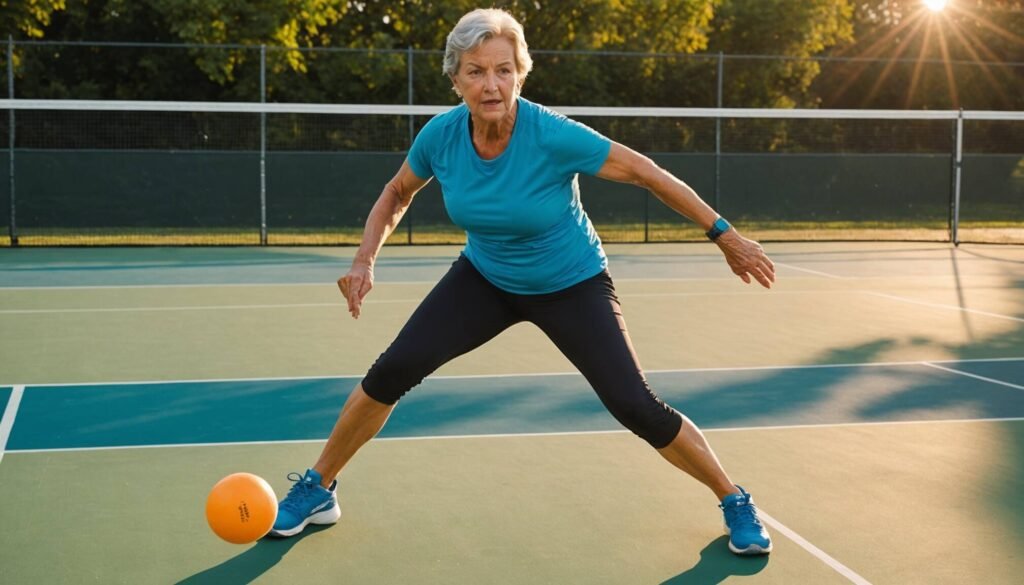
Pickleball is a sport that constantly forces you into positions you did not plan for. You lunge sideways. You back up. You reach low. Every one of those movements asks your hips and trunk to stabilize you in fractions of a second. When they can not do that reliably, you lose your footing. At 65 or 70, losing your footing on a hard court is a serious problem. The good news is that the muscles responsible for that stabilization respond to training at any age. You are not stuck with the balance you have right now.
Hip Strength Is Not Optional — The Data Is Specific
One of the more interesting findings in pickleball-specific research involves hip abduction strength. An investigation of recreational pickleball players found that hip abduction strength showed a significant negative correlation with change-of-direction time. In plain terms: stronger hip abductors, faster direction changes.
Think about what that means on the court. Every lateral push-off you make is a frontal-plane action. The frontal plane is the side-to-side plane, and the hip abductors are the muscles that live there. When you cover the middle on a fourth shot, when you switch sides mid-point, when you push off to cover a wide ball your partner cannot reach, you are asking your abductors to do the work. Training only in the front-to-back direction, which is what most gym exercises default to, leaves the lateral plane undertrained. That is exactly the plane where pickleball happens most of the time.
This is also why framing core strength as just an abdominal issue gets people hurt. The hips are part of the core. Lateral hip work is core work. If your program does not include it, it is missing the piece that the research specifically connected to change-of-direction speed in players like you.
What the Research Shows About Fall Risk Reduction
There is now pickleball-specific evidence on this question, though it comes with real limitations worth understanding. A 12-week randomized controlled study of senior pickleball players with a mean age around 66 tested a multi-faceted program combining balance, strength, and mobility training. The trained group improved change-of-direction time by 0.7 seconds and reported a significant reduction in fear of falling. At the five-month follow-up, 25% of the trained group reported falling during play, compared with 44% of the control group.
That follow-up number is striking, but the limitations matter here. The total sample was 28 people, ranging in age from 57 to 84. The program combined resistance training, core work, dynamic balance training, and dual-task training rather than isolating any single element. So this is not evidence that core strength training alone produces that result. It is evidence that a structured program that includes core work, combined with other training components, has been associated with a meaningful reduction in reported falls over several months. That is a different and more honest claim, but it is still a meaningful one given how serious falls in this population are.
Why Planks Alone Are Not Enough
Here is a finding that should change how a lot of players think about their off-court work. That same recreational-player study found that static single-leg squat assessments showed no significant correlation with fall occurrence during dynamic play. A closed-chain, single-plane, entirely predictable movement did not predict what happened when players had to react to a live ball.
That is the core problem with a plank-only approach. Pickleball balance is reactive. The ball arrives at an angle you did not choose, at a speed you did not set, while you are already moving. Static holds do build a base and they are not worthless. But they do not build the reflex that pickleball actually demands. The research programs that showed results combined static strength work with dynamic, multi-directional training, dual-task drills, and reactive movement. The part that transfers to the court is the part that looks most like the court.
This is why solo drills that force unpredictable movement tend to transfer better to real play than anything you hold still for. The court never asks you to hold still. It asks you to move, stabilize, recover, and move again in a sequence you did not predict.
How to Structure Core and Balance Training for Pickleball
Based on the research programs that showed results, there are five training categories that map to real on-court demand. These are not a specific workout prescription. They are a framework for what needs to be covered, and the loads, sets, and progressions should be worked out with a qualified coach or clinician who can observe how you move.
Anti-rotation work. Resisting trunk twist under load. This is the mechanism you rely on when you get jammed at the kitchen line and have to keep your paddle quiet while your body absorbs the force. Exercises that challenge your trunk to resist rotation rather than produce it are the ones most players skip and most need.
Frontal-plane hip work. Lateral loaded movement targeting the abductors. This is the category the change-of-direction research pointed to directly. Side-lying hip abduction, lateral band walks, lateral step-downs, and loaded lateral lunges all live here. If your program does not include any of these, it is missing the most specific gap the research identified.
Dynamic single-leg work. Moving on one leg, not just standing on one leg. The research was clear that static single-leg assessments did not predict falls during play. What that implies is that the training value is in the movement itself, not in the static hold. Step-through variations, single-leg RDLs with movement, and any pattern that requires you to stabilize while transitioning weight are all in this category.
Dual-task work. Adding a visual or cognitive demand while performing balance or stability work. This is the category closest to what actually happens during a rally. Tracking a ball while moving is a dual task. Reacting to your partner while covering the middle is a dual task. Training balance in silence with nothing to react to is less specific than training it while responding to an external cue.
Rotational transfer work. Loaded rotation through the hips, replicating the kinetic chain doing its actual job. Medicine ball rotational throws, cable rotations from a split stance, and rotational step patterns all fall here. This is where the strength you have built in the other categories becomes usable shot power and directional control.
What the Basketball Research Adds — and What It Does Not
A 12-week core strength training trial found significant improvements in dynamic balance across anterior, posterolateral, and posteromedial reach directions, along with better agility scores compared to traditional exercise controls. That is useful because it supports the mechanism: core training does appear to improve multi-directional dynamic balance and agility in a controlled trial setting.
The important caveat is that the subjects in that study were adolescent basketball players. Trunk stability biomechanics apply broadly across populations, but the specific magnitude of those reach-distance and agility gains cannot simply be transferred to a 68-year-old pickleball player without accounting for the neuromuscular changes that come with age. The research is useful as a mechanical explanation for why this kind of training should work. It is not a promised outcome for an older population with a different set of physical considerations.
Where Core Strength Shows Up in a Real Rally
There are three moments in a typical rally where this training pays off most directly. The first is the lateral scramble when your partner gets picked on and you have to cover unexpected court. The second is the backpedal on a quality lob, which forces you to move backward and backward fast while maintaining enough stability to set up the next shot. The third is the low, stretched reset where your paddle has to stay controlled while your legs are doing anything but staying still.
Watch a skilled 4.5 player handle that third moment. Their trunk barely moves. That stillness is not calm, it is control. It is the product of trunk stability that lets the legs do their job without the whole system collapsing. That stability is exactly what consistent core and hip work is building, even if you cannot see it in the drill that trains it.
What Core Training Cannot Do
It cannot guarantee anything. Fall risk in older athletes is multi-factorial. Your footwear matters. The court surface matters. Reaction time, visual tracking, fatigue, lighting conditions, and stray balls on the court all contribute. Core strength training may reduce fall risk based on the available evidence. It does not eliminate it, and any program or product claiming that level of certainty is not being straight with you.
The boring stuff still counts alongside the training. Proper pickleball shoes built for lateral movement matter. How you recover between sessions matters. Playing while fatigued matters. Stability work is one input among several. Treating it as the whole answer sets people up for overconfidence, which is its own kind of risk.
Key Takeaways
- The core is the lumbo-pelvic-hip complex, not just the abdominals. Hip abductors are a central part of it and the most directly connected to on-court performance in the research.
- Hip abduction strength showed a significant negative correlation with change-of-direction time in recreational pickleball players. Stronger abductors, faster lateral movement.
- A 12-week multi-faceted training program was associated with 0.7 seconds faster direction changes and a reduction in reported falls at five months in a small sample of 28 senior players.
- Static balance testing did not predict falls during live play. Plank-only routines miss the reactive demand that mid-court scrambles actually create.
- Core strength training may reduce fall risk based on current evidence. It does not remove it, and it works best as part of a broader approach that includes proper footwear, recovery, and court awareness.
Frequently Asked Questions
What core exercises should seniors include for pickleball balance training?
The research programs that showed results combined resistance work, core work, dynamic balance, and dual-task training rather than relying on any single movement. The categories that map most directly to on-court demand are anti-rotation holds, lateral hip work targeting the abductors, dynamic single-leg movement, and balance training with an added visual or cognitive demand. Loads and progressions should be set by a qualified coach or clinician who can watch you move. This training pairs well with whatever pickleball training program you already run.
How long does it take for core training to improve pickleball balance?
The pickleball-specific studies behind these claims ran for 12 weeks, with one study following up at five months. That is the timeline the evidence covers. Consistency across the training block appeared to matter more than peak intensity in any single session. Individual results will vary depending on starting fitness, injury history, and how well the program is matched to your specific needs.
Are planks enough for improving balance in pickleball?
Probably not on their own. Research on recreational pickleball players found that static single-leg assessments showed no significant correlation with falls during live play. That suggests single-plane static holds miss the reactive demand that a real rally creates. Planks can build a useful base, but the dynamic, multi-directional work is what the research programs emphasized for meaningful on-court transfer.


