Short Hop Pickleball: Why Your Shot Keeps Popping Up and How to Fix It
If you’ve ever stretched for a wide ball, tried to take it early, and watched it float straight up into your opponent’s wheelhouse, you already know the frustration of a popped-up short hop. It feels like a timing problem. It feels like you just need to be more careful, or maybe swing a little cleaner. But here’s the thing — the timing is rarely the actual issue. Almost every time, the culprit is your paddle angle.
This is one of the most misunderstood moments in pickleball, and fixing it doesn’t require elite hand speed or years of repetition. It requires understanding one simple mechanical idea and building it into your setup before contact even happens. Once you get it, the short hop stops being a risky desperation move and becomes one of the more reliable weapons in your dinking game.
What Exactly Is a Short Hop in Pickleball?
Before getting into the fix, it’s worth making sure we’re all talking about the same thing — especially for players who are still building their vocabulary around the game.
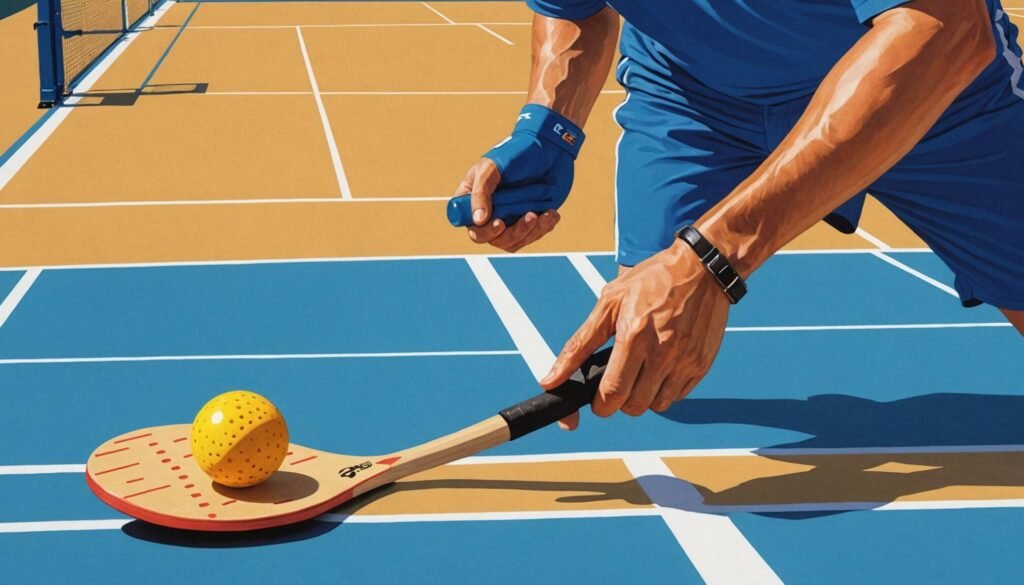
A short hop is when you take the ball immediately after it bounces, before it has time to rise up to a comfortable striking height. Instead of waiting for the ball to come up to your paddle, you’re going down to meet it at ground level, almost the way a baseball infielder charges a grounder rather than waiting back for it to come to them.
The short hop comes up most often on wide balls — shots that are pulling you out toward the sideline. Most recreational players let those wide balls bounce, wait for them to rise, and then try to hit from a stretched-out, off-balance position at an uncomfortable height. That’s actually harder than it sounds, and it usually produces weak returns back to the middle of the court.
Taking the ball early and low, right after it bounces, lets you redirect it with a sharper angle and more control — as long as your paddle setup is right. Done well, it’s a real advantage. Done wrong, it becomes a pop-up that hands your opponent an easy put-away ball. The difference between those two outcomes is almost entirely paddle angle and body position.
Understanding wide ball handling is one of the core skills separating players who survive dink rallies from players who control them.
Why the Ball Keeps Floating Up
Here’s the mechanical reality of why short hops pop up so often. When your paddle face is flat — meaning it’s pointing roughly straight ahead, perpendicular to the ground — any contact that isn’t perfectly centered on the ball tends to send it upward. Hit the bottom half slightly, and the ball launches. Hit slightly off-center, same result. You have essentially zero margin for error.
Now think about what’s happening when you’re going for a wide ball. You’re stretched out, possibly off-balance, your weight is shifting, and you’re trying to make contact at an awkward height close to the ground. This is exactly the situation where your contact point is least reliable. And yet with a flat paddle face, you need near-perfect contact to keep the ball low. That’s a contradiction you cannot win.
The fix isn’t to be more careful or to slow down your swing. The fix is to preset your paddle angle before contact so that imperfect hits still produce usable results. This is the core concept that pickleball instructor Richard Pickleball breaks down on YouTube — and it’s a genuinely useful reframe of the problem.
Instead of trying to perfect your contact, you’re engineering the shot so your mistakes don’t hurt you. That’s a much more sustainable approach, and it’s the same margin-first thinking behind modern pickleball strategy at every level of the game.
The Paddle Angle Fix: How It Actually Works
The concept is straightforward but the execution takes some deliberate practice. Before you make contact with the ball, you preset your wrist so the paddle face is already angled toward the far corner of your opponent’s kitchen — the diagonal cross-court target. You’re not trying to aim with your swing. You’re setting the angle into your paddle before the ball even arrives, and then just making contact.
Here’s what makes this so effective. When your paddle face is angled toward that far corner instead of pointing straight ahead, your margin of error opens up on both sides of your intended contact point:
- If you contact the ball a little early or a little short, the ball lands toward the middle of the opponent’s kitchen. That’s still a perfectly good ball.
- If you contact the ball a little late or a little deeper than intended, the face redirects that energy sideways toward the sideline rather than forward. The ball goes wider, not longer, and still lands in a useful spot.
Compare that to a flat paddle face, where early contact pops it up and late contact sends it long. With the angled face, both of those mishit outcomes become acceptable shots. You’ve essentially eliminated the pop-up as a consequence of imperfect contact, because the geometry of the angled face won’t allow the ball to go straight up even when your contact isn’t centered.
This is the same principle that shapes trajectory on every soft touch shot in the game. Your wrist position and paddle angle before contact determine the outcome far more than anything you do during the swing itself. Small setup adjustments change the entire shape of the shot.
Breaking It Down for Newer Players
If you’re relatively new to pickleball and some of this still feels abstract, here’s a way to think about it that might click more intuitively.
Imagine you’re trying to deflect a ball rolling toward you on a table. If you put your hand flat in front of the ball, it bounces straight back at you. If you angle your hand to the side, the ball deflects sideways in that direction. The same thing happens with your pickleball paddle.
When your paddle is flat and you hit a ball that’s lower than you expected, the ball goes up because your paddle is essentially underneath it with nowhere to go but up. When your paddle is angled toward a corner before contact, even a low or slightly off-center hit gets redirected sideways, toward your target. The ball can’t pop up as easily because your paddle face is already pointing away from the sky.
The short hop itself is simply choosing to hit the ball right after it bounces, while it’s still low, rather than waiting for it to rise. On wide balls — ones that pull you out toward the sideline — waiting for the ball to come up to a comfortable height usually means you’re already stretched too far out and off-balance by the time you hit it. Taking it low and early actually gives you better body control, as long as you get down to the ball first.
So the full picture is: move early, get your hips low, tilt your paddle toward the far corner, and let the geometry do the work. You don’t have to be precise. You just have to be set up correctly.
The USA Pickleball rulebook governs how the kitchen line and non-volley zone play, so it’s worth knowing those boundaries cold as you start building more precise shot placement into your game.
The Complete Setup Sequence for the Short Hop
Understanding the concept is one thing. Executing it in a point, when the ball is moving fast and you’re reacting, is another. Here’s the full sequence that needs to happen for this shot to work consistently.
The first step is reading the ball early. As soon as you recognize that a ball is going to pull you wide, you need to start moving toward it immediately — not after it bounces, not after you see where it lands, but as soon as you can identify the trajectory. Early movement is everything on the short hop because you need time to get into position before the ball gets there.
The second step is getting low. Drop your hips before the ball arrives and get your paddle down to ball level in advance. If you’re standing tall and then bending down to the ball at the moment of contact, your paddle is traveling on a downward path at impact, which creates inconsistent angle. Get low early so your paddle is already at the right level and traveling on a more level plane through contact.
The third step is presetting the wrist. Before contact, angle the paddle face toward the far corner. Do not try to make this adjustment at the moment of impact — it’s too late by then and your contact will be inconsistent. The preset has to happen in the setup phase, while you’re still moving into position.
The fourth step is contacting the ball out in front of your body. Short hops require early contact because you’re taking the ball before it rises. If the ball gets beside you or behind you, you’ve lost the angle and the control. Think about meeting the ball in front of your lead foot, not beside your hip.
The fifth step is using the angle you’ve earned. A wide ball gives you a naturally sharper cross-court angle to the far kitchen corner than you’d have from the center of the court. Take that angle. Don’t give it back by hitting toward the middle. The cross-court landing zone on the far side of your opponent’s kitchen is your target, and the wide ball position makes it more accessible, not less.
This footwork and positioning discipline is exactly what separates players who control the kitchen line from players who are just surviving it. If you want to make these habits automatic, footwork drills focused on early movement and low positioning belong in your regular practice routine.
Why Targeting the Far Corner Matters So Much
A lot of players default to hitting back toward the middle when they’re under pressure on a wide ball. It feels like the safe choice — the middle of the court is the biggest target. But on a wide ball short hop, the middle is actually giving up the most important advantage you have.
When you’ve moved to take a wide ball early, your natural angle to the diagonal far corner is sharper than it would be from anywhere else on the court. That angle makes the ball travel a shorter distance to the kitchen line, which keeps it low. It also forces your opponent to cover the maximum possible distance to reach the return. A ball that lands in the far corner from a wide position is one of the hardest balls in pickleball to handle cleanly.
Hitting back to the middle from a wide position gives up both of those advantages. The ball travels a longer path to the kitchen, making it easier to pop up over the line. And your opponent barely has to move. You’ve turned a positional advantage into a neutral exchange.
The non-volley zone is your friend here. You’re not just trying to land the ball in bounds — you’re trying to land it short enough that it sits low in the kitchen and forces a difficult reply. Using the far corner angle is the most reliable way to achieve that on a wide ball.
Common Mistakes That Kill the Short Hop
Even players who understand what they’re supposed to do make consistent execution errors on this shot. These are the ones worth watching for in your own game.
The most common is forgetting to preset the wrist. If you understand the concept but forget to apply it under pressure, you’re right back to the flat paddle face and the pop-up problem. The preset has to become a habit, not something you remember to do consciously each time. That’s why drilling it matters.
Getting to the ball late is the second major issue. If your feet are still moving when you make contact, your paddle control drops significantly. The sequence has to be move first, stop and set up second, then hit. Hitting on the run produces inconsistent contact and inconsistent angle.
Standing too tall is closely related. The short hop is a low-ball situation. If your hips are up, your paddle has to come down at a steep angle to reach the ball, which works against everything the preset wrist angle is trying to accomplish. Get down before the ball gets there, not at the same time.
Aiming too deep into the kitchen is another mistake that’s easy to overlook. The goal is to land the ball short, in the kitchen, where it’s difficult to attack. Aiming for the back of the kitchen leaves almost no margin. Target the middle of the kitchen at most, and let the angle geometry carry the ball toward the far corner from there.
These mistakes usually travel together. Players who stand tall also move late and aim toward the middle, because the whole shot feels rushed and reactive. Fixing your paddle positioning and getting low early tends to solve all three at once, because the shot suddenly feels controlled instead of desperate.
For a broader look at error patterns that show up in consistent players’ games, it’s worth reviewing the bad habits most players don’t realize they have — many of them trace back to the same footwork and setup issues that cause short hop problems.
How to Practice This Until It’s Automatic
The best drill for building this skill is simple but requires a consistent feeder. Have a partner or coach deliberately feed wide balls at varying speeds and depths — your only job is to get low, preset the wrist angle, and redirect toward the far corner. Don’t worry about pace. Don’t try to do anything fancy. Just rehearse the setup sequence over and over until it becomes automatic.
Start at half speed. The goal at first is to feel what the correct preset position looks like and to experience what happens to the ball when you hit with an angled face versus a flat one. You’ll immediately notice that mishits with the angled face stay low and on target, while mishits with a flat face pop up. That feedback loop is the fastest teacher.
Once the preset feels natural at slow feed speeds, have your partner increase the pace. The challenge of the short hop isn’t the mechanics — it’s maintaining the mechanics when the ball is coming faster and your movement has to be quicker. Gradual speed increases let you build that robustness without developing bad habits from rushing.
You can also practice the wrist preset away from the court. Hold your paddle in the angled position and check it in a mirror. Feel what it looks like so you can reproduce it on demand. Wall practice is another genuinely useful tool for building contact habits — hitting against a wall while maintaining the preset angle forces you to reset quickly and builds the muscle memory faster than open rally practice.
A constraint-based drill that accelerates this specific skill: play regular points but with a rule that you must short hop every ball that lands past the kitchen line. It forces early reading, fast movement, and consistent low positioning. Constraint drills like this tend to build skills faster than unconstrained free play because they eliminate the option of falling back on old habits. Pair this with the


