How Do You Play Pickleball? A Complete Beginner’s Guide to Rules and Shots
If you’ve been wondering how to get started with pickleball, you’re not alone. The fastest-growing sport in America has captured the attention of millions, and for good reason. With simple equipment requirements, straightforward rules, and a surprisingly deep strategic layer, pickleball offers something for everyone, whether you’re looking for casual recreation or competitive play.
The beauty of pickleball lies in its accessibility. You don’t need expensive equipment or years of training to enjoy your first game. A plastic ball, a solid paddle, a 44-foot court, and a handful of rules you can memorize in an afternoon are all it takes to get started. Yet beneath this simplicity lies a game that rewards patience, positioning, and smart decision-making over raw athleticism.
According to USA Pickleball, the sport has grown to over 13 million players nationally. That explosive growth reflects both the game’s approachability and its addictive nature. Once you understand the fundamentals, you’ll quickly discover why so many people have made pickleball a regular part of their lives.
What Is Pickleball, Exactly?
Pickleball is a paddle sport that combines elements of tennis, ping-pong, and badminton into something entirely unique. The game is played on a court roughly one-quarter the size of a tennis court, with a low net stretched across the middle. Players use solid composite or graphite paddles to hit a perforated plastic ball back and forth, following a specific set of rules that create a distinctive rhythm of play.
Games are typically played to 11 points, and you must win by at least 2 points. One critical rule sets pickleball apart from most racket sports: only the serving team can score points. This scoring system fundamentally shapes strategy and creates a different dynamic than sports where either side can score on any rally.
The sport was invented in 1965 on Bainbridge Island, Washington, when three dads cobbled together a game for their bored kids using ping-pong paddles and a perforated plastic ball. What started as an improvised backyard activity remained relatively obscure for decades before exploding into mainstream culture in recent years. The full history of pickleball’s origins is a fascinating story of how simple innovations can evolve into cultural phenomena.
Understanding the Court Setup and Equipment
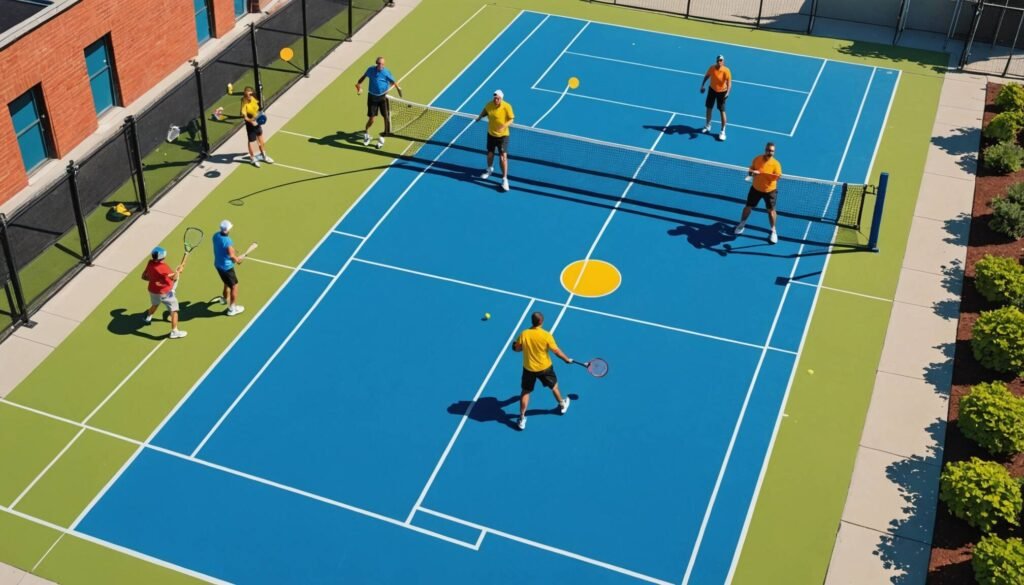
The pickleball court measures 20 feet wide by 44 feet long, with the same dimensions used for both singles and doubles play. The net sits at 36 inches high at the sidelines and dips to 34 inches in the center, creating a subtle arc that affects shot selection near the net.
Perhaps the most important feature of the court is the non-volley zone, commonly called the kitchen. This area extends 7 feet from the net on both sides and represents the strategic heart of pickleball. You cannot volley the ball, meaning hit it out of the air, while standing inside the kitchen. This single rule shapes the entire tactical approach to the game and creates the distinctive soft-game exchanges that make pickleball unique.
The kitchen rule forces players to think carefully about positioning and shot selection. It prevents players from camping at the net and smashing every ball downward, instead rewarding controlled, strategic play. Understanding how to use the kitchen to your advantage marks the difference between casual play and competitive skill development.
Equipment requirements are minimal. You need a paddle, which can be made from various materials including graphite, carbon fiber, or composite materials. You’ll also need a pickleball, which comes in outdoor and indoor varieties with different hole patterns and weights. Finally, court shoes with good lateral support are essential for preventing injuries during the quick directional changes that pickleball demands.
Serving Rules and the Scoring System
Every rally in pickleball begins with a serve, and the serving rules are more specific than many beginners expect. The serve must be hit underhand, with contact made below the waist. The paddle head must be below the wrist at the point of contact, and you must strike the ball in an upward arc. These requirements prevent overpowering serves and keep the game accessible to players of all ages and abilities.
You serve diagonally cross-court, aiming for the opposite service box. The ball must clear the kitchen line and land in the service box beyond it. Serves that land in the kitchen or on the kitchen line are considered faults and result in loss of serve or a point for the receiving team.
The scoring system takes some getting used to, especially in doubles play. Only the serving team can score points. Games are played to 11 points, and you must win by 2. In doubles, both players on a team get to serve before the serve switches to the opposing team, with one exception: on the very first service sequence of each game, only one player serves before the initial side-out.
When serving in doubles, you call the score as three numbers. The first number is the serving team’s score, the second is the receiving team’s score, and the third indicates whether you’re the first or second server on your team. So if you hear “4-3-2,” it means the serving team has 4 points, the receiving team has 3 points, and the second server is currently serving.
This scoring system creates interesting strategic dynamics. Because only the serving team scores, there’s asymmetry in each rally’s stakes. The serving team is playing to score, while the receiving team is playing to earn the right to serve. Understanding this dynamic helps explain why certain shot selections make sense in different situations.
The Two-Bounce Rule: Why It Changes Everything
The two-bounce rule, officially called the double bounce rule in the rulebook, is perhaps the most important rule in pickleball. After the serve, the receiving team must let the ball bounce before returning it. Then the serving team must also let that return bounce before hitting it. After these two bounces have occurred, both teams can volley freely or continue letting the ball bounce as they choose.
This rule fundamentally shapes pickleball strategy. It prevents the serving team from rushing the net immediately after serving, which would give them an overwhelming advantage. Instead, it creates a built-in transition phase that rewards patience, smart positioning, and controlled shot selection over raw power.
The two-bounce rule forces a rally structure where both teams start at or near the baseline, then work their way forward to the kitchen line during the exchange. This transition phase is where much of pickleball’s strategic depth emerges. Players who understand how to navigate this transition effectively gain a significant advantage over those who don’t.
Understanding how to use the two-bounce rule to your advantage is fundamental to improving your game. It’s not just a restriction, it’s an invitation to develop a more nuanced understanding of court positioning and shot selection. Once you grasp that controlling the kitchen line is the primary objective in most rallies, the entire game starts to make more sense.
The Five Essential Shots Every Player Needs
You don’t need an extensive arsenal of trick shots to be effective on a pickleball court. Instead, you need to execute five core shots consistently and know when to use each one. Everything else is situational and comes with experience.
The Serve
For beginners, the serve has one primary goal: consistent and in. Don’t try to blow the ball past your opponent or paint the lines. Just get the ball in the service box and start the point. As you improve, you can develop more sophisticated serves with depth, spin, and placement. But early on, reliability wins over flash every time.
A consistent serve keeps you in control of points and prevents giving away easy side-outs. As you develop comfort with the basic serve, you can start weaponizing your serve with strategic placement and varied pace to put pressure on your opponents from the very first shot.
The Return of Serve
Deep returns are your best friend when receiving serve. Hitting the return deep toward your opponent’s baseline keeps them pinned back and gives you time to advance toward the kitchen. Weak, short returns give the serving team easy transition balls and allow them to attack from an advantageous position.
Where you place your return matters tremendously. Different return targets create different tactical situations. A deep return to the middle of the court is generally safe and effective. Returns to the backhand corner often yield weaker third shots. Understanding these options transforms the return from a defensive necessity into an offensive weapon.
Learning to weaponize your return represents one of the first significant skill jumps you’ll make as you progress beyond beginner status. The receiving team starts with a positional advantage, they’re already at or moving toward the kitchen line. A good return maximizes this advantage.
The Third Shot Drop
This is the most important and most difficult shot in pickleball. After the serve and return have both bounced, the serving team faces their third shot of the rally. The best option in most situations is a soft, arching shot called a third shot drop that lands in the opponent’s kitchen.
The third shot drop neutralizes the receiving team’s positional advantage at the net and allows the serving team to advance forward. Without a good third shot drop, the serving team remains trapped at the baseline, vulnerable to aggressive attacks from opponents positioned at the kitchen line.
The third shot drop takes weeks to develop and months to trust in competitive situations. You’ll hit many into the net or too high before developing the touch and consistency needed. But persistence pays off because this shot unlocks the entire strategic game of pickleball.
For players still developing their drop shot, there are three baseline options worth understanding: the drop, the drive, and the lob. Each has its place, and knowing when to use each one is a genuine skill that develops with experience.
The Dink
The dink is a soft shot hit from near the kitchen line that lands in the opponent’s kitchen. When executed well, it’s unattackable because it forces your opponent to hit upward from below the height of the net. This puts you in control of the rally and creates opportunities for winning shots.
Dinking is not passive play. It’s calculated pressure. Each dink should have purpose, whether it’s moving your opponent laterally, pulling them off the line, or setting up an attacking opportunity. The kitchen is where points are won and lost, and dinking is the primary tool for controlling that critical area.
Mastering your dinking technique is how you graduate from a casual player to someone who truly understands the game. The soft game separates pickleball from other racket sports and rewards patience and precision over power.
The Volley
Volleys are shots hit out of the air, and they’re most dangerous when you’re positioned at the kitchen line. The standard technique uses a compact punch motion without big backswings. You’re looking for controlled placement rather than maximum power.
Fast hands and a confident backhand volley separate good players from great ones at the net. Being able to handle pace from both sides allows you to hold your position at the kitchen line under pressure and turn defensive situations into offensive opportunities.
If you want a deeper breakdown of how these shots connect in match play, understanding the five essential shots in context helps build a complete game rather than isolated skills.
Common Faults and Rules Violations
A fault ends the rally and either scores a point for the receiving team or results in loss of serve for the serving team. Understanding the most common faults helps you avoid giving away points needlessly.
The most frequent fault for beginners is volleying from the kitchen. If you step into the non-volley zone and hit the ball out of the air, it’s a fault. This applies even if you step out immediately after hitting the ball. If your momentum carries you into the kitchen after a volley, even if you made contact outside the zone, it’s still a fault.
Hitting the ball into the net or out of bounds is obviously a fault, but the court is smaller than it looks. Many beginners struggle with depth perception initially and send balls sailing over the baseline. Developing touch and control takes time and repetition.
Violating the two-bounce rule is another common fault. This happens when you volley the serve return or when the serving team volleys the return before it bounces. Both of those initial shots must bounce before volleys are allowed.
Foot faults on the serve occur when any part of your feet touch the baseline, centerline, or sideline when making contact with the ball. Both feet must be completely behind the baseline during the serve.
Before bad habits become ingrained, reviewing common amateur mistakes can save you frustration and accelerate your improvement. Many beginners develop patterns that seem to work initially but create limitations as competition improves.
Singles vs. Doubles: Different Games, Different Strategies
Most people learn pickleball in a doubles format with four players, two per side. Doubles is the dominant format at both recreational and competitive levels. The teamwork element, the extended dinking exchanges, and the kitchen battles are where pickleball really shines as a social and strategic sport.
Doubles strategy involves communication, positioning as a unit, and understanding how to use court coverage as a team. You and your partner need to move together, maintain proper spacing, and support each other’s weaknesses while leveraging strengths. Understanding court coverage as a team fundamentally changes how you approach positioning.
Singles pickleball is a completely different animal. The court remains the same size, but now one player covers it alone. This makes singles significantly more physically demanding. You’ll cover more ground, hit more drives, and rely less on the soft game that dominates doubles play.
Singles strategy emphasizes depth, consistency, and fitness. You can’t rely on a partner to cover gaps in your game. Every weakness gets exposed and exploited. But singles also offers unique rewards for players who enjoy the individual challenge and physical demands.
If you’re just getting started, doubles is the right format to learn. The social element makes it more enjoyable, the reduced court coverage makes it less physically demanding, and the strategic depth emerges more clearly. Finding a regular group and joining a pickleball club


