
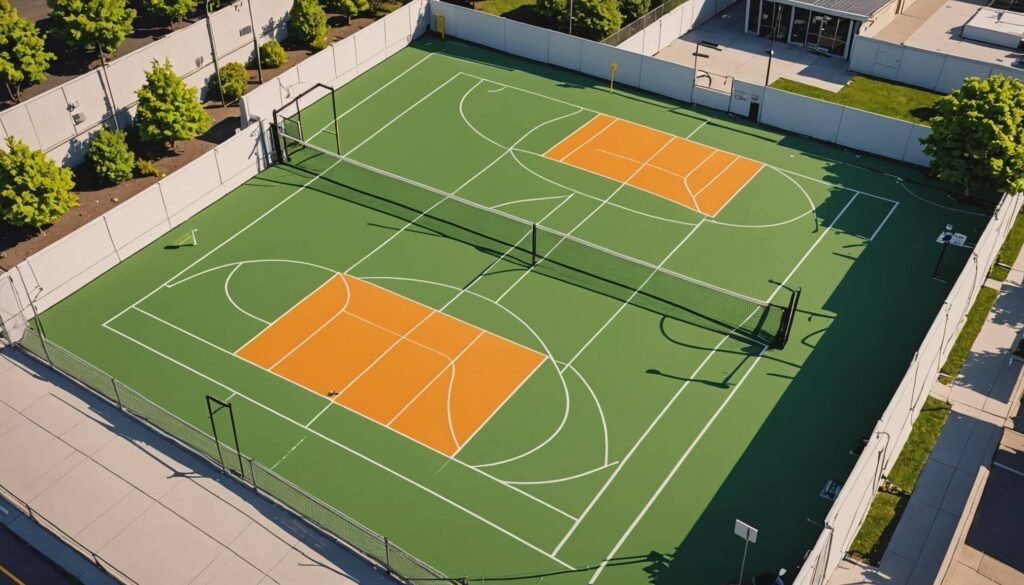
Pickleball Court Measurements: The Complete Guide to Every Line and Zone
Pickleball court measurements define the game at every level of play. Whether you’re stepping onto a recreational court for the first time or setting up a backyard court of your own, understanding these dimensions matters more than most players realize. The exact distance from the kitchen line to the net, the width of the sidelines, and the precise height of the net at its center versus the posts all shape how the game unfolds, from casual play to USA Pickleball sanctioned tournaments.
When you get the numbers wrong, you’re not really playing pickleball. You’re playing something close to it, but not quite right. This guide provides a complete breakdown of every dimension, line, and zone on a standard pickleball court, with no guesswork and no filler. Whether you’re building a court from scratch, teaching someone new to the sport, or simply tired of debating whether a ball landed in or out, this is your definitive reference for understanding exactly how a pickleball court is laid out and why those measurements matter to your game.
Understanding Standard Pickleball Court Dimensions
A regulation pickleball court measures exactly 44 feet long by 20 feet wide. These are the official playing surface dimensions as defined by the USA Pickleball Official Rulebook, which governs all sanctioned play throughout the United States. This standardization ensures that whether you’re playing in Florida, California, or anywhere in between, the court dimensions remain consistent and predictable.
What’s particularly interesting about these dimensions is that they don’t change based on whether you’re playing singles or doubles. The full court remains 44 feet by 20 feet regardless of how many players are on each side. What does change is how that space gets used strategically and how much court each player needs to cover. In doubles, each player typically covers roughly 10 feet of width. In singles, you’re responsible for the entire 20-foot width on your own, which dramatically increases the physical demands of the game.
While the playing surface itself is 44 by 20 feet, the total recommended space for a complete pickleball court including out-of-bounds clearance is 60 feet long by 30 feet wide. This buffer zone matters significantly, especially on hard courts where players are sprinting for wide balls and need space to safely decelerate. Dedicated pickleball facilities and recreation centers typically build to this full specification to ensure player safety and optimal gameplay. Converted tennis courts, on the other hand, often fall short of this ideal clearance, which is why those courts can feel cramped at the sidelines and potentially more dangerous when players are chasing balls near the boundaries.
The consistency of these measurements across all levels of play means that practicing on any regulation court translates directly to tournament play. There’s no adjustment period needed when you move from your local rec center to a competitive venue. This standardization is one of the sport’s great strengths, allowing players to develop muscle memory and court sense that remains relevant no matter where they play.
The Non-Volley Zone: Pickleball’s Most Critical Area
The non-volley zone, universally known as the kitchen in pickleball circles, is perhaps the most strategically important area on the court. This zone runs the full 20-foot width of the court on both sides of the net and extends exactly 7 feet from the net on each side. When you calculate the total depth of both non-volley zones combined, you get 14 feet of court space between the two kitchen lines where special rules apply.
Here’s where many players, especially beginners, get tripped up: the kitchen line itself is part of the non-volley zone. If you step on that line while executing a volley, it’s a fault. The rule isn’t just about being inside the zone with your feet, it includes contact with that boundary line. This catches players constantly, even those who have been playing for years. You’ll see it happen in recreational play and occasionally even in professional matches when a player gets caught up in the moment and their momentum carries their foot onto the line during a volley.
The strategic importance of the kitchen cannot be overstated. At higher levels of play, most of the game happens at or near this line, with players engaging in what’s often called the “dinking” battle. This involves soft shots hit from one kitchen line to the opponent’s kitchen line, with players waiting patiently for an opportunity to attack a ball that pops up too high. Understanding how to position yourself at the kitchen is fundamental to advancing your game beyond the beginner level.
The geometry of pickleball court measurements makes this 7-foot zone the most strategically dense area in the sport. It’s where patience meets opportunity, where soft touch matters more than power, and where most points are ultimately won or lost. The kitchen forces a unique dynamic that doesn’t exist in tennis or other racquet sports: you must allow certain balls to bounce rather than attacking them in the air, which creates a completely different tactical environment.
Net Specifications and How They Affect Play
The pickleball net spans the full 20-foot width of the court and must be set to specific heights at two key points: 36 inches at the sideline posts and 34 inches at the center. That 2-inch difference, creating a slight sag at the middle of the net, isn’t accidental or the result of a loose net. It’s actually part of the official specification and is intentionally designed into regulation play.
The net posts are positioned 22 feet from the center of the court, which places them slightly outside the sideline on each side. This is a crucial detail that many people miss when setting up courts, especially DIY installations. The posts themselves sit outside the actual playing area, not on the sideline itself. This positioning is essential for maintaining proper net tension and achieving the correct height specifications.
This detail trips up many court builds, particularly backyard installations where people are working without professional guidance. The common mistake is measuring to the sideline rather than understanding the proper post position. The result is a net that’s either too loose, too tight, or set at incorrect heights. If you’re setting up your own court, always verify the post placement first, measuring from the center of the court outward, then adjust the net tension to achieve that 34-inch height at center and 36 inches at the posts.
According to equipment standards, the net must maintain that 34-inch center height under tension during active play, not just during initial setup. This means the net needs to be properly tensioned and secured. A net that sags too much at center or sits too high changes the game fundamentally, affecting serve trajectories, the difficulty of passing shots, and the viability of certain strategic approaches.
The 2-inch height difference between the center and the posts creates what’s essentially a target zone at the center of the net. Experienced players exploit this lower center section when hitting passing shots or trying to keep balls low on returns. Understanding these exact measurements helps you develop better shot selection and targeting, particularly when you’re trying to keep balls as low as possible over the net to limit your opponent’s attacking options.
Every Line on the Court and Its Function
Every single line painted on a pickleball court has a specific name and serves a particular function in defining legal play. While most players quickly learn the major lines, understanding all of them and their precise purposes helps clarify rules questions and improves court awareness. Here’s the complete breakdown of what each line means and where it sits on the court.
The baseline is the line running parallel to the net at each end of the court. This line marks the back boundary of the 44-foot playing surface. All serves must be struck from behind the baseline, and a player cannot step on or over this line until after making contact with the ball on a serve. In rally play, the baseline represents the back boundary, and a ball landing on or beyond this line is out unless it touches the line, in which case it’s in.
The sidelines run the full length of the court on each side, defining that 20-foot width. These lines extend from baseline to baseline and are perhaps the most frequently disputed lines in recreational play. Here’s the critical rule that settles most arguments: a ball that lands on a sideline is in. Period. The line is always considered in bounds. This is a source of endless line call disputes among recreational players, but the rule is absolute and applies to all boundary lines on the court.
The non-volley zone line, more commonly called the kitchen line, runs parallel to the net at exactly 7 feet from the net on each side. As discussed earlier, standing on this line while volleying constitutes a fault. This line defines where the special no-volley rule begins, and it’s one of the most important lines for players to develop a precise awareness of. Experienced players develop an almost instinctive sense of where this line sits in relation to their feet, allowing them to get as close as possible without committing a fault.
The centerline divides the court vertically from the kitchen line all the way back to the baseline, creating two equal halves on each side of the net. This line is crucial for serving, as it defines the two service boxes. The centerline essentially splits the court into left and right service areas, and understanding its position helps servers target specific zones and receivers position themselves correctly.
The service areas themselves are each 10 feet wide (exactly half of the 20-foot court width) and 15 feet deep, measured from the kitchen line to the baseline. When serving, the ball must land in the diagonal service box from where you’re serving. It must clear the kitchen entirely and land in that 10-by-15-foot rectangle. A serve that lands in the kitchen or on the kitchen line is a fault. Understanding these dimensions helps you develop more precise serving and better anticipate where serves are likely to land when you’re receiving.
How Pickleball Court Size Compares to Other Court Sports
If you’re coming to pickleball from another racquet sport, understanding how court sizes compare provides useful context and helps explain why the games play so differently despite surface similarities. These comparisons also matter practically if you’re involved in converting existing facilities or building new courts.
A standard tennis singles court measures 78 feet long and 27 feet wide. Tennis doubles courts extend to 36 feet wide using the doubles alleys. When you compare this to pickleball’s 44-by-20-foot footprint, you can see that a pickleball court is roughly one-third the total area of a full tennis court. This size difference is precisely why four pickleball courts can fit inside one tennis court layout, though the conversion process has its own complications and considerations that affect gameplay and player experience.
Badminton singles courts run 44 feet long and 17 feet wide. This makes badminton nearly identical in length to pickleball but notably narrower. The net height difference between these sports is dramatic: while pickleball nets sit at 34 inches at center, badminton nets are positioned at 5 feet. This height difference fundamentally changes the game, making badminton much more vertical in its shot selection and strategy compared to pickleball’s emphasis on keeping balls low.
Table tennis, for reference, is played on a 9-foot-long table. The jump from table tennis to pickleball is enormous in terms of footwork demands, court coverage requirements, and the physical conditioning needed to play competitively. While the hand-eye coordination skills transfer somewhat between these sports, the movement patterns and stamina requirements are completely different.
These comparisons matter for several practical reasons. If you’re converting a tennis court to pickleball, understanding the size difference helps you plan the layout efficiently and avoid common mistakes. If you’re coming from badminton, you already have a sense of the court length but need to adjust to the wider playing area and dramatically different net height. And if you’re planning new construction, knowing how pickleball compares to other sports helps you communicate effectively with contractors and make informed decisions about space allocation.
Singles Versus Doubles: Does Court Size Change?
This is one of the most common questions new players ask, and the answer might surprise those coming from tennis: No, pickleball court dimensions are identical for singles and doubles play. The full 44-by-20-foot surface is used in both formats without any modification.
This design choice makes singles pickleball extremely demanding physically compared to doubles. In doubles play, each player is typically responsible for covering roughly 10 feet of court width, with partners working together to cover the full 20-foot span. In singles, that responsibility doubles. You’re covering the entire width on your own, which means significantly more lateral movement, longer sprints to reach wide balls, and much higher cardiovascular demands over the course of a match.
The strategic implications of using the full court for singles are profound. Footwork and court positioning become even more critical when the court dimensions don’t scale down with the player count. Singles players need to be more calculated about when to move forward to the kitchen line, because retreating to cover a lob becomes much more costly when you’re solely responsible for the entire court. Shot selection changes too, with more emphasis on placement and moving your opponent side to side to create open court.
The physical fitness requirements for competitive singles play are substantially higher than for doubles. While doubles pickleball can be enjoyed by players of varying fitness levels and ages, singles demands consistent cardiovascular conditioning, quick lateral movement, and the stamina to maintain high-level play across multiple games. This is one reason why doubles remains the more popular format, especially among older players and in recreational settings, while singles tends to attract younger, more athletic players looking for an additional physical challenge.
Indoor Versus Outdoor Court Measurements
The dimensions remain exactly the same whether you’re playing indoors or outdoors. Indoor and outdoor pickleball courts share identical measurements as specified by USA Pickleball regulations. This consistency is important because it means skills developed in one environment transfer directly to the other without any spatial adjustment period. The differences between indoor and outdoor play are environmental and equipment-based, not dimensional.
Outdoor courts typically use thicker, heavier balls with smaller, more numerous holes, designed to handle wind and temperature variations. The most common outdoor ball is the Franklin X-40 or similar models that can withstand outdoor conditions without being blown off course too easily. Indoor balls tend to be lighter and faster, with larger holes and a smoother surface. These ball differences affect pace of play and bounce characteristics significantly, but they don’t change the court size.
The court surface itself differs substantially between typical indoor and outdoor installations. Outdoor courts are most commonly built with asphalt or concrete bases topped with an acrylic coating system that provides color, traction, and weather resistance. Indoor facilities often use wood gymnasium flooring or specialized sport tile systems. These surface variations affect ball bounce consistency, joint impact, and how quickly players can change direction, but again, none of this changes the actual court measurements.
Surface type affects ball bounce more than many players expect. A well-maintained indoor court tends to produce a more consistent, predictable bounce than an outdoor court that’s been exposed to weather, temperature cycling, and general wear. Outdoor courts can develop cracks, uneven settling, or surface degradation that creates unpredictable bounces, adding an element of adaptation to outdoor play. Neither surface type changes the measurement specifications, but they do change how the game feels and flows.
Why Understanding Court Measurements Improves Your Game
Knowing the exact dimensions of a pickleball court isn’t just academic knowledge. It directly impacts how you practice, compete, and develop strategy. Understanding these measurements changes your approach to several critical aspects of the game.
Consider third shot targeting. The kitchen line sits exactly 7 feet from the net. Your third shot drop needs to clear the net at its lowest point, which is 34 inches at center, and land before or on that kitchen line. Understanding this exact geometry helps you visualize the margin for error on every drop attempt and practice with specific spatial targets in mind. You begin to develop an intuitive sense of the trajectory needed to consistently hit that target zone.
Serve depth is another area where measurements matter tactically. The service box extends 15 feet deep, from the kitchen line back to the baseline. A deep serve that lands near the baseline pushes your opponent back and makes it harder for them to attack on their return. A short serve that lands closer to the kitchen line gives them an easier approach and better court position. Understanding those 15 feet helps you target your serve deliberately rather than just hoping it lands somewhere in bounds.
In doubles play, court coverage becomes more precise when you understand the exact


