The Dink Minor League Pickleball Championships: Everything You Need to Know About the Biggest Amateur Event in the Sport
If you’ve been following the Minor League Pickleball scene, you’ve probably been calling the end-of-season event “Nationals.” A lot of people have. But that name is officially retired. What was once called Nationals is now the MiLP Championships, and the rebrand isn’t just cosmetic — it actually reflects something real about what this event has become.
This is no longer a domestic competition with a few international players sprinkled in. The MiLP Championships has grown into a genuinely global amateur pickleball event, with players flying in from dozens of countries to compete for a share of a $100,000 prize purse. Calling it “Nationals” undersells what’s happening. Championships fits. And once you understand what this week actually looks like, you’ll understand why the name change matters.
What Is the MiLP Championships, and Why Should You Care?
Let’s back up for a second, because if you’re newer to the pickleball world or just getting familiar with the competitive amateur scene, the Minor League Pickleball structure might still feel a little foreign. Here’s the simplest way to think about it.
Major League Pickleball is the top-tier professional league — the equivalent of the NBA or the NFL in terms of being the premier competitive circuit for the best players in the world. The Dink Minor League Pickleball, or MiLP, is the amateur version built around the same team-based format. Instead of just showing up to an open tournament and playing singles or doubles brackets by yourself, MiLP puts you on a team. You compete with and against other teams in a format that mirrors what the pros play. It’s organized, it’s structured, and there’s a full season of local, state, and regional events that feed into one massive end-of-season moment: the Championships.
Think of it like a recreational soccer league that culminates in a championship weekend. Except in this case, the championship weekend spans five full days, takes place at a large athletic facility in Arizona, and has a hundred thousand dollars on the line. For amateurs. That’s not nothing. That’s actually a remarkable thing to exist in any sport, let alone one that only recently became a mainstream fixture in American recreational life.
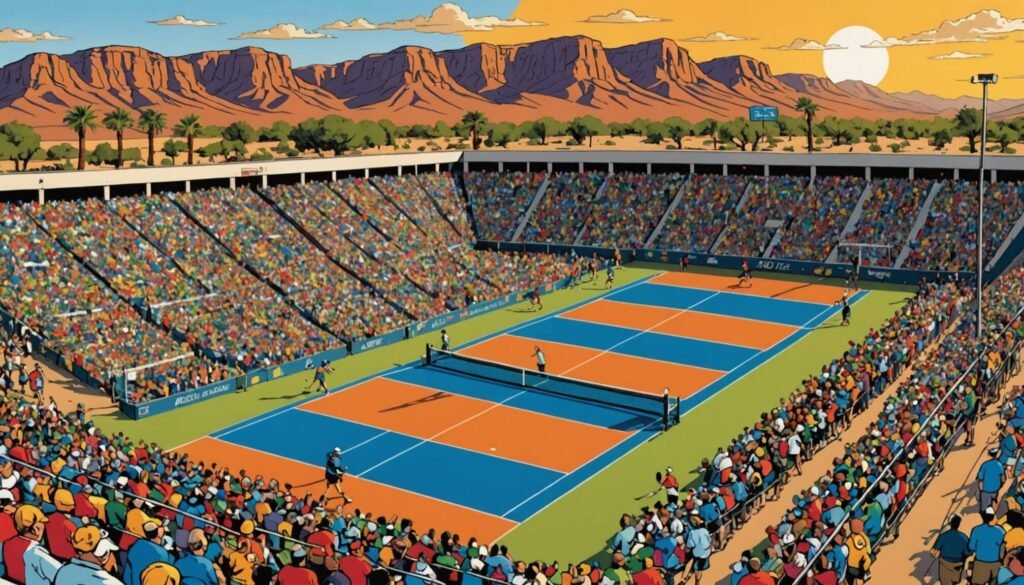
The 2027 MiLP Championships is scheduled for February 24–28, 2027, at Arizona Athletic Grounds in Mesa, Arizona. Forty-one courts. Five days. Five distinct events. Players from more than 20 countries already confirmed to attend. If you play pickleball at any level and haven’t been paying attention to what MiLP has built, now is a good time to start.
How the Growth of This Event Tells a Bigger Story
The trajectory of the MiLP Championships is one of the more remarkable growth stories in amateur sports over the last few years. When the inaugural Championships was held in 2023, it drew 272 players — 68 teams from 24 U.S. states and 3 countries. Solid for a first year, but modest by the standards of what came next.
By 2024, the event had grown to 424 players, 106 teams, 34 states, and 7 countries. Still climbing. Then 2025 happened: 1,000 players, 318 teams, 35 states, and more than 23 countries represented. That is not organic growth. That is a sport exploding in popularity in real time, and an organization that built an infrastructure capable of channeling that energy into something structured and meaningful.
For the 2026 season, MiLP adjusted the season calendar to end December 31, 2026, specifically to accommodate the growing international player base and make sure competitors from outside the U.S. had enough lead time to plan travel to Mesa. That kind of operational adjustment signals something: the international demand is real, and the organization is taking it seriously.
By 2027, the event is expected to host around 2,000 players, with 21 countries already confirmed to participate. That is a tenfold increase in player count over four years. In almost any amateur sports context, that would be an extraordinary story. In pickleball, it feels almost inevitable given how fast the sport has grown — but the MiLP structure deserves credit for giving that growth a destination.
The Five Events at Championships
One of the things that makes the MiLP Championships genuinely interesting is the variety of competition formats under one roof. This isn’t just one big bracket. There are five distinct events happening across the week, each with its own format, schedule, and stakes.
MiLP Open Age
This is the flagship format — the classic four-player mixed team structure that MiLP was built around. DUPR divisions range from 12 through 22, meaning players across a wide range of skill levels have a division to compete in. Round robin play happens on Saturday, with bracket playoffs running on Sunday. Every team that qualifies has a path to compete across the full weekend.
If you want to understand the MiLP format in more depth, The Dink has a full breakdown of every way to play in the league.
MiLP 50+
The same mixed team format, but specifically for players 50 and older. The 50+ divisions kick off the week, with round robin play happening Wednesday and bracket playoffs on Thursday. DUPR divisions in this bracket run from 12 through 18. Every team advances from round robin to bracket play, so there’s no early exit just because you had a rough pool play day.
MiLP v3
V3 is MiLP’s gendered team format — three players per team, three games to 21, no DreamBreaker. It runs separately from the main mixed format and has its own leaderboard that feeds into Championship qualification. The Dink’s v3 explainer walks through how the format actually works a year into its existence. V3 runs on Friday for both open age and 50+ divisions, with DUPR levels from 9 through 15.
Nations Cup
This is the addition that most directly explains why “Nationals” no longer works as a name. The Nations Cup is country vs. country competition — not for elite pros, but for regular players at every skill level. DUPR 14, 16, and 18 divisions. Round robin pool play on Friday. Playoffs and finals on Saturday.
International pickleball competition at the amateur level has historically been almost nonexistent. Nations Cup changes that in a significant way. Players qualify through their country’s national leaderboard or by winning their division at a national-level event. Twenty-one countries are already confirmed for 2027, including Australia, England, Argentina, India, and the Philippines. The original Nations Cup announcement has more detail on how the format was conceived and how country eligibility works.
The concept is straightforward and genuinely exciting: any player, at any level, can earn the chance to wear their country’s colors and compete on a global stage as part of a team. That’s a unique thing in amateur sports, and it’s a compelling reason for players outside the U.S. to engage with the MiLP ecosystem throughout the year.
College Regional
New for the 2027 Championships is the College Regional, running on Sunday. College teams compete in a one-day round robin to playoff format, with a bid to the College Pickleball Tour Nationals on the line for the winner. This is a meaningful addition because it formally brings the next generation of competitive players into the Championships week and connects MiLP to the broader college pickleball circuit. More details on format and eligibility are expected to come from the organization ahead of the event.
How Players Qualify for Championships
Getting to Mesa isn’t just a matter of signing up. There’s a qualification structure, and it runs through the same local and regional events that form the backbone of the MiLP season year-round.
The two main paths to Championships are the National Leaderboard and Dream Tickets. The National Leaderboard tracks your MiLP results across the entire season. Points accumulate from every event you play — local events, state championships, regional showdowns. Top performers on the leaderboard at the end of the season earn automatic bids to Championships. If you’re playing v3, those results feed into a separate v3 leaderboard, but they count toward qualification the same way.
Dream Tickets are awarded to division winners at State Championship and Regional Showdown events. Win your division at one of those events, and your team earns a direct bid to Championships. One ticket per gold medalist team, no additional qualification required.
There are a couple of additional pathways worth noting. Teams affiliated with MLP-partnered Minor League franchises can earn direct bids through that partnership. And for international players, each country has its own qualification pathway that runs through their national leaderboard or national-level events.
One important technical note about Championships: DUPR division caps are slightly expanded for the event. The DUPR 16 division, for example, runs up to 16.900 instead of the usual 16.300, and so on down the line. This applies to v3 divisions as well. The reason is practical — ratings shift throughout a season, and players shouldn’t be penalized for improving. Championships makes room for that movement.
Why the Name Change From Nationals to Championships Actually Matters
It would be easy to read the “Nationals to Championships” rebrand as pure marketing — a fresh coat of paint on the same event. But there’s a real argument that the name change reflects something substantive about where MiLP has arrived.
“Nationals” implies a national competition. It implies that the country of origin is the defining frame for the event. When MiLP was primarily a U.S.-based league with a few international participants, that framing made a kind of sense. But 23 countries in 2025, 21 already confirmed for 2027 with more expected, a dedicated Nations Cup format, and a player base that spans multiple continents — that’s not a national event. It’s a world event for amateurs, and calling it Championships acknowledges that reality.
It’s also a more aspirational name in the right way. Championships communicates finality, stakes, and significance without being tied to geography. When you earn your Dream Ticket and book your flight to Mesa, you’re going to the Championships. That means something regardless of which country’s passport you’re traveling on.
The Bigger Picture: What MiLP Has Built
Zoom out for a moment and consider what The Dink Minor League Pickleball has actually constructed. There’s a full seasonal calendar of local, state, and regional events that give amateur players a real competitive structure to engage with throughout the year. There’s a point system that makes every event matter. There’s a team format that transforms individual recreational play into something more communal and competitive. And there’s a Championships at the end of it all that has grown from 272 players in its first year to an expected 2,000 players with global representation in 2027.
That is a legitimate sports league infrastructure, built for and around amateur players. The closest analogy might be USA Hockey’s adult league structure or the regional qualifier systems that recreational runners use to get into major marathons — but MiLP has compressed that kind of ecosystem into just a few years, and added a prize purse on top of it.
For anyone who plays pickleball recreationally and has wondered what the next level of engagement looks like, MiLP is a concrete answer. You don’t have to be a pro. You don’t have to quit your job and train full time. You just have to show up to local events, play in the format, accumulate points or win your division, and earn your way to Mesa. The structure is there. The destination is real. And in February 2027, it will be called the Championships.
If you’re serious about tracking your results and understanding how the leaderboard works heading into the 2027 event, The Dink is the best place to stay current on MiLP news, format updates, and qualification standings throughout the season.


