Pickleball Etiquette for Beginners: The Unwritten Rules That Matter
Stepping onto a pickleball court for the first time involves more than just knowing how to hit the ball. Beyond the official rulebook lies an entire social framework that governs how players interact, communicate, and respect one another on the court. These unwritten rules matter just as much as your serve technique, and understanding them early can mean the difference between becoming a welcomed regular or someone others avoid partnering with.
The beauty of pickleball lies partly in its accessibility. Millions of people across the United States are discovering this sport, and its welcoming nature makes it easy for beginners to jump in. But that welcoming atmosphere depends on everyone following certain behavioral standards that aren’t printed anywhere official. This guide explores the essential etiquette principles every new player should understand before their first game.
Understanding What Pickleball Etiquette Actually Means
Pickleball etiquette encompasses the behavioral standards that shape player interactions both on and around the court. These standards cover how you announce scores, handle disputed calls, wait for court availability, and interact with fellow players during games. While you won’t find these guidelines in the official rulebook, they fundamentally determine whether other players want to share the court with you again.
The distinction between rules and etiquette parallels the difference between knowing how to play poker and understanding table manners at a casino. The written rules get you into the game, but etiquette determines whether you’ll be invited back. Many new players concentrate exclusively on developing their technical skills, working on footwork, shot placement, and strategy. While building fundamental skills remains crucial, neglecting court manners can undermine even exceptional technique.
The social dimension of pickleball distinguishes it from many other sports. Courts often host mixed skill levels, ages, and experience levels simultaneously. This diversity creates a rich playing environment but also requires everyone to maintain awareness of how their behavior affects others. Players who master both the technical and social aspects of the game consistently have better experiences and improve faster because they’re welcomed into higher-level games.
The Single Most Critical Etiquette Rule
If you remember only one etiquette principle, make it this: call the score before every serve, clearly and loudly enough for all players to hear. This isn’t a suggestion or a courtesy extended to beginners. According to USA Pickleball Rule 4.A.1, the server must announce the score before each serve. Failing to do so creates confusion, slows gameplay, and signals to everyone on the court that you’re not paying proper attention.
In doubles, the format follows a specific pattern: server score first, then receiver score, followed by server number (either one or two). In singles play, you announce the server score followed by the receiver score. This might feel awkward initially, especially when you’re concentrating on your serve mechanics, but it quickly becomes automatic with practice. Establishing this habit from day one sets a professional tone for your entire approach to the game.
The score announcement serves multiple purposes beyond rule compliance. It gives all four players a moment to reset mentally between points, ensures everyone agrees on the current score, and creates a natural rhythm to the game. Players who consistently skip score announcements disrupt this rhythm and often find themselves in disputes about the actual score, wasting time and creating tension that could have been easily avoided.
Navigating Line Calls Without Creating Conflict
Line calls represent the most frequent source of etiquette violations and interpersonal tension in recreational pickleball. The governing principle is straightforward but requires discipline: if you cannot call a ball out with complete certainty, you must call it in. This standard isn’t merely a polite convention; it’s embedded deeply in pickleball culture for sound reasons.
Research into recreational sports participation reveals that perceived fairness stands as the top predictor of whether people continue playing a sport long-term. A 2022 study published in the Journal of Sport & Exercise Psychology found that fairness perception in recreational settings directly influences participant retention. Simply put, people keep playing games that feel fair and abandon those that don’t. Questionable line calls drive players away from courts and damage the community atmosphere that makes pickleball special.
The fundamental guideline governing line calls states that each player calls only the lines on their own side of the net. Calling your opponent’s lines for them, even when you believe you have a better view or are certain about the call, violates a core etiquette principle. The ball landed on their side, so the call belongs to them. Trust them to make it honestly.
When a call genuinely feels incorrect to you, you have the option to mention it once, calmly and without aggression. State your perspective, listen to their response, then let it go and move on. The pickleball community has earned a reputation for honesty that exceeds most other recreational sports. Trust that culture and give your fellow players the benefit of the doubt. One questionable call won’t determine the outcome of your game, but your reaction to it will certainly determine whether people want to play with you again.
Professional pickleball is moving toward technological solutions for line calling challenges, with automated systems expected to arrive soon. Until that technology reaches recreational courts, however, the honor system remains the backbone of fair play in pickleball.
Strategic Shot Selection Versus Unsportsmanlike Play
One etiquette question that confuses many beginners involves targeting the weaker player in doubles. The answer depends entirely on context. In competitive tournament play, targeting an opponent’s weakness represents legitimate strategy. In recreational open play, however, repeatedly hammering a player who’s clearly overmatched doesn’t demonstrate skill; it demonstrates poor sportsmanship.
Understanding this distinction matters because most beginners primarily play in recreational rather than competitive settings. The social norms differ between these environments. In open play or casual pickup games, spreading your shots around and playing your natural game without deliberately making someone feel targeted creates a better experience for everyone involved. You can still win points and play well without making another player feel humiliated or unwelcome.
This principle applies especially in doubles, where partnership dynamics shape the game significantly. Good partners protect each other, and good opponents respect each other. Finding the balance between competitive play and recreational enjoyment represents one of the skills that separates players who improve quickly from those who plateau despite technical ability. Players who understand this nuance consistently get invited into better games and develop faster as a result.
Developing a complete game requires learning various shots that allow you to win points through skill rather than exploitation. The lob, drop volley, and ATP all provide ways to finish points that feel satisfying for you and respectful to your opponents.
Understanding Open Play Rotation Systems
Open play, sometimes called rec play or drop-in pickleball, operates according to its own etiquette system that newcomers must understand. While specific procedures vary by facility, most venues follow a similar basic structure that ensures fair court access for everyone who shows up to play.
When you arrive at open play, place your paddle on the designated rack or board. Courts rotate based on the order in which paddles were placed, creating a first-come, first-served system. This approach prevents stronger players from monopolizing courts and ensures everyone gets playing time regardless of skill level.
The typical rotation pattern has winners staying on the court while losers rotate off, with the next group in line rotating in. However, some facilities use different systems, including timed rotations where everyone switches courts after a set period regardless of who won. Before assuming you understand the rotation, confirm the specific format used at your facility. Asking demonstrates awareness and respect rather than ignorance.
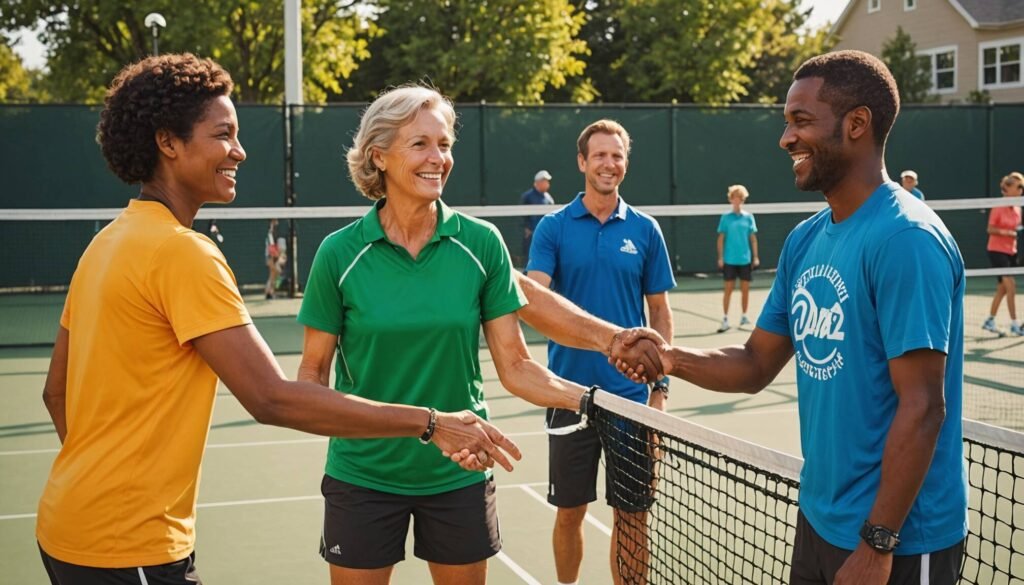
When your game ends, don’t linger on the court. Grab your gear, shake hands with all players, and clear out promptly so the next group can begin. Those few minutes you spend chatting on the court after your game ends might seem insignificant to you, but they matter to the players waiting for their turn. This small courtesy makes a substantial difference in how others perceive you.
What you actually gain from rec play depends significantly on how you conduct yourself socially. Earn a reputation as someone easy and pleasant to play with, and you’ll never lack for games. Develop a reputation for bending rules, lingering too long, or creating drama, and you’ll find fewer people placing their paddles next to yours. The politics of open play extend beyond simple rotation systems to encompass the entire social ecosystem of your local pickleball community.
Behaviors That Destroy Your Court Reputation
Certain behaviors violate pickleball etiquette so fundamentally that they can damage your reputation before you’ve played enough games to establish yourself. Three actions stand out as particularly problematic: offering unsolicited coaching, celebrating excessively, and making excuses after losses. Each damages court culture in distinct ways.
Unsolicited coaching ranks as the most commonly cited etiquette violation among experienced players. Nobody asked you to diagnose and fix their backhand technique. Even when you’ve correctly identified a problem that’s costing them points, keep that observation to yourself unless specifically asked for feedback. The impulse to help can feel positive, but unsolicited advice typically lands as condescending rather than helpful. There’s absolutely a time and place for coaching and skill development, but that moment is not during a recreational game. Amateur players have plenty of habits worth breaking, but they’ll address those on their own timeline or by seeking out instruction intentionally.
Excessive celebration creates a more nuanced etiquette question. Fist pumps after great shots are perfectly acceptable and add energy to games. However, elaborate celebrations after an opponent’s error, particularly when that opponent is clearly a newer or less skilled player, crosses into poor sportsmanship territory. Read the room and calibrate your celebrations to match the competitive intensity and skill balance of your game. Celebrating your own excellent shots feels different from celebrating your opponent’s mistakes.
Making excuses after losses drains energy from everyone around you. The sun was in your eyes, the wind affected your shots, your paddle grip felt off—maybe all of those factors were genuinely true. Nobody wants to hear about them after the game ends. Developing mental habits and rituals that build resilience serves you far better than verbalizing excuses. Learn from your losses privately, acknowledge your opponents’ good play, and move forward.
Understanding the appropriate times to attack in pickleball involves reading both the tactical situation and the social context. Timing, positioning, and reading your opponent matter more than simply hitting the ball as hard as possible whenever you get the chance.
Managing Noise, Language, and Boundaries
Pickleball often takes place in community centers, public parks, and multi-use facilities where families, children, and people from diverse backgrounds share space. The sport’s growth across all age groups has created a genuinely cross-generational community, and your behavior should reflect that diversity. Keep your language clean and your volume reasonable.
Several specific noise and boundary issues catch beginners off guard. Don’t yell across courts to friends playing on adjacent courts while points are in progress. Wait for a natural break between games or during a court change. This seems obvious, but the excitement of seeing friends often overrides common sense in the moment.
Keep music to yourself. Bluetooth speakers that bleed audio onto adjacent courts aren’t welcome, regardless of how excellent your playlist might be. People come to pickleball courts to play pickleball, not to serve as a captive audience for your music preferences. If you want music during play, use earbuds with low enough volume that you can still hear score calls and communicate with your partner.
One small gesture that separates classy players from everyone else: thank the net. When a net cord gives you a lucky winner that you didn’t earn through skill, acknowledge it. A simple “sorry” or raised paddle toward your opponents communicates that you recognize the point came from fortune rather than excellence. This tiny courtesy costs nothing and demonstrates respect for the game and your opponents.
Learning the vocabulary and inside jokes of pickleball helps you understand and participate in the culture. The sport has developed its own language, and familiarity with common phrases helps you feel connected to the broader community. These unwritten rules extend far beyond what any article can capture, but understanding the core principles gives you a foundation to build from.
Kitchen Line Violations and Self-Officiating
The non-volley zone, commonly called the kitchen, generates frequent rule questions among beginners. Volleying while standing in the kitchen constitutes a fault, but the etiquette dimension involves what happens after a violation occurs. The standard is clear: call violations on yourself immediately. Don’t wait for your opponent to say something, and don’t pretend you didn’t notice.
Self-officiating represents a fundamental component of recreational pickleball culture. USA Pickleball Rule 9.A explicitly states that non-volley zone faults are the responsibility of the player involved. If your momentum carries your foot into the kitchen after hitting a volley, call it on yourself immediately. If you step on the line while volleying, call it. Letting violations slide when you’re aware of them represents one of the fastest ways to lose your reputation on any court.
The momentum rule trips up many players. You can stand in the kitchen as much as you want, but if you hit a volley and then your momentum carries you into the kitchen afterward, that’s still a fault even though you hit the ball from outside the zone. This rule requires honest self-assessment in the moment. Did your follow-through carry you forward into the zone? Did you step into the kitchen to maintain balance after your shot? These are your calls to make, and making them honestly builds trust with everyone you play with.
Understanding proper positioning at the kitchen line helps you avoid these violations in the first place. Better positioning means fewer close calls and fewer opportunities to accidentally cross the line. The kitchen rules can feel intimidating initially, but as one essential guide explains, the best way to internalize these rules is simply to play. Pay attention to where your feet are when you volley, feel your momentum, and after a few matches, it becomes second nature.


