Roll Volley vs Punch Volley: Why Your Fourth Shot Keeps Failing (And How to Fix It)
You’re moving up toward the kitchen. The ball drops into that awkward middle zone, not coming right at you, not sitting up nicely. You reach out and punch it. It floats long, or worse, it balloons up and gets hammered back at your feet.
Here’s the thing: your reaction time probably wasn’t the problem. Your shot selection was. You hit a punch volley when the situation was asking for a roll volley, and those are two genuinely different shots with different mechanics, different setups, and different purposes.
Most recreational players don’t realize this. They default to one volley type regardless of what the ball is doing, then wonder why their fourth shots keep breaking down at the worst moments. This breakdown pulls from coaching content on Selkirk TV, where the coaching staff walks through exactly when and how to execute the roll volley on the fourth shot.
What’s the Difference Between a Roll Volley and a Punch Volley?
Before getting into mechanics, it helps to understand what each shot is actually designed to do, because they solve different problems.
The punch volley is your go-to when the ball is coming directly into your body at a manageable height. You meet it flat, redirect it with a firm wrist, and keep the motion compact. It’s efficient and works well when you’re in control of the exchange.
The roll volley is a topspin volley. You use it when gravity is working against you and the ball is descending into a difficult zone, somewhere around your knees or below, where a flat punch would either pop the ball up into your opponent’s wheelhouse or send it wide. The roll volley uses a low-to-high brushing motion to generate topspin, which pulls the ball back down into the court even when you’re making contact from a tough position.
Reading which situation you’re in, and reading it early, is what separates players who extend rallies from players who keep ending them accidentally. The complete pickleball volley guide from The Dink breaks this out across all three volley types if you want the full picture.
For Players New to This Concept: Here’s What It Means in Plain Terms
If you’re newer to pickleball or haven’t dug deep into shot mechanics yet, here’s a straightforward way to think about it.
Imagine you’re playing catch. If someone throws the ball right at your chest, you just reach out and grab it. Easy. That’s the punch volley situation.
Now imagine someone throws the ball a little low and to the side, and it’s dropping fast. If you just swipe at it the same way, you’ll either miss it or knock it straight up into the air. Instead, you’d naturally scoop upward a little to redirect it. That scooping motion, applied to a pickleball paddle with a bit of spin on it, is essentially what a roll volley does.
The topspin you create makes the ball arc up and then drop down quickly, like a heavy ground ball in baseball. That’s useful because it forces your opponent to dig the ball up from a low spot, which makes it very hard for them to attack you on the next shot. It’s a smart, strategic shot, not just a defensive one.
Why Paddle Position Is Everything on the Roll Volley
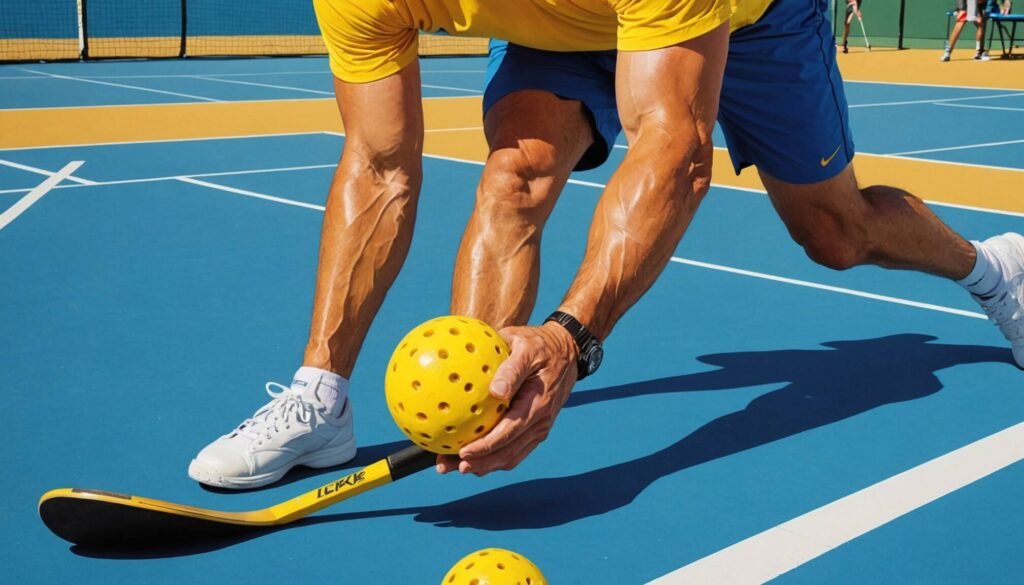
The most important mechanical piece of the roll volley is this: your paddle head needs to dip below the level of the ball before you make contact. That is not optional. Without that dip, you cannot generate the upward brushing motion that creates topspin, and without topspin, the ball floats instead of dropping.
Most players keep their paddle too flat or too high when they see the ball descending. The result is a half-punch, half-roll hybrid that does neither job well. You have to commit fully to the dip.
Here’s what the full roll volley setup looks like when it’s done correctly:
- Keep your paddle out in front of you at all times in a ready position, not tucked to your side.
- As you recognize the ball is dropping, dip the paddle head so it falls below the ball before contact happens.
- Make contact in front of your body, never beside you, never behind you.
- Brush upward through the ball from low to high, finishing with the paddle still visible in your peripheral vision.
- Stay low throughout the entire shot with bent knees and a stable center of gravity.
That last point about keeping the paddle in your peripheral vision matters more than it sounds. If the paddle disappears behind you during the follow-through, your margin for error increases dramatically and your consistency drops. The finish should be compact and forward, not wrapped around your body.
The principle of paddle positioning below the ball applies here directly, and it’s one of the most common mechanical gaps The Dink has identified in intermediate players.
The Contact Point Rule You Cannot Break
Contact in front of your body. This applies to both volley types, but it matters even more on the roll volley because of the swing path required.
When you let the ball get beside you or past you, you lose the ability to direct your swing upward through it. The topspin generation requires a clean low-to-high brush, and that motion only works when your paddle is leading the way out in front of your body. If the ball gets to your side before you contact it, the best you can do is push it somewhere and hope.
Staying in a proper ready position is what gives you enough time to dip the paddle and get set before the ball arrives. Paddle out, knees bent, weight balanced, ready to move in either direction. That athletic stance is what creates the window you need to execute the roll correctly.
What “Stay Low in Your Chair” Actually Means
One of the most practical coaching cues for the roll volley is to imagine you’re sitting in a low chair and you’re not allowed to stand up during the shot. That image keeps your knees bent and your body compressed through the entire stroke.
When players stand up during a roll volley, two things go wrong simultaneously. First, the swing path flattens out and you lose the topspin. Second, the contact point drifts back because your posture has shifted and the ball gets past you. Both errors lead to the same outcome: a floated ball that your opponent is happy to receive.
Staying low keeps everything in front of you and keeps the brush angle intact. Knee bend isn’t a suggestion here. It is the actual mechanism that makes the shot function. Players who tend to stand up through their volleys often have the same problem in the transition zone, where rushing to get tall instead of staying patient and low causes repeated errors.
How to Aim the Roll Volley
The target on a roll volley is almost always your opponent’s feet. Topspin pulls the ball down quickly, which means a well-executed roll volley will land at or just past the kitchen line and drop fast toward whoever is standing there. That forces them into a low contact situation, which significantly limits their offensive options on the next ball.
This is not a shot you rip cross-court at full pace and hope for the best. It’s a placement shot that uses spin to create a difficult angle. The spin does the work when your swing path and contact are correct.
A simple aiming sequence for the roll volley during a live point:
- Identify where your opponent is positioned at the kitchen line.
- Pick a landing zone at or just past the kitchen that forces them to reach down.
- Execute the low-to-high brush with a trajectory that peaks early and drops fast.
- Hold your low stance through the finish so the swing stays on its correct path.
When you add topspin with intention, you’re not just keeping the ball in play. You’re creating a shot that puts your opponent in a genuinely difficult position. Understanding how topspin works in pickleball makes this targeting process much more intuitive over time.
What Happens When Your Swing Gets Too Big
One of the most common errors on the roll volley is taking too large a backswing. When the prep is too big, the paddle disappears from your peripheral vision and the follow-through pulls it behind your body. At that point you’ve lost spin, direction control, and your ability to recover for the next shot, all at once.
The roll volley is a compact stroke. Not a full groundstroke swing. Think of it as a controlled brush, not a full rip. The paddle head dips, contacts the ball, and finishes out in front, still visible, still ready. That is the complete motion. Anything more is adding error without adding power.
Players who struggle with inconsistent swing mechanics across shot types often find that the roll volley is where that inconsistency shows up most clearly, because it requires more precision than a flat drive and punishes oversized mechanics immediately.
How the Roll Volley Fits Into Your Fourth Shot Strategy
Your fourth shot is one of the most consequential shots in any rally. You’ve played a third shot drop or drive, you’re transitioning toward the kitchen, and now you need to make a real-time decision about what to do with the incoming ball.
The decision framework is simple but needs to happen early. If the ball is coming directly at your body at a manageable height, punch it. If the ball is dropping and falling into that awkward zone below your normal contact point, roll it. The decision should be made before the ball reaches you, not during contact.
Learning ball height rules for shot selection is what makes that early read possible. The more you train your eye to spot the ball’s trajectory early in its flight, the more time you give yourself to set up correctly.
It’s also worth noting that players who struggle with fourth shots often have a third shot issue feeding the problem. If your third shot is too high, your opponent’s response will be aggressive, and you’ll face exactly the kind of awkward falling ball that demands a roll volley you haven’t practiced enough. The third shot drive vs drop decision and the fourth shot are directly connected.
Drills That Build Roll Volley Consistency
You cannot develop this shot just by thinking about it during games. The mechanics need to be grooved through repetition so the low-to-high brush becomes automatic under pressure. Here are three focused approaches:
Shadow drilling: Without a ball, practice the dip and brush motion slowly. Check that your paddle stays in your peripheral view throughout the finish. Feel the low stance and hold it through the imaginary follow-through. This builds the muscle memory of the correct motion before you add the complexity of a moving ball.
Hand feed practice: Have a partner feed balls low and slightly away from your body, specifically into the dropping zone, while you focus only on paddle dip and low-to-high contact. Do this 50 times before trying to use the shot in a live rally. Isolation drilling like this is how the 70 percent rule for making practice stick actually gets applied.
Live drilling with a target: Rally with a partner and call out “roll” whenever a ball drops into the zone. Your only job on those balls is to execute the shot and find your partner’s feet. Track how many land where you intended. The accountability of tracking makes the drill meaningfully different from just rallying.
Wall work can also supplement your development when a partner isn’t available. The wall won’t give you the exact same ball flight, but it trains the swing path and the compact finish. Players who’ve invested time in pickleball wall practice drills often report that the repetition builds a feel for the brush that translates well to live play.
The goal across all these drills is the same: make the paddle dip and low contact feel completely natural. When you’re in a real point and a ball drops into the roll zone, you should not be thinking about mechanics. The body should just execute. That level of automaticity is what you see in players who have worked through progressive drilling across skill levels and have a shot ready for every situation.
The Difference Between a Good Roll Volley and a Wasted One
A good roll volley lands low, moves with pace, and forces your opponent to dig from below the net. A wasted roll volley either floats because the swing path was too flat, or sails long because the brush happened late and the contact point was behind the body.
Trajectory is the key indicator. You want the ball to peak early and drop hard, not float across at net height and give your opponent a comfortable swing to work with. The topspin is what controls that trajectory, and the topspin comes entirely from the dip and the upward brush. If either of those elements is missing, the shot doesn’t do its job.
The difference between 4.0 and higher-level players often comes down to exactly these kinds of in-between decisions. The better player reads the ball earlier, selects the right shot faster, and executes with less wasted motion. The roll volley is a perfect example of that gap showing up in real points. Once you own this shot, it opens up the rest of your kitchen attack toolkit, including the roll versus flick decision that becomes available once you’re consistently at the line and reading the ball well.
Frequently Asked Questions
What is a roll volley in pickleball?
A roll volley is a topspin volley hit by dipping the paddle head below the ball and brushing upward through contact. It is used when the ball is falling into a low or awkward zone where a flat punch would pop it up or send it long. The result is a ball that drops quickly toward your opponent’s feet.
When should I hit a roll volley instead of a punch volley?
Hit a roll volley when the ball is dropping and falling below your normal contact zone, rather than coming directly into your body. A punch volley works best when the ball is at a manageable height and you can meet it flat. If the ball is descending and you try to punch it, you will likely float it or miss wide.
Why does my roll volley keep sailing long?
The most common reason is that your contact point is too far back, beside or behind your body, which flattens the swing path and eliminates the topspin. Without topspin, nothing pulls the ball down into the court. Keep your contact point in front of your body and dip the paddle head before the ball arrives.


