
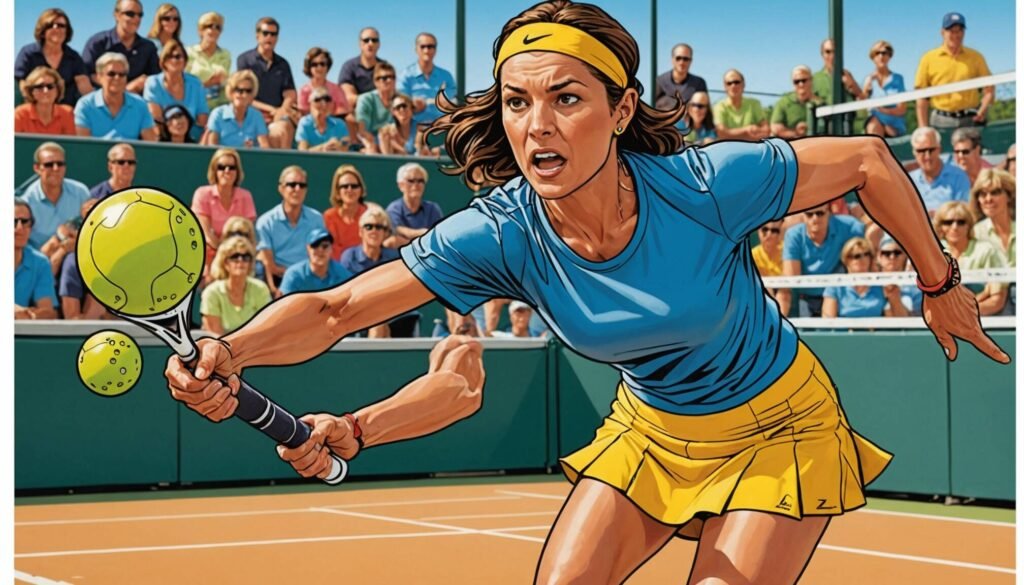
Fighting Pace with Pace: The Two-Handed Backhand Counter in Pickleball
When you’re standing at the kitchen line and an opponent fires a speed-up directly at your backhand side, you face a critical decision point. Most recreational players either attempt a soft reset to neutralize the pace or they panic and hit the ball out. But there’s a third option that changes the entire dynamic of fast-hands exchanges at the net: the two-handed backhand counter. This shot allows you to absorb incoming pace and redirect it with control, keeping you aggressive even when you’re under pressure.
Professional player Ava Ignatowich recently broke down the mechanics of this essential weapon in detail, covering everything from grip positioning to the subtle wrist action that keeps your counters in play. For players who struggle with backhand volleys or feel like they’re constantly on the defensive during net exchanges, mastering the two-handed backhand counter represents a significant leap forward in competitive capability.
Understanding the Two-Handed Backhand Counter for Beginners
If you’re relatively new to pickleball or haven’t spent much time working on advanced net techniques, the concept of a two-handed backhand counter might seem intimidating at first. Let me break down what this shot actually is and why it matters.
In pickleball, a “counter” is any shot where you’re responding to an opponent’s aggressive attack with your own aggressive shot rather than simply resetting the ball back into a slow rally. Think of it as fighting fire with fire. When someone hits a hard, fast ball at you at the kitchen line, a counter shot redirects that pace back at your opponent rather than absorbing it into a soft reply.
The “two-handed” aspect simply means you’re using both hands on the paddle grip, similar to how many tennis players hit their backhand groundstrokes. This provides extra stability and power compared to a one-handed technique. For your backhand side specifically, this means your dominant hand is on the bottom of the grip with your non-dominant hand stacked on top.
Why does this matter? At the kitchen line, exchanges happen extremely fast. When you can confidently counter an attack rather than just defending against it, you completely change the tactical equation. Your opponents can’t simply speed the ball up at you and expect an easy point. You become a threat even when under pressure, which fundamentally alters how points develop.
Why the Two-Handed Backhand Counter Changes Kitchen Line Dynamics
The kitchen line in pickleball is where points are won and lost. It’s also where pace becomes the primary currency of exchange. When an opponent executes a well-timed speed-up targeting your backhand, responding with a one-handed counter puts you at a significant disadvantage. You’re trying to control and redirect substantial momentum using only one arm, which means your margin for error shrinks dramatically and your ability to generate counter-pace diminishes.
The two-handed backhand counter fundamentally solves this problem by distributing force across your entire upper body. Instead of your arm acting alone, your shoulders, core, and both arms work as a coordinated unit. This creates a stable platform that can absorb incoming pace while simultaneously redirecting it with authority. The stability factor is what truly separates effective counters from balls that either sail long or drop into the net.
Ignatowich emphasizes that this shot becomes particularly valuable in specific situations. When you’re positioned on the right side of the court and a ball comes high past your inside hip, you face a choice. Most recreational players default to a reset in this scenario, which surrenders the initiative. With a developed two-handed backhand counter, you can maintain offensive pressure and immediately shift momentum back in your favor. It transforms what would be a defensive moment into an attacking opportunity.
The shot isn’t purely about power generation, though that’s certainly a benefit. The real value lies in the consistency and control that two hands provide. When you’re engaged in fast-hands battles, the player who can reliably counter without errors typically wins the exchange. The two-handed technique gives you that reliability while maintaining enough pace to keep opponents uncomfortable.
Mastering the Grip: Your Foundation for Control
The grip intimidates many players initially because it looks complex and feels foreign if you’ve spent your entire pickleball career hitting one-handed backhands. But Ignatowich breaks the process down into straightforward, repeatable steps that anyone can master with practice.
Start with your dominant hand using a continental grip. To find this grip properly, locate the U-shaped groove between your thumb and index finger, place it on the top edge guard of your paddle, and slide your hand down onto the grip. This creates a neutral hand position that sits between an Eastern and Western grip, providing the flexibility you need for varied shots at the net.
Next, stack your non-dominant hand directly on top of your dominant hand. Position the U-shaped groove of your top hand over the flat part of the paddle grip, then close your fingers around it. Slide both hands up or down the grip until you find a position that feels comfortable and secure. This stacking creates the stable platform that makes the two-handed counter so effective.
The beauty of this grip setup is that it’s highly personal and adaptable. Some players prefer choking up on the paddle for enhanced control on rapid exchanges. Others hold lower on the grip to maximize their reach when balls are slightly farther from their body. Ignatowich herself has been experimenting with positioning her index finger at the back edge of the paddle, which she reports has improved her control recently. The key principle is finding what works for your specific hand size and comfort level, then maintaining consistency.
One critical mistake to avoid is overthinking the grip to the point where it becomes a mental block. If you’re spending more time adjusting hand positions than actually practicing the stroke mechanics, you’re missing the forest for the trees. Get your grip close to the recommended position, ensure it feels reasonably comfortable, then move forward to footwork and swing mechanics. You can make minor refinements as you accumulate repetitions.
Many players also wonder whether their grip should change based on different situations. For the two-handed backhand counter specifically, you want to maintain the same grip regardless of ball height or pace. This consistency allows you to develop muscle memory and react instinctively during fast exchanges rather than thinking about hand positioning.
Footwork Fundamentals: Stability Over Movement
Most players assume that executing an effective two-handed backhand counter requires complex or athletic footwork patterns. This assumption leads to unnecessary movement that actually undermines shot quality. Ignatowich’s approach is refreshingly simple: stay square to the net and keep your feet still during the stroke.
At the kitchen line, you should never be in a sideways stance. Your body orientation should be open toward the net, with both shoulders and hips facing the court. This positioning allows you to cover balls to both your forehand and backhand sides without needing to rotate your body significantly. When a ball comes at your backhand, your natural instinct might be to step or shift position, but this instinct works against you.
The split step is your primary footwork element. As your opponent makes contact with the ball, perform a small split step to prepare your body for movement in any direction. Once you identify that the ball is coming to your backhand side at a height you can counter, plant your feet and execute the stroke from a stable base. This stability is non-negotiable for consistent execution.
Why does this matter so much? Balance is the foundation of control. When your feet are moving during contact, your entire body platform becomes unstable. The paddle face angle becomes inconsistent, your contact point varies, and your ability to control direction diminishes. By keeping your feet planted, you eliminate these variables and can focus entirely on the stroke itself.
Ignatowich admits she catches balls late approximately fifty percent of the time, but her technique still produces effective counters because her feet are set and her backswing is compact. You cannot compensate for late timing if your feet are also moving. The stable base gives you a margin for error that moving feet eliminate.
There are rare exceptions where lateral movement becomes necessary. If a ball pulls you significantly wide toward the middle of the court, you may need to take a lateral step to maintain proper court position. But these situations are the exception, not the rule. The default approach should always be to plant your feet and execute from a stable foundation.
Stroke Mechanics: The Compact Backswing and Wristy Finish
The stroke itself is where the two-handed backhand counter truly distinguishes itself from other net techniques. The backswing must be short. Not moderately compact or relatively small. Genuinely short. This compact backswing is the most critical element for success.
Why does backswing length matter so much? Timing windows at the kitchen line are extremely narrow. If you take the paddle back too far and the ball arrives while you’re still in your backswing, you have no time to accelerate through contact. The result is either a ball that drops into the net or an awkward punch with no control. A compact backswing creates a built-in safety margin. Even when your timing is slightly late, you can still roll over the ball with spin and keep it in play.
Ignatowich describes the backswing motion as a tiny loop, similar to a Nike swoosh shape. You’re taking the paddle back just slightly, creating a small arc, then driving forward through the contact point. The ball should be contacted out in front of your body and slightly to the side, which allows you to hit through it rather than reaching back for it.
The forward swing comes from your shoulders and arms working together. This isn’t an arm-only motion. Your shoulders rotate slightly through contact, driving the paddle forward while your arms extend. But here’s where the technique gets nuanced: your non-dominant hand provides the majority of the feel and control.
Ignatowich states she wants ninety percent of the sensation in her left hand (her non-dominant hand). This hand is responsible for closing the paddle face and creating topspin at contact. As you swing through the ball, your top hand rolls over slightly, brushing up and over the back of the ball. This rolling action generates topspin that brings the ball down into the court rather than allowing it to float up and sail long.
Many players make the mistake of thinking power comes purely from arm strength or swing speed. In reality, power comes from your shoulders driving through the shot, while control and spin come from the wrist action in your non-dominant hand. It’s a partnership where both elements must work together. If you just swing with your arms and don’t incorporate that wristy finish, your counters will lack both pace and consistency.
The follow-through should be natural and relatively short. You’re not taking a full baseball swing. After contact, your paddle should finish slightly across your body, indicating that you’ve rolled over the ball properly. A long, extended follow-through suggests you’re swinging too hard or with too much backswing.
Ball Selection: Knowing When to Counter and When to Reset
Not every ball that comes to your backhand deserves a counter attempt. Understanding ball selection is just as important as mastering the mechanics. Ignatowich is explicit about this principle: if the ball is dipping below your waist level, don’t attempt a counter. Reset it instead. Trying to swing up on a low ball is a low-percentage play regardless of how refined your technique is.
The ideal ball for a two-handed backhand counter is one that arrives high past your inside hip. This height allows you to hit down on the ball or at minimum drive through it on a level plane. When the ball is at this height, you can counter aggressively with a high probability of keeping it in play while generating significant pace.
This distinction between counter-worthy balls and reset-worthy balls matters because it prevents you from developing poor habits. If you constantly attempt to counter balls that are too low, you’ll ingrain an upward swing path into your muscle memory. This upward path is the opposite of what you want for consistent counters. You want to be hitting down or through the ball, not lifting it.
Think of it as a simple decision tree. When a ball comes to your backhand, your first assessment is height. Is it above waist level? If yes, you can consider countering. Is it below waist level? Reset. This binary decision-making process removes hesitation and allows you to react instinctively during fast exchanges.
The second factor to consider is pace. If an opponent hits a ball with substantial pace that arrives at a counter-friendly height, your two-handed backhand becomes an excellent option. You’re using their pace against them, redirecting momentum rather than generating it entirely from your own swing. However, if a ball arrives with minimal pace, even at a good height, a counter might not be your best option. You might need more backswing to generate pace, which increases your error rate.
Location also matters. Balls that come directly at your body or slightly to your backhand side are ideal for two-handed counters. Balls that pull you wide toward the middle or force you to reach outside your body position are better handled with resets or one-handed techniques. The two-handed backhand counter is most effective when you can execute it from a balanced, stable position without stretching or reaching.
Practice Progression: Building the Shot Systematically
Most players try to develop their two-handed backhand counter during live points or competitive games. This approach is inefficient and leads to frustration. You need to build the shot systematically through a proper progression that starts in controlled conditions and gradually increases complexity.
Begin with fed ball work. This means having a coach, partner, or friend feed you balls at a consistent height and pace while you focus exclusively on your technique. The feeder should stand at the kitchen line and toss or hit balls to your backhand side at the height where you’d typically counter. This controlled environment allows you to dial in your grip, ensure your feet are staying planted, verify your backswing is compact, and develop the wristy finish without worrying about ball variation.
During these fed ball sessions, focus on one element at a time. Spend one session purely on grip comfort and consistency. The next session, focus on keeping your feet still. Another session, work exclusively on shortening your backswing. This isolated focus accelerates learning because you’re not trying to master everything simultaneously. Your brain can process and integrate one variable more effectively than multiple variables.
Video feedback becomes invaluable during this stage. Set up your phone on a tripod and record yourself from multiple angles. Watch the footage and look for specific technical elements. Is your backswing actually as short as you think it is? Are you taking the ball out in front of your body? Is your top hand rolling over the ball at contact? Are your feet staying planted? Video reveals truth that feel alone cannot provide.
Once you’ve accumulated significant repetitions with fed balls and your technique looks consistent on video, progress to counters from the baseline. Have your partner hit speed-ups from the opposite baseline while you practice countering them. This increases the challenge because the ball is coming from farther away with more pace variation, but you’re still in a semi-controlled environment.
The final progression is live play at the net. Start with controlled drilling where you and a partner engage in hands battles with the specific intention of practicing counters. Don’t keep score initially. Just work the technique. As your confidence builds, incorporate the shot into regular gameplay. You’ll miss some counters initially. This is normal and expected. Every player goes through a period where new technique feels awkward before it becomes automatic.
The key is patience and commitment to the progression. Players who skip steps and jump straight to competitive play rarely develop reliable counters. Those who respect


