Why You’re Always Late on Your Two-Handed Backhand (And How to Fix It)
If your two-handed backhand keeps falling apart when the pressure is on, the problem almost certainly starts before you ever swing the paddle. Most players assume being late means they need to swing faster or react quicker. The truth is much simpler and much more fixable than that. Being late on your two-handed backhand is a preparation problem, not a swing problem. The moment you accept that, the path to fixing it becomes a lot clearer.
This breakdown is rooted in coaching from ThatPickleballGuy Daily on YouTube, where the exact mechanics of the unit turn and early paddle set are broken down in a way that actually translates to real game improvement. Let’s walk through all of it.
What Is the Two-Handed Backhand and Why Does It Matter?
Before we get into the mechanics of fixing it, it’s worth quickly explaining what the two-handed backhand actually is and why so many pickleball players are gravitating toward it. The two-handed backhand is exactly what it sounds like — instead of hitting backhand shots with just one hand on the paddle, you use both hands. Your dominant hand stays on the grip as normal, and your non-dominant hand grips higher up on the handle to assist with stability and power.
The shot has become increasingly common in pickleball, especially as the game gets faster and more athletic. Players who come from a tennis background often bring it with them, and even those who didn’t play tennis are picking it up because of the advantages it offers. When it’s working properly, the two-handed backhand gives you more control on hard-driven balls, more power on drives, and more consistency under pressure because both hands are sharing the load of the shot.
The problem is that this shot requires precise timing and solid preparation to work. When those things break down — specifically when you’re late — the shot falls apart quickly. You get cramped swings, mishits, and pop-ups that opponents can punish easily.
The Real Reason You’re Always Late
Here is the honest answer that most players don’t want to hear: you are late because you are waiting too long to get ready. It’s that simple. Most recreational players start their backswing when the ball is already close to them. At that point, you are not preparing for the shot anymore — you are reacting to it. And reacting under time pressure produces rushed, arm-driven swings that generate inconsistent contact and very little real power.
The fix is not to swing faster. The fix is to get your paddle set much earlier — before the ball is anywhere near you. This is a principle that applies across most racket and paddle sports, but in pickleball it matters even more because the court is smaller. The ball gets to you faster than in tennis, which means the window you have to prepare is shorter, which means your preparation needs to start even sooner.
Many recreational players never address this because on slower balls or in casual rallies, late preparation still kind of works. But the moment pace picks up or you get a ball that is driven hard at your backhand, the late preparation exposes itself instantly.
Understanding the Unit Turn: The Foundation of Everything
The unit turn is the single most important concept in fixing a late two-handed backhand. Once you understand it clearly, a lot of other things click into place.
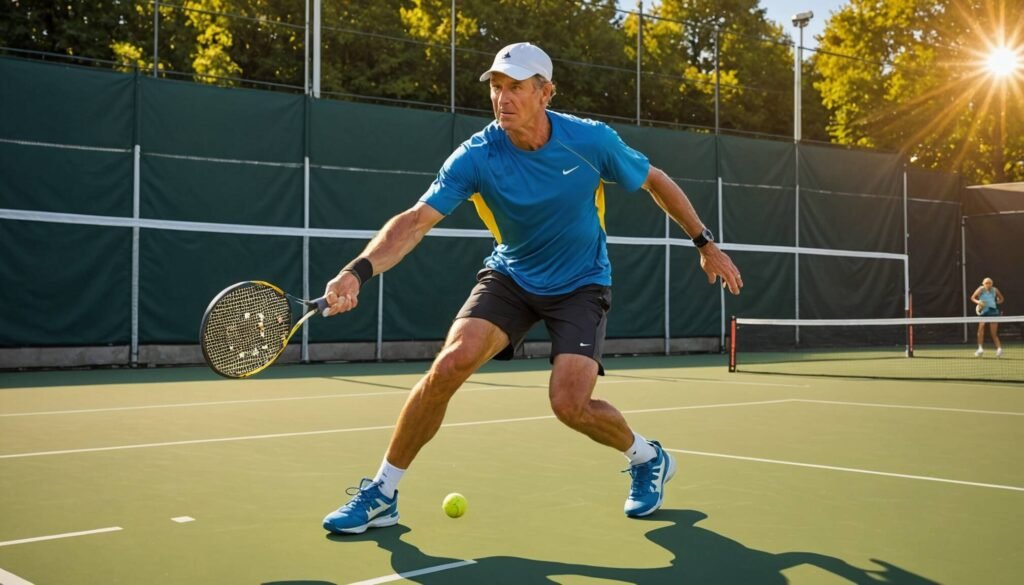
The unit turn is the coordinated rotation of your shoulders and hips together as a single unit the moment you recognize that a backhand is coming. This is not about moving just your arms or just your paddle. You are rotating your entire torso so that your outside leg faces the direction you are about to move. Your paddle gets set in the backswing position as part of that turn — not after it.
Think about it this way: the unit turn is your preparation. Everything that happens after — the swing, the contact, the follow-through — is just the natural conclusion of a movement sequence that already started. When you do the unit turn correctly and early, the actual swing becomes almost automatic. Your body is already loaded. Your paddle is already set. All you have to do at contact is step in and extend through the ball.
The coordinated rotation of the hips and shoulders working together is what separates players who generate real power from those who are just arming the ball. When you leave your body square to the net and try to drive the shot entirely with your arms, you are fighting against your own mechanics. The arms alone simply cannot generate the same kind of consistent force that comes from a full body turn.
How Early Should You Actually Be Turning?
The answer is almost always earlier than you think. The second you read that a backhand is coming — based on your opponent’s paddle face, their body position, the angle of their swing — your shoulders should already be starting to rotate. You do not wait until the ball crosses the net. You do not wait until you have taken your first step. The turn begins the instant you identify the incoming shot as a backhand.
Here is the five-step sequence that builds this habit into your movement on the court:
- Read the ball early. Watch your opponent’s paddle face and body position before they even make contact. This tells you whether a backhand is coming before the ball ever crosses the net.
- Trigger the turn immediately. The moment you identify it as a backhand, rotate your shoulders and turn your outside leg in the direction you will move. This happens at recognition, not at arrival.
- Set the paddle as part of the turn. Your backswing should be complete by the time you arrive at the ball. Not starting when you arrive — complete.
- Move parallel to the shot. Your footwork gets you into position while your upper body is already loaded and ready to fire.
- Step in and extend through contact. At the ball, the only thing you are doing is stepping forward and following through. All the hard work is already done.
This sequence moves the complexity of the stroke to the early part of the process. By the time contact happens, you should not be thinking about mechanics at all. You should just be completing a movement that is already well underway. That mental and physical simplicity at contact is what produces clean, consistent shots.
Why This Feels Unnatural at First
If you have been preparing late for months or years, getting your paddle set that early is going to feel strange. Your instinct will be to wait. You will feel like you are committing too early, like you might get caught out if the ball goes somewhere unexpected. That discomfort is normal, and you need to push through it.
The discomfort is just your brain adjusting to a new movement sequence. Within a few focused practice sessions, early preparation will start to feel like the only logical way to approach the shot. The late preparation you relied on before will start to feel sloppy and reactive by comparison.
A useful mental image comes from watching elite tennis players — how someone like Serena Williams would load her racket on the backhand side immediately, before she even started moving toward the ball. That kind of commitment to early preparation is exactly what you are building. If you have tennis habits hurting your pickleball game, late preparation on the backhand is one of the most common carryovers, because in tennis you can sometimes get away with it on slower balls. In pickleball, you generally cannot.
Staying Closed: What It Means and Why It Matters
Staying closed means keeping your shoulders rotated toward the sideline rather than opening them back up toward the net before you make contact. This is one of those things that sounds simple but is very easy to get wrong, especially for players who are excited to generate power.
When you open your shoulders too early, you release all the stored energy from your unit turn before it can transfer into the ball. The shot becomes flat, weak, and difficult to direct accurately. You might feel like you are being more aggressive because you are opening up faster, but what you are actually doing is bleeding power out of the shot before contact happens.
Staying closed keeps that stored energy loaded until the exact moment you step in and extend. The follow-through is what opens your body naturally at the end of the swing. That opening should be a result of the swing completing itself, not something you force early in the sequence. This is one of those bad habits that many players develop without realizing it, because opening early genuinely feels powerful in the moment — it just doesn’t produce a more powerful shot.
The Step-In and Extend Finish
Once your preparation is done — once the unit turn is complete, the paddle is set, and you have arrived at the ball in a closed position — the contact moment should feel almost easy. You step into the ball and extend your arms through the contact point. That is it.
There should be no last-second scrambling to get the paddle in position. No arm-only flailing because your body never turned. No cramped, jammed swing because you arrived at the ball before your preparation was complete. The step-in and extension should feel like the natural, relaxed conclusion of a movement sequence that was already well underway before the ball even got close to you.
This is the payoff for everything you did earlier in the sequence. And it’s why early preparation matters so much. It’s not about what you do at contact. It’s about everything you do before contact, and how all of that work makes contact feel simple.
If you’re working on your two-handed backhand drive overall, the step-in and extension phase is where all of the earlier preparation pays off visibly. You can also study the five essential two-handed backhand shots that every advancing player should have in their arsenal — the same finish applies across all of them.
Common Mistakes to Stop Making Right Now
Here are the errors that show up most often when players are consistently late on this shot. Each of these is a form of being late — just at a different stage of the process:
- Waiting to turn until the ball is close. This is the root cause of almost every late two-handed backhand. The turn needs to happen the instant you read the incoming shot, not after it has already crossed the net and is heading toward you.
- Keeping your body square to the net. A square stance means your arms have to do everything. There is no stored energy from a body turn, no hip rotation, no loaded torso. Rotate early, stay rotated, and let your arms be the delivery mechanism rather than the entire engine.
- Starting the backswing after arriving at the ball. If you are still loading your paddle when the ball reaches the hitting zone, you have already lost the shot before you swung. The backswing must be complete on arrival.
- Opening your shoulders before contact. Premature shoulder rotation kills both power and accuracy. Stay closed through the swing and let the follow-through open your body naturally as the swing completes itself.
- Thinking about swing mechanics at contact. By the time the ball reaches you, your only thought should be about the follow-through. All mechanical decisions should be complete before then. If you are still thinking about your backswing when the ball arrives, you are thinking too late.
Fixing the first mistake — waiting too long to turn — tends to clean up the others automatically. When your turn happens early and your paddle is set before you arrive, there is no reason to open early, no reason to arm the ball, and no mechanical scrambling at contact.
You can pair this work with backhand dink drills to build out the full range of your backhand game, from baseline drives all the way to soft net exchanges.
How to Practice This Until It Actually Sticks
Understanding the unit turn intellectually is not enough. You need to drill it until it becomes automatic, because in a real game you will not have time to consciously think through the sequence on every shot. The movement needs to be deeply ingrained.
The best way to build this habit is through repetition with a feeder. Have someone stand at the net and feed balls to your backhand side at medium pace. Your only job on each rep is to trigger the unit turn before the ball crosses the net. Do not worry about where you are hitting it. Do not worry about pace or spin. Focus entirely on the timing of your turn and your paddle set. Once that timing feels automatic — once you are not thinking about it anymore — start adding intention to your shot placement and pace.
For solo options, wall practice drills can help reinforce the unit turn if you are disciplined about resetting your body position between each rep. The key is that you treat every single rep as an opportunity to trigger the turn correctly, not just as swings at the wall. You can also use progressive pickleball drills that build this type of footwork and body rotation from the ground up — especially useful if you’re working to move through skill levels in a deliberate way.
How This Connects to the Rest of Your Game
Everything that makes your two-handed backhand reliable is rooted in preparation. Swing mechanics matter. Grip matters. Contact point matters. But none of those things show up consistently if you are always arriving late. Early preparation is the prerequisite for everything else working properly.
There is another benefit that often gets overlooked: when your body is already loaded and your paddle is already set, your eyes are free. You are not scrambling to get ready, so you can keep your attention on your opponent for longer. That gives you better information about shot selection before you commit to the swing. Players who struggle with pickleball decision-making often find that the real issue isn’t choosing the wrong shot — it’s that they’re choosing correctly but too late, because their preparation was already behind.
If your backhand third shot drop is also breaking down under pressure, early preparation is worth examining there too. The same principle applies across virtually every backhand shot in pickleball. The unit turn and early paddle set are not specific to


