The Inside-Out Forehand Volley: The Pickleball Shot Most Players Never Learn (But Should)
The forehand volley is one of the most available weapons you have at the kitchen line in pickleball. And most players are completely wasting it. You get to the net, the ball comes to your forehand side, and instead of ending the point, you push it back softly and hope things work out. Sound familiar? The problem is not your paddle, and it is not your fitness level. The problem is that nobody ever properly taught you how this shot actually works.
This breakdown covers the full mechanics, the timing, the grip, the footwork, and the specific adjustments that turn a passive forehand volley into a genuine point-ending weapon. The core concepts here draw from ItsEZ Pickleball on YouTube, where they break down exactly the kind of technical details that separate 3.5 players from 4.5 players. If you want to move up a rating level this season, this shot is one of the clearest ways to get there.
What Is a Forehand Volley and Why Does It Matter So Much?
A forehand volley is any shot you hit out of the air on your dominant side without letting the ball bounce first. At the kitchen line, this shot comes up constantly. In nearly every dinking rally, in every transition, in every fast exchange at the net, you are going to get a ball on your forehand side that you need to deal with out of the air.
Most recreational players treat the forehand volley like a blocking shot. They just want to keep the ball in play and survive the exchange. That is the wrong mindset entirely. The forehand volley, when executed correctly, is an attacking shot. It is one of the primary ways you win points at the net without needing a perfectly set up opportunity. If you are not treating it that way, you are giving your opponents time to reset and recover when you should be putting them under pressure instead.
Think about what happens when you push a forehand volley softly back into the middle of the court. Your opponent gets a comfortable ball at a comfortable height with time to reset their position. You have done all the work of getting to the net and earned nothing from it. Contrast that with a sharp, low, directed forehand volley at their hip or feet, and suddenly you have created a situation they have to scramble out of. That is the difference this shot makes.
Understanding the Shot for Newer Players
If you are newer to pickleball or still getting comfortable with the terminology, here is a quick explanation of what we are talking about and why it matters to your game right now.
In pickleball, the kitchen line is the line closest to the net on each side of the court. Most competitive points are decided right there at that line because both teams are trying to control the net. A volley is any shot you hit before the ball bounces. So a forehand volley is when the ball comes to your paddle hand side and you hit it directly out of the air without letting it drop to the ground first.
The reason this shot is so important is that it is your fastest way to end a point when you are already at the net. If the ball is at or above the height of the net on your forehand side, and you are standing at the kitchen line, you are in a perfect position to hit down on the ball and make your opponent scramble. The problem is that most beginners and intermediate players just block the ball back softly, which resets the point instead of winning it. Learning to attack with this shot changes everything about how you play at the net.
Why Most Players Get This Shot Wrong
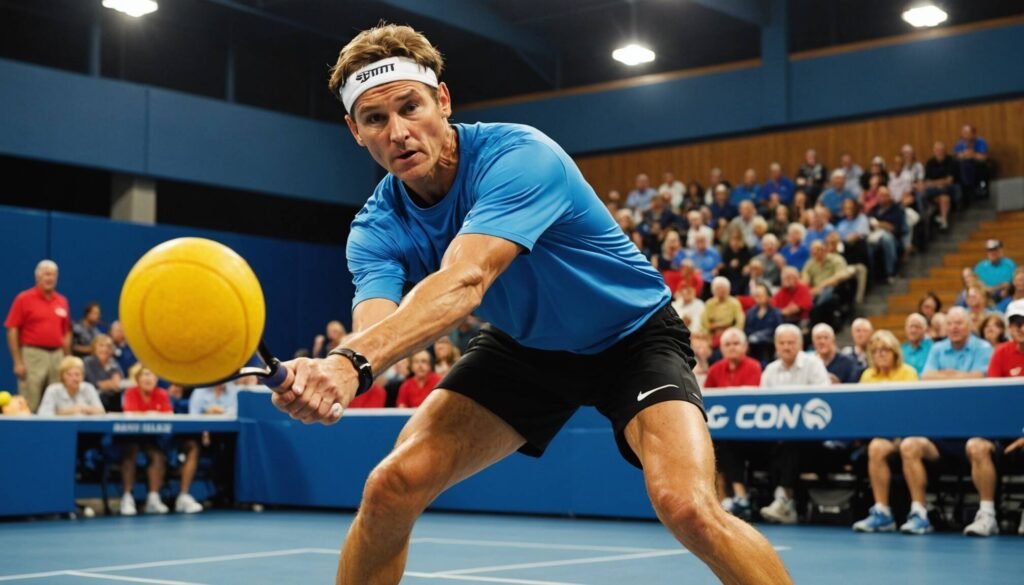
The most common mistake players make on the forehand volley is using a big backswing. They wind up like they are hitting a groundstroke from the baseline, and by the time the paddle comes through the contact zone, the timing is off and the ball either goes into the net or sails long past the baseline. Volleys at the kitchen are compact shots. The power comes from wrist snap and body rotation, not from a long swing. A shorter swing gives you more control and more disguise, which is exactly what you need when you and your opponent are separated by just a few feet of court.
The second major mistake is dropping the paddle head below the wrist. When the paddle dips below wrist level, you lose the ability to direct the ball with any precision. Your contact angle becomes awkward, your wrist position cannot support proper force transfer, and your shot selection narrows dramatically. The mechanics of the forehand volley fall apart fast when the paddle head dips.
A third mistake that does not get discussed enough is playing flat-footed. Players plant their feet at the kitchen line and wonder why they cannot generate anything on their volleys. Your stance directly affects your ability to rotate through the shot, and without rotation, the forehand volley becomes purely an arm swing with no real power or direction behind it.
The Grip That Sets Everything Up
Grip pressure is where the forehand volley either works or falls apart before the point even develops. Too tight, and you lose feel on any ball that requires touch or redirection. Too loose, and you lose control when a hard-hit ball comes at you with pace. The right baseline is around a 4 out of 10 on the grip pressure scale. Firm enough to handle a fast incoming shot without the paddle twisting in your hand, but relaxed enough to redirect with touch when you need to drop the ball softly at someone’s feet.
For grip style, a continental grip or a slight eastern forehand grip works best for the forehand volley. The continental grip keeps your paddle face in a neutral, versatile position that lets you direct the ball downward at your opponent’s feet rather than floating it back up into their hitting zone. The eastern forehand grip gives you a slightly more natural forehand feel while still keeping the face angle manageable for directed volleys.
One thing worth noting is that grip pressure and grip style interact with each other. Even a technically correct grip becomes a problem if you are squeezing the life out of the handle. Staying loose through the fingers while maintaining firmness in the palm is the balance most good volleyers have developed over time.
How to Generate Power Without a Big Backswing
The answer to generating pace on the forehand volley without winding up is body rotation and wrist acceleration working together. When your core initiates the movement and your wrist snaps through the ball at contact, you do not need a long swing. The physics of it work in your favor when the mechanics are right.
Here is a practical checklist for building power into your forehand volley mechanics:
- Keep your elbow in front of your body rather than tucked into your side
- Step into the shot with your non-dominant foot whenever the timing allows
- Rotate your shoulder through contact, not just your arm in isolation
- Accelerate the paddle through the ball with a slight downward angle at contact
- Follow through short and punchy toward your target, not long and looping
That downward angle at contact is the detail that most players skip, and it is the most important one. A downward contact angle is what keeps your shot low and forces your opponent to dig the ball up from below their knees. A flat or upward contact angle gives them a ball at a comfortable height that they can attack right back at you. You want to be the one attacking, not the one creating opportunities for the other team.
If you want to understand how forehand shots become consistent weapons, the mechanics above are where every player needs to start. There are no shortcuts around sound fundamentals at this level of the game.
Where Should You Be Aiming on the Forehand Volley?
Aim low. Every single time. The target on your forehand volley should be your opponent’s feet or the area just past their kitchen line. That is it. There is no scenario at the net where a high volley is a better choice than a low one. High volleys are the ones that come back hard. A ball placed at the feet forces a defensive dig, which means the next ball you get will be easier to finish.
Beyond the height of placement, direction matters enormously. Cross-court placement opens up angles and pulls opponents out of their position, making the rest of the point easier for you and your partner. A forehand volley hit straight down the line catches opponents who are cheating toward the middle to cover the obvious cross-court option. When you mix those two directions within a match, you become very difficult to defend against because your opponents cannot commit to covering one side without leaving the other exposed.
Understanding cross-court strategy in pickleball gives you a real tactical foundation for using placement rather than pure power to create winning situations. Power without placement is just hitting hard. Placement with enough pace to keep opponents honest is how you actually win points consistently at higher levels of play.
What About the Flick Volley?
The flick forehand volley is a more aggressive variation of the standard forehand volley, and it is one of the most effective weapons you can develop at the kitchen line. The concept is simple. You use a quick wrist snap to redirect a dink or soft incoming shot with sudden pace that your opponent does not see coming. They are in a slow dinking rhythm, expecting another soft exchange, and instead you snap your wrist through the ball and drive it at their hip or feet before they have time to prepare.
This shot is most effective when a dink sits up slightly at or above net height on your forehand side. That is your trigger. Instead of pushing it back into the dinking pattern, you load your wrist and fire. Mastering this requires solid flick technique fundamentals, specifically the wrist loading position that most players completely skip when they try to learn the shot on their own.
Here is a simple progression for building the flick volley into your game:
- Start with slow shadow swings focusing only on the wrist snap motion, no ball involved yet
- Practice with a partner feeding soft dinks to your forehand side at a controlled pace
- Aim for a target at your partner’s hip height rather than trying to drive it past them immediately
- Gradually increase the pace of incoming feeds as the wrist action becomes more automatic
- Add the step-in footwork once the wrist snap itself feels natural and repeatable
The progression matters here. Players who try to add footwork before the wrist action is automated end up with a messy, inconsistent shot that they cannot use under pressure. Build the mechanics first, then layer in the athleticism around them.
Does Your Footwork Actually Affect the Forehand Volley?
Yes, significantly more than most players realize. The connection between footwork and volley quality is direct and immediate. Most players stand flat-footed at the kitchen line and cannot figure out why they cannot generate anything on the ball. The answer is almost always their feet.
Staying on the balls of your feet keeps you mobile and lets you load into the shot naturally before you make contact. A flat-footed stance makes your volley passive by default because your body literally cannot rotate properly from that position. You end up relying entirely on your arm, which is the opposite of what produces a powerful, controlled volley.
Your split step timing feeds directly into your volley quality as well. Split stepping before each shot keeps you in an athletic ready position so you can push off in any direction the ball requires. If you are not split-stepping before each exchange at the net, you are already late when the ball arrives, and a late volley is almost always a weak one that gives your opponent an easy ball to work with.
Fixing your footwork habits is not glamorous work, but it is some of the highest-leverage improvement you can make to your overall net game. The players who look comfortable and in control at the kitchen are almost always the ones with the best footwork habits built underneath everything else they do.
The Role of Wrist Position at Contact
Your wrist should be firm and slightly laid back at the moment of contact on the forehand volley. Laid back means the paddle face is slightly open relative to your wrist, not collapsed forward. This is a subtle position that makes a large difference in the quality of your shot.
A collapsed wrist at contact causes two consistent problems. Either the ball goes straight into the net because the paddle face is angled too far down, or you pop the ball up because you have to compensate for the collapsed position with an upward swing. Neither outcome is useful. Both give your opponent an easy next shot.
The wrist position fix that improves your drop shot game also applies directly to the forehand volley. When your wrist is in the correct laid-back position at contact, the paddle face does the directing work without requiring extra compensation from your arm or shoulder. The shot becomes simpler, more repeatable, and more accurate as a result.
When Should You Volley Versus Dink?
The decision rule here is straightforward, and it is one of the most important shot selection concepts in pickleball at any level. Use the forehand volley when the ball is at or above net height on your forehand side. That height is your signal to attack rather than reset. Use the dink when the ball is below net level, because attacking a ball that is below the net means you have to swing upward to make contact, which gives your opponent an attackable ball at a comfortable height.
Understanding shot selection based on ball height is a fundamental skill that separates consistent players from inconsistent ones at every rating level. A lot of players make the mistake of trying to attack balls that are too low, and they end up popping up an easy opportunity for the other team. The net height is your reference point on every single exchange at the kitchen. Get in the habit of reading that reference point before you decide what to do with the ball.
The decision matrix becomes second nature once you have drilled it enough. High ball equals attack. Low ball equals reset or dink. That simple framework eliminates a huge amount of decision fatigue during fast exchanges and lets you react with the right shot automatically rather than thinking through the choice while the ball is already in the air.
Building This Shot Into Your Game Under Pressure
Knowing the mechanics of the forehand volley is one thing. Actually using it with confidence when the score is close and the point matters is something else entirely. The gap between understanding a shot and trusting it under pressure is where most players stall out, and it is a gap that only gets closed through specific, intentional practice.
The most effective way to build that pressure tolerance is through


