Pickleball Elbow: What It Actually Is and the 4 Exercises That Fix It
If your elbow has been nagging you after a few hours on the pickleball court, you have probably already gone down the rabbit hole of icing it, resting it, strapping it, and maybe even popping some ibuprofen. And if you are like most players, you felt a little better, went back out, and then felt worse than when you started. That cycle is not bad luck. It is a misunderstanding of what is actually happening inside your elbow, and fixing it starts with getting that part right.
Pickleball elbow is not an inflammation problem. It is a capacity problem. The tendon on the outside of your elbow has lost its ability to handle the load you are putting on it, and resting it does not restore that capacity. In many cases, extended rest makes things worse. Here is a clear breakdown of what is going on, why the standard advice keeps failing people, and the four-exercise progression that actually rebuilds the tendon instead of just quieting the symptoms for a week or two.
What “Pickleball Elbow” Actually Is — And Why the Name Matters
Most of the health websites you will find when you search for pickleball elbow will tell you the same story. Your tendons are inflamed, so rest, ice, take an anti-inflammatory, and wear a counterforce strap. That advice sounds reasonable, but there is a significant problem with it. When researchers have actually taken tissue samples from these irritated tendons, they have not found inflammation. What they found instead was disorganized collagen, immature blood vessels, and scattered fibroblasts — tissue that looks structurally compromised rather than acutely inflamed. The classic inflammatory cells that the term “epicondylitis” implies simply were not there in the samples.
This is why sports medicine literature moved away from the term “lateral epicondylitis” years ago. The more accurate terms now are tendinopathy or lateral epicondylalgia. The suffix changed because the scientific understanding changed. The problem is that the internet has not caught up, and millions of players are still following a treatment model built on the old, incorrect framework.
Why does this terminology shift matter to you specifically? Because if the tendon is inflamed, the goal is to calm it down. But if the tendon is degenerated and structurally under-loaded, calming it down is exactly the wrong move. You have to load it back into capacity. Those are opposite interventions, and choosing the wrong one is why so many players stay stuck in a frustrating loop for months or even years.
Why Rest Feels Like It Is Working, Then Completely Fails You
Here is the cycle that plays out for the vast majority of players dealing with this injury. The elbow starts hurting. You take two weeks off. The pain fades because you stopped doing the thing that was provoking it. You feel like you fixed it. You come back and play three days in your first week back because you missed it. By day four, it is worse than it was before you took any time off.
That is not a coincidence. Tendons are living tissue that adapts to the demands placed on them, and two weeks of rest means two weeks of losing whatever tendon capacity you had. When you returned to the court, you brought the same paddle, the same grip pressure, and the same playing volume — but your tendon was actually less prepared to handle those demands than it was when you first got hurt. Rest did not fail you because you did not rest long enough. It failed because rest was never the right intervention to begin with.
What you actually want is relative rest, which is meaningfully different. That means turning your court volume down enough that you are not making things worse, keeping some level of play where you can tolerate it, and simultaneously starting to load the tendon in a deliberate and progressive way. The goal is to give the tendon a stimulus to rebuild, not to take the stimulus away entirely.
What Pickleball Does to Your Elbow That Is Unique to the Sport
A lot of medical sites treat pickleball elbow as tennis elbow with a different name. That framing misses some important and specific things about how pickleball loads the forearm that make this injury particularly common in our sport.
The hands battle at the kitchen line is a major one. During a fast exchange at the non-volley zone, your wrist extensors are firing eccentrically — meaning they are contracting while being lengthened — to control the paddle face while the ball comes back at you in under half a second. You do that thirty or forty times a match at close range with almost no time to prepare. Nothing in tennis loads the forearm in quite that way or at that frequency in a single session.
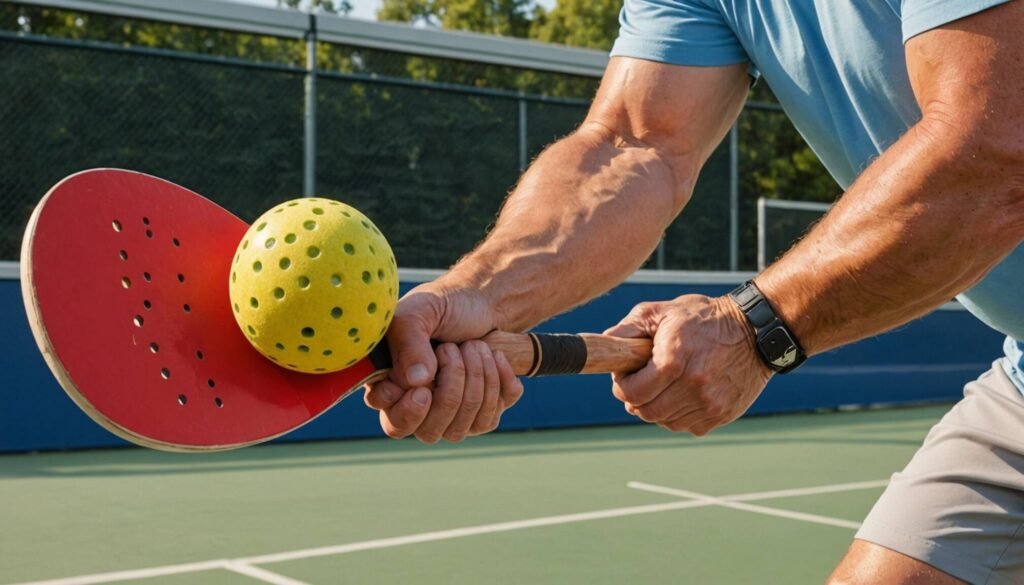
Grip pressure is another overlooked factor. Every coach in pickleball tells you to hold your paddle at a two out of ten for dinking. The reality is that when a speedup comes at you, most players clamp down to an eight and never fully let go for the rest of the rally. Sustained grip force is one of the most reliable ways to load and irritate the extensor tendons, and the majority of players have no awareness of how tightly they are actually holding on during a match.
Off-center contact matters too. A stiff carbon fiber face punishes mishits, and the shock that does not transfer into the ball goes directly into your hand and forearm. Then there is the volume problem, which might be the biggest factor of all. A tennis player who picks up pickleball has decades of racquet-sport tendon conditioning behind them already. A 52-year-old who played zero racquet sports, discovered pickleball in the spring, and is now playing five mornings a week does not have that base. Tendons adapt on a timeline of months. Pickleball addiction builds overnight. That gap is exactly where this injury lives and thrives.
A Note on Paddle Choices and What Actually Affects Your Elbow
The most common equipment advice you will hear is to switch to a lighter paddle. That advice is half right at best. Mass actually absorbs shock, so a very light paddle can send more vibration into your hand and forearm than a slightly heavier one. Players also tend to swing lighter paddles faster and with more wrist involvement, both of which increase the load on the lateral elbow. Going lighter can genuinely make things worse for some players. If you want to check your paddle setup, the things actually worth evaluating are grip size first — too small a grip forces you to squeeze harder to prevent the paddle from rotating in your hand, and most players are using a grip that is under-sized for their hand. Balance matters more than total weight, since a head-heavy paddle requires more forearm effort to control. Face stiffness and dwell time are relevant, as softer faces with more dwell are generally gentler on the arm. Cold or dead balls on cold mornings also transmit noticeably more shock than a fresh ball in warm conditions. Change one variable at a time so you can actually learn what is and is not helping.
Breaking It Down Simply: What Is a Tendon and Why Does Loading Help?
If you are newer to pickleball or not particularly familiar with sports medicine, some of this might sound a little counterintuitive. Why would you load a tendon that already hurts? Here is a simple way to think about it.
A tendon is the tough, fibrous tissue that connects your muscle to your bone. In your elbow, the extensor tendons connect the muscles of your forearm to the bony bump on the outside of your elbow, called the lateral epicondyle. Every time you swing a paddle, grip something firmly, or extend your wrist, those tendons are under tension.
When a tendon gets overloaded — meaning it gets more work than it is currently adapted to handle — it does not just get sore and then go back to normal. The internal structure starts to break down slightly. The collagen fibers that give the tendon its strength become disorganized. The tendon essentially loses some of its structural integrity. Resting does remove the pain stimulus temporarily, but it does not fix the disorganization. It can actually allow the tendon to become even less capable of handling load, which is why so many players feel worse when they return after rest.
Loading the tendon deliberately — at the right intensity, in the right way — gives the body a signal to rebuild and reorganize that collagen. It is the same principle behind why weight training makes bones and muscles stronger over time. The tendon needs a progressive challenge to remodel itself into something more capable. That is what the exercises below are designed to provide.
The 4 Exercises That Actually Rebuild the Tendon
Do these five days a week. They take about ten minutes. The order is intentional and matters.
1. Isometric Wrist Extension Holds
Five sets of 30 to 45 seconds at moderate effort, with one minute of rest between sets. Place your forearm supported flat on a table with your palm facing down. Hold a light dumbbell or use a resistance band. Extend your wrist up to a neutral position and simply hold it there without any movement. This is your starting exercise, and crucially, you do it even if the elbow is currently hurting. Isometric loading — where the muscle and tendon are under tension but not moving — lets you apply meaningful stress to the tendon without the provocative movement that causes flare-ups during active play. Many players notice a temporary reduction in pain for a few hours after doing this exercise. It is often the thing that gets you back on court fastest because it starts the remodeling process without aggravating symptoms.
2. Eccentric Wrist Extension
Three sets of 15 repetitions with a three-second lowering phase. This exercise uses a rubber resistance bar — the green or red resistance level is the right starting point for most players. Hold the bar vertically in your affected arm with your wrist extended, then grab the top of the bar with your healthy hand. Use your healthy hand to twist the bar into a loaded position, bring both arms out in front of you, then slowly allow your affected wrist to rotate back down over a full three seconds while your healthy arm maintains control of the bar. Of everything in this article, the eccentric loading method has the strongest research support for lateral elbow tendinopathy. The rubber resistance bar itself costs under twenty dollars and fits in most paddle bags, making it one of the most practical and high-value purchases an injured pickleball player can make.
3. Slow-Loaded Supination and Pronation
Three to four sets of eight to twelve repetitions in each direction, with a three-second controlled phase. Rest your forearm on a flat surface and hold a hammer by the end of its handle. Slowly rotate your forearm so your palm faces up, then slowly rotate so it faces down, controlling both directions with deliberate, unhurried movement. Your forearm rotators — the muscles that spin your forearm — are active on virtually every dink, reset, and roll shot you hit, and almost nobody trains them directly. Heavy, slow, controlled loading is what drives tendon adaptation most effectively. Start with a lighter hammer and gradually increase the load as the exercise feels manageable. The long handle of the hammer creates leverage that loads the forearm rotators far more effectively than a short dumbbell would.
4. Shoulder External Rotation and Scapular Work
Three sets of 12 to 15 repetitions. Use a resistance band for external rotations with your elbow held at your side, and pair that with rows or band pull-aparts for the muscles around your shoulder blade. This is the exercise that almost never appears on orthopedic blogs, and it is arguably the one that matters most for keeping this injury from coming back. Your elbow does not work in isolation. When your shoulder and shoulder blade cannot effectively control and decelerate your arm during a swing or a block, your forearm and elbow compensate and absorb the extra work. You can do everything right for the elbow and still find yourself back in the same place six months later if you ignore what is happening upstream. Strengthening the shoulder external rotators and the scapular stabilizers closes that gap and protects the elbow from within the system rather than just treating the symptom locally.
How Much Pain Is Acceptable While Training Through This
This is the question that most resources never actually answer clearly, and the ambiguity is why so many players either stop at the first hint of discomfort or push hard enough to cause a real setback. Here is a practical guideline. During the exercises, your pain should not exceed about a four or five out of ten on a subjective scale. After the session, your elbow must return to your normal baseline by the next morning. If you wake up the next day feeling the same as usual or better, you loaded appropriately. If you wake up feeling worse than your baseline, you did too much — reduce the load or volume and try again the next day.
Some discomfort during loading is expected and is not the same as damage. The tendon is being asked to do something it has not been doing, and that comes with some sensation. Most people need explicit permission to hear that mild discomfort during these exercises is okay and is part of the process.
How Long This Actually Takes
Longer than you want it to. Tendon remodeling is a months-long process. It is not like a muscle strain that fades in a week. Expect to notice meaningful improvement somewhere in the eight to twelve week range if you are genuinely consistent with the loading program, and understand that the first two to three weeks may feel like absolutely nothing is changing. That is normal and does not mean the approach is not working.
The players who get past this injury are not the ones who found some secret exercise or bought a special device. They are the ones who committed to an unglamorous ten to twelve minute routine five days a week for several months while also being honest with themselves about how much court time they could handle without making things worse. That combination — consistent loading plus managed volume — is what actually moves the needle.
When to See a Doctor Instead
The framework described in this article is a loading progression for a common tendinopathy. It is not a diagnostic tool. Get evaluated by a physician or physical therapist if you experience any of the following: numbness, tingling, or pins and needles spreading into your hand or fingers; pain that wakes you up at night; sudden or significant loss of grip strength; any swelling, locking, or a sense of instability in the elbow joint; or no meaningful change after six full weeks of consistent loading work. Those signs suggest something beyond lateral tendinopathy may be happening and warrant a proper clinical evaluation.
Quick Answers to Common Questions
How long does pickleball elbow last? With a consistent loading program, most players see meaningful improvement in eight to twelve weeks. Left alone, or managed with rest only, it commonly persists for six months or longer.
Can I keep playing while dealing with this? Usually yes, at a reduced volume. Cut back to a level where your elbow returns to baseline by the next morning, and start the loading exercises simultaneously. Complete rest is rarely the right call.
Do elbow straps help? A counterforce strap can reduce symptoms while you play by altering the mechanical load on the tendon slightly. It does not change the underlying tendon structure. Use it as a bridge to keep playing at reduced volume, not as a long-term solution on its own.
Should I stretch the forearm? Gentle wrist flexion stretching can feel good and may provide temporary relief, but stretching alone does not rebuild tendon capacity. Loading does. Stretch if it feels helpful, but do not substitute it for the actual rehabilitation work.
Is this the same as tennis elbow? Same tissue and same general condition. The specific loading mechanisms differ because of the hands battles, sustained grip demands, and rapid eccentric contractions that are particular to pickleball, but the underlying tendon pathology is the same.


