
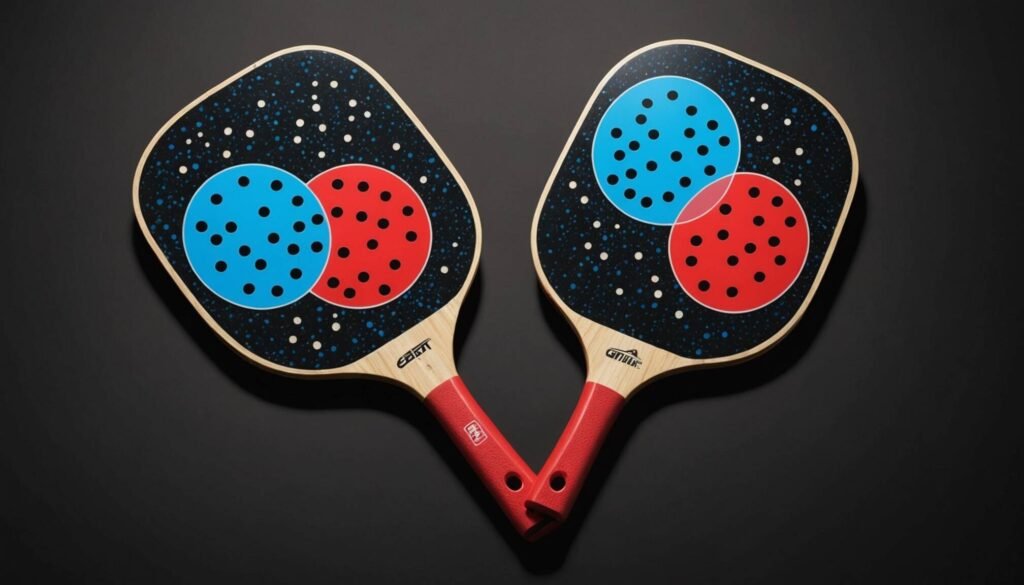
Warping Point Nightblade 001 vs. 002: Which Pickleball Paddle Is Right for Your Game?
Most pickleball paddles try to be everything to everyone. Warping Point took a different approach with its new Nightblade lineup — and honestly, it’s a smarter one. Instead of splitting the difference between power and control and hoping players don’t notice, the brand released two distinct paddles built for two genuinely different types of players. Same silhouette, same price, completely different personalities under the hood.
The Nightblade 001 is built for aggressive, attack-first players. The Nightblade 002 is built for players who prioritize stability, composure and controlled power. Both come in at $149.99, which positions them well below a lot of the premium competition without asking players to sacrifice much in terms of build quality or technology.
This isn’t just a marketing story about two colorways or slight weight differences. The two paddles have different internal cores, different edge materials and different energy return characteristics. Warping Point is making a real claim here: that one player’s ideal paddle is genuinely different from another’s, and that both deserve something purpose-built rather than a compromise.
Let’s break down what makes each version tick, why that internal difference matters more than most players realize, and how to figure out which one belongs in your hand.
What Is the Warping Point Nightblade? A Quick Explainer for New Players
If you’re newer to pickleball or haven’t spent much time researching paddles, the idea that two paddles with the same shape and thickness could feel dramatically different might seem a little far-fetched. But it’s real, and it comes down to what’s happening inside the paddle — not just on the surface.
Pickleball paddles have three main components that affect how they play: the hitting surface (the face), the core (what’s inside), and the edge (the border around the perimeter). Change any one of those three things and you change how the paddle behaves when the ball makes contact.
A paddle with a faster, more reactive core is going to pop the ball off the face with more explosive energy. That’s great for offensive players who want to speed the ball up and punish weak returns. But that same responsiveness can work against you if you’re trying to absorb a hard shot and reset the point — the ball might fly off the face when you want it to stay short and controlled.
A paddle with a more stable, dampening core does the opposite. It takes some of that energy out of the equation, which makes it easier to control the ball during defensive exchanges, resets and long rallies. You don’t get quite the same explosive pop, but you get more predictability and confidence on difficult shots.
That’s essentially the difference between the Nightblade 001 and the Nightblade 002. Same outer shell. Very different inner character. And understanding that difference is the key to choosing the right one for your game.
Nightblade 001: Built for Players Who Want to Attack
The Nightblade 001 is designed without apology for players who like to dictate points. If your natural instinct is to look for opportunities to speed up the ball, attack short returns and put pressure on opponents before they get comfortable, this is the paddle the 001 was engineered around.
Warping Point describes the 001 as emphasizing speed, explosive response and instant power. Those aren’t just marketing words. They’re a description of how the MPP core and TPE edge combination behaves during play. When the ball contacts the face, energy returns faster, which translates to a more immediate, snappier response. For a player throwing a speed-up from the kitchen line or attacking a floated third shot, that fast energy return is an asset.
Fast hands players — the ones who thrive in firefights at the net and look to take time away from opponents — are going to feel at home with the 001. It rewards decisiveness. It complements a playing style that’s built around striking early and maintaining offensive pressure.
There is a trade-off, and it’s worth being honest about. Paddles that are tuned for explosive response are generally less forgiving during defensive moments. If you’re getting attacked and need to absorb pace, a faster, more reactive paddle can make that harder. The 001 is built for players whose game leans toward aggression often enough that this trade-off is acceptable — or who are skilled enough to manage it.
One caveat for tournament players: the 001 is currently listed as UPA-A approved but not USA Pickleball approved. If you’re playing in sanctioned USA Pickleball events, verify eligibility before committing to this paddle as your tournament weapon.
Nightblade 002: Controlled Power for the Patient Player
The Nightblade 002 is the counterpart — and in a lot of ways, it’s the more nuanced of the two options. It doesn’t abandon power. It just puts that power in service of a different kind of game.
Where the 001 is built to maximize explosive output, the 002 uses an EPP core and EVA edge combination that emphasizes stability, a solid feel through contact and longer ball dwell time. Dwell time is the amount of time the ball stays on the face before leaving — more dwell generally means more feel, more control over spin direction and a more predictable response on touch shots.
For players who like to construct points methodically, keep opponents moving, and wait for the right moment to attack rather than forcing aggression on every ball, the 002 aligns with that approach much better than the 001 would. It’s also a better tool for resets — the shots that neutralize an opponent’s attack and bring the rally back to a neutral state. A stable, controlled paddle makes those resets more consistent and less risky.
Think of it this way: the 001 is for players who want to put a point away. The 002 is for players who want to win the point over time, keeping quality and composure through however many exchanges it takes. Neither is wrong. They’re just different competitive philosophies.
The 002’s current approval status is also worth noting: it is listed as neither UPA-A nor USA Pickleball approved at the time of writing. Competitive players should confirm current approvals directly with Warping Point or the relevant governing body before purchasing.
Shared Platform: What Both Paddles Have in Common
Despite their internal differences, the Nightblade lineup shares a lot of DNA. Both paddles feature an elongated 16.5-inch body, a 16mm thickness, a 5.5-inch handle and a carbon-fiberglass-carbon composite face. Both also use full-foam construction throughout.
That shared foundation matters for a few reasons. First, it means that if you play with both paddles back to back, you’re not adjusting to a completely foreign shape or balance point. The core feel of swinging the paddle, reaching for wide shots and handling the grip will be consistent between the two. The differences you feel will be genuine performance differences rather than shape or weight adjustments messing with your perception.
Second, the carbon-fiberglass-carbon composite face is a meaningful choice. It provides a textured surface that helps generate spin while maintaining enough durability to hold up over time. The full-foam construction adds to the overall feel of the paddle and contributes to how each version’s core technology is able to do its job — the foam surrounds and supports the core, which helps define how that core’s energy characteristics translate to the hitting surface.
This shared platform approach is smart product design. Warping Point isn’t making two completely different paddles and calling them a family. They’re making two genuinely related paddles that are differentiated where it counts: internal engineering tuned for opposite ends of the performance spectrum.
The Science Fiction Angle: A Marketing Move Worth Acknowledging
Warping Point is doing something genuinely unusual with the Nightblade launch, and it deserves a mention because it says something interesting about where pickleball as a culture is heading.
Rather than releasing the paddles with the standard slow-motion footage, dramatic on-court angles and promises of unprecedented spin and power, Warping Point built an entire science-fiction universe around the product. The Nightblade Chronicles involve distant civilizations, advanced technology and interstellar conflict. It’s ambitious, it’s creative and it’s a notable departure from what most paddle brands are doing.
Whether or not the storytelling lands for you personally, the instinct behind it is sound. Pickleball is growing fast enough that brands need reasons to stand out beyond spec sheets. Building a world around your product and letting players feel like they’re choosing a side — the aggressive 001 or the controlled 002 — creates a more memorable buying experience than most paddle launches offer.
The dark-versus-light framing fits the two-paddle concept well, and the futuristic visual identity gives the paddles a distinct look on the court. For a sport that’s increasingly capturing the attention of younger, design-conscious players, this kind of creative direction isn’t just fun — it’s strategically smart.
Price, Warranty and Value: Where the Nightblade Stands Out
At $149.99, both versions of the Nightblade punch above their price point. Full-foam construction, composite faces and specialized core tuning are features you typically see on paddles in the $200 to $250 range. Getting all of that for $150 is a meaningful advantage for players who want serious performance technology without the premium price tag.
Warping Point backs both paddles with a one-year limited warranty, which is a solid commitment for a paddle at this price. The brand also offers a 30-day trial for direct purchases — meaning you can actually play with the paddle and return it if it’s not the right fit. That’s the kind of confidence in a product that’s worth noting, especially for players who are skeptical about buying a paddle without being able to demo it first.
For context, many of the most discussed paddles in the pickleball market right now are selling for $230 to $280. The Nightblade isn’t trying to be a budget option — it’s genuinely competing at a performance level while coming in at a lower price. That makes it an interesting option not just for intermediate players looking to upgrade, but also for experienced players who want a secondary paddle for different playing conditions or surfaces without spending another $250.
Which Nightblade Should You Choose?
The honest answer is: it depends on how you actually play, not how you want to play or how you picture yourself playing at your best.
If you find yourself consistently looking for opportunities to speed up the ball, you’re comfortable in fast exchanges at the net and your natural instinct is to go on offense first — get the 001. It was built for you. The faster energy return and explosive response will feel like an extension of your game rather than something you have to fight against.
If you’re a player who wins by being steady, who excels at resets and neutralizing your opponent’s aggression, who values consistency through long rallies over explosive individual shots — the 002 is the better match. The added stability and dwell time will make your controlled game even more reliable.
And if you’re somewhere in between? That’s actually a decent argument for the 002. The 001 rewards commitment to an aggressive style. If you’re not consistently playing that way, the explosiveness can work against you more often than it helps. The 002’s stability is more forgiving for players whose game shifts depending on the situation — which, honestly, describes most recreational and club-level players.
Either way, $149.99 is a reasonable price to pay for a paddle that was actually designed with your playing style in mind rather than a generic performance promise. The Nightblade lineup is a good reminder that the best paddle isn’t always the most expensive one — it’s the one that fits how you play.
Visit Warping Point’s Nightblade collection to see both options side by side and decide which one belongs in your bag.


