
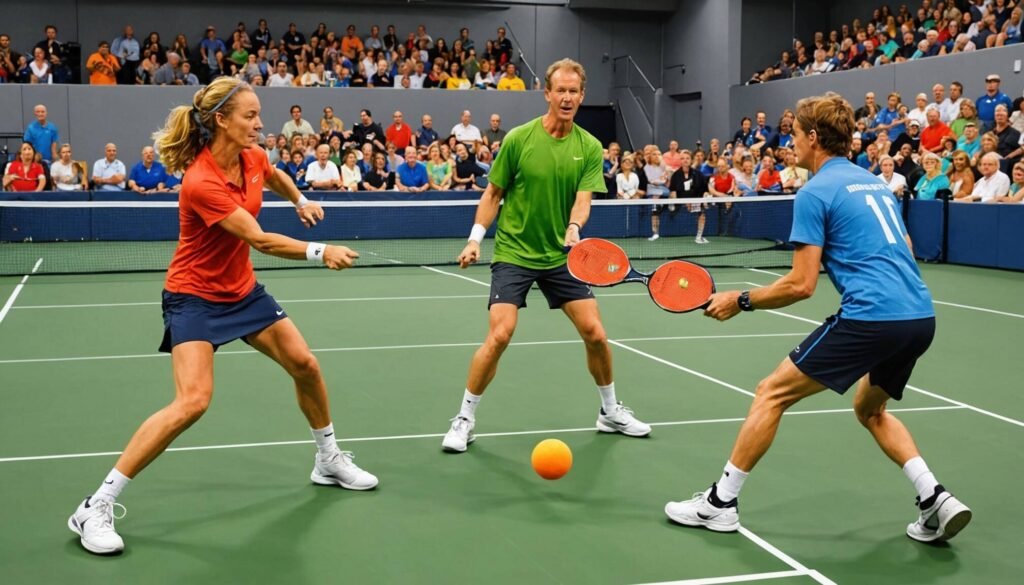
7 Forehand Speed Up Patterns That Make the Right Side a Weapon
Most players who play the right side in doubles pickleball already know the forehand speed up exists. They practice it, they try it in games, and then they wonder why it keeps getting countered back at their feet. The problem almost never comes down to the swing itself. It comes down to having no real system behind the shot — no plan for where to go, when to pull the trigger, or what to do next.
That is exactly what pro coach Zack Silver addresses in a lesson from Pickleball Studio on YouTube. Silver, who works with top players including Auggie Ge and Kyle Koszuta, sat down with Chris Olson and skipped the mechanics entirely. What they covered instead was strategy: which spots to attack, in what sequence, and the reasoning that connects each pattern to the next. Here is a full breakdown of what that lesson revealed.
Why Attacking Off the Bounce Feels So Risky
If your forehand speed up feels like a coin flip every time you use it, the problem is almost certainly a lack of structure around the shot. You see a ball you think you can attack, you swing, and then you hold your breath hoping nobody counters it back at your shoelaces. That vulnerability is not about your technique. It is about walking into an attack without knowing what comes next.
Silver’s framework flips that entirely. He builds a complete system around when to attack, where to aim, and why each choice sets up the next one. He even admits openly that he does not have great hands. His edge comes from being the one initiating rather than the one reacting, and he gets there by making each attack feel automatic through deliberate pattern work. When you understand how a point is likely to unfold, the forehand speed up stops feeling like gambling and starts feeling like execution.
A Quick Breakdown for Newer Players
If you are still getting your footing in pickleball, here is what you need to know before diving into the patterns. In doubles, the right side player is the one standing on the right half of the court from your own perspective. The forehand speed up is when you suddenly accelerate a ball, usually during a dinking exchange at the kitchen line, with the goal of catching your opponents off guard and forcing an error or a weak reply. The kitchen line, also called the non-volley zone line, is the line closest to the net. Most competitive doubles play happens with both teams camped right there, trading soft shots called dinks, waiting for the right moment to attack. The challenge is knowing when that moment is and exactly where to send the ball. That is what these seven patterns are designed to solve.
Which Spot Should You Attack First
Silver’s core principle here goes against what most recreational players do instinctively. Most players default to the highest percentage shot when they attack, which from the right side is usually through the middle at the opponent’s elbow or shoulder. Silver says to save that shot and go down the line first, even though it is the harder option.
The reasoning is strategic rather than mechanical. The middle attack, aimed at the chicken wing of the left side player, is your most reliable weapon. If you use it early and often, your opponents adjust to it quickly and start sitting on that spot. By going down the line first, even if you miss a few, you force the left side player to think about that angle. Once they start respecting the line, the middle opens up naturally and becomes even more effective when you eventually go there.
The 7 Patterns That Turn the Right Side Into a Weapon
These patterns come directly from the lesson Silver taught. They are meant to be worked through in a general sequence, with each one building on what came before. Use them as a system, not just individual tricks.
1. Go Down the Line First
Start with your hardest shot and use it intentionally. Hitting down the line from the right side requires good contact and good timing, but doing it early forces your opponent to account for it from the very first rally. Even if you miss, the threat is planted. Your opponent now has to consider that angle on every future exchange, which creates the openings you will exploit later. Silver treats the difficult shot as the investment that pays off later in the game.
2. Keep Going Until They Cover It
Silver does not switch away from the line after one or two tries. He keeps attacking it as long as he can get the ball there cleanly. He only stops when an opponent Ernies it, meaning they leave the court to intercept the ball in the air, or when someone clearly starts sitting on that lane. Until one of those things happens, keep going. Repetition to one spot trains your opponent’s body to lean that direction, which is exactly the setup you need.
3. Use the Middle Second
Once the left side player is mentally and physically committed to protecting the line, the middle opens up dramatically. Silver describes it as parted seas. The player who was crowding the line has shifted their weight and attention in that direction, and the middle gap becomes wider and easier to exploit than it would have been at the start of the game. This is the payoff for going down the line first.
4. Save the Inside Hip for Later
The inside hip attack, which jams the left side player at close range, is a high percentage shot that is difficult to handle. Because it is so effective, you want to preserve it rather than burn it early. Hit it once or twice to show your opponents you have it, then hold it back. When you bring it out again later in a tight moment, your opponent is less prepared for it because you have not been relying on it constantly throughout the match.
5. Attack on Wide to Wide Exchanges
Outside leverage is the condition where your opponent has been pulled wide toward the sideline while you still hold the angle. When you send a ball wide and it comes back wide, both opponents have shifted toward that side of the court. In that moment, the down the line shot is the easiest ball in the game because the court behind them is open. Silver treats this as one of the clearest triggers for a speed up. When you have outside leverage, you can execute the line attack even slightly off balance and still win the point.
6. Bait the Forehand Dink
This one is a little more nuanced. Silver will intentionally dink to the left side player’s inside foot, because a smart player will try to take that ball out of the air. Taking balls out of the air on dinks is generally considered a mistake at higher levels, but Silver actively wants them to do it. If they volley it back, the ball naturally comes toward Silver’s preferred counter zone and he already knows exactly where it is going, so his reaction time is ahead of theirs. If they leave it and it sits up high, Silver attacks it directly. Either way, he has created a situation where he holds the advantage.
7. Attack on Movement and Chaos
Movement and confusion are better triggers for a speed up than ball height alone. When opponents are shifting, adjusting their positioning, or scrambling to cover after an unexpected shot, they are not set and ready to counter. Silver prefers to speed up into chaos rather than into a player who is perfectly balanced and waiting. A clean, obvious attack ball often gets countered by elite players who are reading you. A ball struck during disorder frequently wins even if it is not perfectly placed.
What Outside Leverage Actually Means and Why It Changes Everything
Outside leverage is a concept worth understanding clearly because it shows up throughout Silver’s approach. When you send the ball wide and your opponent is forced to retrieve it from near the sideline, their body weight shifts that direction and their partner shifts with them to cover. In that moment, you hold the angle advantage. The down the line shot becomes a percentage play rather than a risky one, because the court behind them is largely open and they are leaning the wrong way to recover.
Without outside leverage, the line is a short shelf life shot. You can still throw it in occasionally to keep your opponent honest, but it should not be your default because the coverage angle works against you. Treating outside leverage as a trigger rather than hitting the line whenever you feel like it is one of the clearest separators between recreational and competitive right side play.
How to Bait and Benefit from the Forehand Dink Exchange
The baiting pattern Silver describes is a good example of how advanced pickleball involves winning points before they happen. You already know where the ball is going because you set up the situation deliberately. Research on anticipation in sport frames this kind of thinking as probability estimation rather than raw reaction speed. You are not reacting faster than your opponent. You have simply already decided what is likely to happen and positioned yourself accordingly.
When your opponent volleys the dink back and you counter it cleanly, you win the point twice. You win it in the moment, and you win it again later because your opponent now remembers that testing you in that zone is dangerous. They become more hesitant, which creates even more space for you to work with.
Where the Right Side Player Should Actually Stand
Silver makes a point that gets overlooked constantly at recreational and intermediate levels. Most right side players stand tight to the kitchen line and drift toward their forehand lane, trying to shut down a shot that almost never comes. Speed ups at lower and mid levels almost never get directed at the right side player’s forehand side. Standing there accomplishes nothing except exposing your backhand.
Good court positioning means standing where the actual threats live, not where an imaginary threat might come from. Silver even suggests standing in a position where you are essentially inviting an attack through the middle, because he would rather deal with that ball than abandon his backhand side to cover a shot that will not arrive. If none of your positioning makes sense, none of the patterns above will work in practice.
How to Make Your Dinks Look Like Speed Ups
Disguise is what separates a speed up system from a speed up habit your opponents adjust to. Most players telegraph an attack by changing something in their setup: a wider stance, a different paddle angle, or a more deliberate windup. A good opponent reads those tells immediately and is already countering before you finish swinging.
Silver’s fix is to keep your setup identical on both shots. Get the ball out in front of you and keep a slightly dropped paddle face whether you are dinking or attacking. When both shots look the same out of your hand, your opponent has to guess. That uncertainty is where the real advantage lives. If you are behind the ball with it out in front, you can dink, speed up, or even lob from the same setup, and nobody in front of you knows which one is coming until it is already past them.
Why Stepping Off the Kitchen Line Can Help
Silver pushes back against the idea that you always need to be glued to the kitchen line. Modern paddles and balls move fast enough that standing too close can actually put you at a disadvantage. Injury research comparing pickleball to tennis notes the shorter reaction times and tighter player proximity that define kitchen line exchanges, which makes recovery positioning even more important than it used to be.
If you leave a dink too high from right on the line, you are stuck trying to recover while moving forward into the net. From a step or two back, you have time to split step and load properly for the next ball. Stepping back also gives you the distance to reset the point if your opponent speeds up on you rather than the other way around. You are not giving up position by moving off the line. You are buying time and flexibility, which is especially valuable when your attack did not quite go where you intended.
The Steve Nash Principle and What It Means for Attacking
Silver draws on an analogy from basketball to explain how he thinks about each speed up attempt. Steve Nash used to dribble behind the hoop not to score, but to see how defenders reacted. Every attack is a question you are asking your opponent. Will the left side player crash to cover for their partner? Will they stay home? Do they shift wide when you go wide, or do they hold their position?
Each speed up you attempt, whether it wins the point or not, gives you an answer about how your opponents are organized and what they expect. The more variety you show, the more complete your information becomes. That is how you stay unpredictable once opponents start to recognize your tendencies. You are not just attacking to win one point. You are gathering data that wins you the next five.
Why Percentages Beat Perfection Every Time
Silver closes the lesson with a mindset point that is easy to understand but hard to actually internalize. You are playing percentages, not chasing perfection. If your pattern wins 75 percent of the points where it applies and loses 25 percent to excellent counters, you are winning. The 25 percent you lose is not a system failure. It is pickleball. Great opponents will hit great shots. Accept it and move on.
Losing that 25 percent will occasionally hurt. But overthinking it or pulling back from attacking will cost you far more over the course of a match than the occasional perfect counter ever will. Patience is the thing that keeps the system working. You do not force a speed up on a ball that is not right just because you want to attack. You wait for the setup, execute the pattern, and trust that the percentages will work in your favor over time.
Frequently Asked Questions
Where should I hit my forehand speed up from the right side?
Start down the line since it is your hardest shot, which forces your opponent to respect that angle. Once they start sitting on the line, the middle opens up. Save the inside hip attack for moments when you really need it, so it stays effective and unpredictable throughout the match.
When is the best time to speed up in pickleball?
The best moments are when opponents are moving or out of position. Wide to wide exchanges where you hold outside leverage are ideal. Movement and chaos are better triggers than simply seeing a ball that sits a little high, especially against players who counter well when they are set and ready.
How many times should I attack the same spot?
Keep attacking the same spot as long as you are winning the exchange there. Only switch when an opponent clearly starts covering it or when someone Ernies it. Those are your signals that it is time to open a different lane.
Should I stay on the kitchen line when playing the right side?
Not always. Standing a step off the line gives you recovery time and keeps you from over-covering shots that rarely come your way. It also keeps your backhand side protected rather than leaving it exposed while you camp on an angle that is not being tested.
How do I stop telegraphing my speed ups?
Keep your setup identical on dinks and attacks. Get the ball out in front and maintain a similar paddle angle on both shots. When both look the same, your opponent cannot tell which one is coming and has to guess, which is exactly the position you want them in.


