How to Hit the Perfect Pickleball Reset Every Time
The pickleball reset shot might be the most critical skill separating recreational players from competitive ones, yet it remains surprisingly misunderstood. If you’ve ever found yourself popping balls up during fast exchanges and watching opponents smash winners past you, you already understand the frustration. The good news is that mastering the reset doesn’t require athletic genius or years of experience. It requires understanding what the shot actually accomplishes and why your body needs to move in specific ways to execute it consistently.
The reset is fundamentally a defensive shot with an offensive purpose. When a ball comes at you with pace and you’re caught in a vulnerable position, the reset allows you to neutralize that speed, regain court position, and shift the momentum back in your favor. Professional player Nicholas Wise, who has competed on the PPA tour, breaks down this essential technique in a way that makes it accessible to players at every level. His insights, combined with coaching from Liam Duffin, reveal that the reset isn’t about spectacular athleticism but about proper positioning, controlled movements, and high-percentage decision-making.
What makes the reset particularly valuable is its role in the transition game. Most points in pickleball are won and lost in the area between the baseline and the kitchen line, and the reset is your primary tool for navigating that danger zone. When opponents attack with pace, you’re often caught moving forward, off-balance, or positioned poorly. The reset gives you a chance to survive that moment, get your feet set, and advance to the net where you can control the point. Without a reliable reset, you’ll find yourself perpetually stuck in the transition zone, unable to establish the net position that wins matches.
Understanding What a Reset Actually Does
Before diving into technique, it’s important to understand the shot’s purpose. A reset is any shot where you intentionally slow down a fast-moving ball. It can be executed as a volley out of the air or off the bounce after it lands. The key word here is “intentionally.” You’re not passively blocking or hoping the ball goes back over the net. You’re actively controlling the pace, taking speed off the ball, and placing it in a location that gives you and your partner time to establish better court position.
The reset isn’t about winning the point outright. You’re not trying to hit a winner or even create immediate offense. Instead, you’re buying time. When opponents drive the ball at you with pace, they’re trying to force an error or create a pop-up they can attack. The reset denies them that opportunity. By slowing the ball down and placing it low over the net, preferably landing in or near the kitchen, you force opponents to hit up on their next shot rather than down. This shifts the advantage back to you.
Many players misunderstand this concept and try to do too much with their reset. They attempt to hit sharp angles, add excessive spin, or aim for the tiniest targets. This leads to errors and inconsistency. The most effective resets are often the simplest ones. You’re getting the ball over the net with control, landing it deep in the kitchen, and giving yourself time to move forward. That’s it. Once you accept that simplicity wins in pickleball, your reset becomes dramatically more reliable.
The Foundation: Stance and Body Position
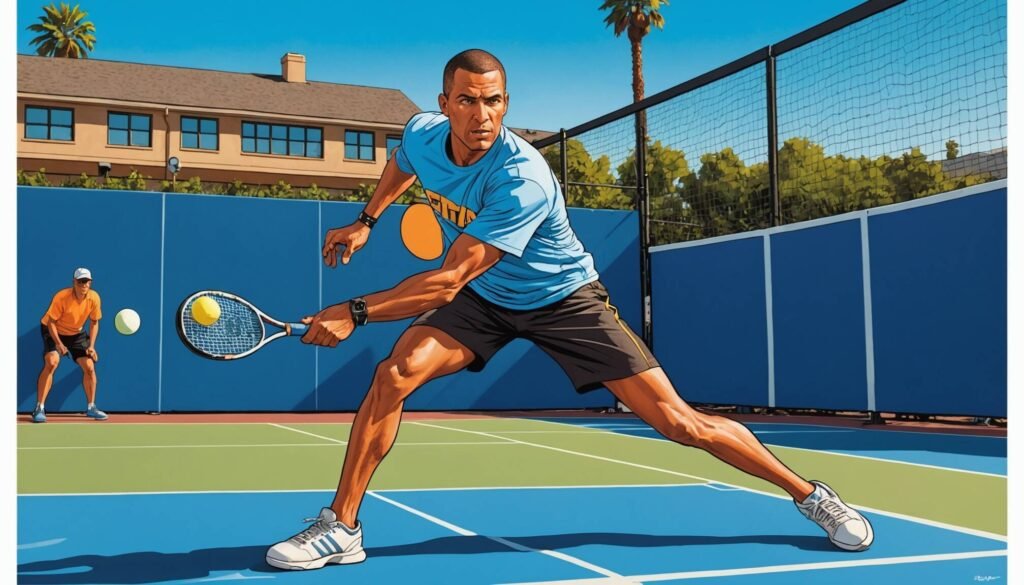
Every successful reset begins before you even swing the paddle. Your body position determines whether you’ll have the stability and control needed to execute the shot under pressure. Most players fail at resets not because their swing is wrong but because their stance doesn’t give them a foundation to work from. Nicholas Wise emphasizes that getting low is non-negotiable. Your legs need to be wide, significantly wider than shoulder-width in many cases, and your weight should be balanced in the middle of your feet rather than back in your heels.
Think about sitting in a chair. That’s the feeling you want in your lower body when preparing for a reset. This athletic position gives you stability when a fast ball comes at you and allows you to move laterally without taking extra steps. If you’re standing upright with your legs close together, you have no base. The ball will push you around rather than you controlling the ball. A wide base allows you to absorb pace and redirect it with control.
Your paddle position is equally critical. The paddle needs to be down low, not held up at chest or shoulder height. When the paddle is too high, you have to drop it quickly to meet the ball, which creates rushed, inconsistent contact. By keeping the paddle low in your ready position, you’re already prepared to meet the ball at the correct height. This also prevents the common mistake of swinging upward at a low ball, which sends it sailing long.
Weight distribution deserves special attention. When your weight sits back in your heels, you’re in a defensive posture with limited mobility. You can’t move efficiently, and you’re likely to lean back when hitting the ball, which adds loft and causes errors. Instead, keep your weight forward on the balls of your feet. This keeps you engaged and ready to move in any direction. You’re not stuck in cement but rather balanced and prepared to react to whatever comes your way.
Grip Pressure: The Detail That Changes Everything
One of the most overlooked aspects of the reset is grip pressure, yet it might be the single most important factor in controlling pace. If you grip your paddle too tightly, the ball will ricochet off the face with excessive speed. If you grip too loosely, you lose control and the paddle may twist in your hand on impact. The ideal grip pressure sits around four out of ten, firm enough to maintain control but loose enough to absorb pace.
Katherine Prento offers a helpful drill that Wise references in his instruction. Take your dominant hand and hold the very bottom of the paddle grip using only your thumb, pointer finger, and middle finger. Keep this grip loose and relaxed. Then add your ring finger and pinky back onto the grip. This automatically creates the proper grip pressure. Most players grip far too tightly, especially under pressure, and this simple technique prevents that mistake.
The type of grip matters as well. Use a continental grip, sometimes called a handshake grip, where you hold the paddle as if you’re shaking hands with it. This neutral grip allows you to hit both forehand and backhand resets without changing your grip, which saves time and maintains consistency. Some players try to use extreme forehand or backhand grips, but these require adjustments that create timing issues when balls come at you quickly.
Grip pressure isn’t static throughout the shot. Many advanced players actually start with a loose grip and then firm it up slightly at the moment of contact. This gives you the best of both worlds: the loose grip absorbs pace, while the slight firming at contact provides control. This is an advanced concept, but even beginners benefit from understanding that a death grip on the paddle throughout the entire shot creates more problems than it solves.
The Swing: Compact, Shoulder-Driven, and Controlled
Once your stance and grip are set, the actual swing mechanics become relatively straightforward. The key principle is keeping everything compact and letting your shoulder do the work rather than your wrist or arm. This is a fundamental shift for players coming from other racquet sports where big swings generate power. In pickleball resets, big swings are your enemy. You’re trying to slow the ball down, not speed it up, so a compact motion is essential.
Your shoulder should drive the forward motion of the paddle. Think about pushing the paddle forward with your shoulder rather than swinging with your arm. This creates a stable, controlled movement that’s easy to repeat under pressure. When you swing with your arm and wrist, you introduce variables that make consistency difficult. The shoulder provides a reliable, repeatable motion that works even when you’re stretched out or off-balance.
Meeting the ball out in front of your body is crucial. The moment the ball gets beside you or behind you, your shoulder tightens up and you lose control. If the paddle ends up all the way to the side of your body, you’re more likely to take a big swing at a fast ball, which defeats the entire purpose of the reset. By keeping the contact point in front, you maintain control and can direct the ball where you want it to go.
The elbow position ties into this concept. You don’t want your elbows glued to your torso, which restricts movement, but you also don’t want them extended so far forward that you lose stability. Wise describes this as the “hula hoop” position. Imagine a hula hoop around your waist. When your hands and paddle stay within that hula hoop space, you have maximum control. When they move outside that space, control diminishes.
The Seesaw Technique: Matching Paddle Angle to Ball Height
One of the most useful mental models for the reset is what Wise calls the seesaw technique. Imagine a seesaw on a playground. When one side is up, the other is down. Apply this to your reset: when the ball is up high, you need to get really low with your body and paddle. When the ball is at a lower height, you can come up slightly. This simple visualization automatically puts your paddle at the correct angle to control the ball’s trajectory.
This technique prevents one of the most common reset errors: hitting under the ball with an open paddle face when the ball is already low. When a ball comes at you at knee height or below and you have an open paddle face, you’re going to pop it up. By getting low yourself and matching your paddle angle to the ball’s height, you can keep the ball down. The seesaw image makes this adjustment intuitive rather than something you have to consciously think about during play.
The seesaw also applies to balls at different heights. A ball at shoulder height requires a different approach than one at your knees, but the principle remains the same. Match your body position and paddle angle to the ball’s height, and you’ll find the correct contact point naturally. This is particularly valuable during fast exchanges when you don’t have time to analyze and calculate. Your body responds to the visual cue of ball height, and the seesaw technique provides the roadmap.
Many players struggle with resets on high balls because they don’t get low enough. A ball that comes at you at chest or shoulder height with pace is difficult to control, but if you drop your body down so you’re hitting it from a lower position, it becomes manageable. The seesaw reminds you that the higher the ball, the lower you need to be. This counterintuitive movement is what separates players who can consistently reset high balls from those who pop them up.
The Split Step: Timing Your Movement for Maximum Efficiency
The split step is a concept borrowed from tennis that translates perfectly to pickleball resets. The idea is simple: you want to land on the balls of both feet right as your opponent makes contact with the ball. This landing gives you the best possible position to move in any direction based on where the ball is hit. Without a split step, you’re either still moving forward when you need to react, or you’re flat-footed and unable to move efficiently.
The timing of the split step is everything. As you’re moving forward from the baseline toward the kitchen line, you’re watching your opponent. The moment you see them begin their forward swing, you take a small hop and land with your feet wide, weight balanced, and body low. This landing occurs just as they make contact with the ball, which means you’re perfectly timed to react to their shot. If you split step too early, you’re stuck waiting. If you split step too late, you’re rushed and off-balance.
The width of your split step stance matters enormously. Many players land with their feet too close together, which doesn’t provide the base needed for a quality reset. Wise emphasizes that you can be wider than shoulder-width apart. A wider base gives you the ability to side lunge and cover more court without taking extra steps. You’re moving more efficiently with less energy, which becomes crucial during long rallies and matches.
Don’t rush through your split step to get to the kitchen line. One of the biggest mistakes intermediate players make is running through the transition zone without proper footwork. They’re so focused on reaching the kitchen line that they don’t give themselves a platform to hit from. Instead, move forward until you see your opponent about to make contact, then split step and get into your reset position. Quality of position matters more than speed of forward movement. You’d rather be balanced three feet farther back than off-balance at the kitchen line.
Three Types of Resets: Which One to Learn First
There are three primary ways to hit a reset depending on where the ball is positioned relative to your body: the two-handed backhand reset, the single-handed backhand reset, and the forehand reset. Each has its place, but they’re not equally important, especially for players still developing their reset skills. Understanding which to prioritize can dramatically accelerate your improvement.
The two-handed backhand reset is the most stable option because you have both arms on the paddle. Since the ball is already coming at you with pace, stability is your greatest asset. The two-handed backhand covers a significant portion of your body, roughly from your left hip to the center of your body for right-handed players. This shot should be your foundation, the one you practice first and rely on most when learning to reset. The extra stability makes it more forgiving and consistent, especially under pressure.
The single-handed backhand reset is the workhorse of pickleball resets. Wise points out that this shot covers approximately eighty percent of all balls you’ll encounter on the court. It allows you to reach balls that are wider to your backhand side than the two-handed backhand can cover. While it’s slightly less stable than the two-handed version, it’s still more reliable than the forehand reset for most players. Once you’ve developed confidence with the two-handed backhand, the single-handed version should be your next focus.
The forehand reset covers only about twenty percent of the court area. It’s the shot you hit when balls come directly at your right hip or to your forehand side for right-handed players. Many players over-rely on their forehand because it feels more natural, but in reality, the forehand reset is the last one you should master. The backhand resets cover far more territory and should be your priority. Save the forehand reset for situations where it’s truly the best option, not just the comfortable one.
Spin Options: Flat, Topspin, or Slice
You can hit a reset with three different types of spin: flat with no spin, topspin, or slice. Each has advantages and disadvantages, but they’re not equally appropriate for players at different skill levels. Understanding when to use each type of spin can help you make smarter decisions during matches and practice more effectively during training.
The flat reset involves no spin whatsoever. You’re simply pushing the ball over the net with a compact motion, focusing entirely on control and consistency. This should be your default option, especially when you’re learning the shot or when the ball is coming at you with extreme pace. When you don’t have time to do anything fancy, the flat reset is your safety valve. It’s the highest percentage option in most situations and should form the foundation of your reset game.
The topspin reset involves brushing up the back of the paddle face at contact, which imparts forward rotation on the ball. This allows you to be slightly more aggressive because topspin brings the ball down more quickly after it crosses the net. However, creating topspin requires more precise timing and paddle angle, which means you sacrifice some consistency. Wise recommends adding topspin only after you’ve mastered the flat reset. If you can


